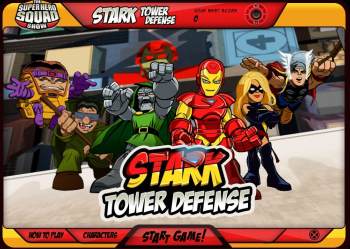
Cartoon Network actually has a Stark Tower Defense game. Seriously.
Unfortunately, the title works a lot better than the actual game, which is a shame.
Just another nerd.
Cartoon Network actually has a Stark Tower Defense game. Seriously.
Unfortunately, the title works a lot better than the actual game, which is a shame.
Slate had an interesting article back in July 2009 on the problems faced by museums trying to preserve plastic art and artifacts,
The problem of preserving plastics isn’t limited to highbrow art. Not long after The Graduate debuted, manufacturers around the world began to incorporate synthetic polymers into their goods. As plastics revolutionized the making of furniture, toys, health care products, and electronics, museums of industry, design, and medicine began snapping up plastic objects that were either historic (the first artificial heart) or culturally important (Barbie dolls). Plastics hold up well for the decade or so during which a consumer uses most products. But museums, unlike consumers, are in it for the long haul, and when plastics crash, they crash precipitously. As a result, museums of all sorts have been having Gabo moments in the past decade.
The casualty list is appalling: Antique plastic dolls at the National Museum of Denmark have begun to peel and flake; classic furniture at the Victoria & Albert Museum in London might as well have been left out in the sun for years; the first-ever plastic toothbrush, at the Smithsonian, is collapsing into a pile of crumbs; etc. A whole generation of irreplaceable items that are as representative of our culture as pottery or flintheads were of ancient ones are dying—and many people charged with their care have no idea how to stop further damage.
And, for the most part, Slate says there isn’t really much of a solution. Plastics simply don’t last as long as other compounds and there are a whole host of challenges they face, including mold and bacteria that have evolved to eat plastic!
So I guess my action figure collection won’t likely make it to the next century. Maybe the solution will be instead of buying the actual plastic object, buying the plans to replicate it on something like MakerBot and then simply print a new one as the old one begins to degrade. Store data, not atoms.
BounceBack is backup software for Windows machines. I use other software for backing up important data, but I also want to backup my individual machine so when the hard drive in my laptop eventually fails I can minimize downtime.
BounceBack will create an image of your hard drive on an external drive, so if your hard drive dies or suffers other problems, you should be able to boot off of the external drive without losing anything. The software supports continuous backups, “timed version” backups like Apple’s Time Machine does, AES 256-bit encryption, etc.
A very nice toolset when what you really need is a rolling backup of everything on a particular machine.
 In February, Blizzard and Upper Deck both issued statements surrounding the World of Warcraft: Trading Card Game which Upper Deck had published since its release in 2006.
Coincidentally, the announcement came shortly after Upper Deck reached a settlement with Konami over the Yu-Gi-Oh! trading card game. Until December 2008, Upper Deck had been the distributor of that game outside of Asia. But Upper Deck got caught printing hundreds of thousands of counterfeit cards.
Konami pulled no punches in its press release announcing the settlement,
“This entire situation came as a huge shock to us. As a company that has based their entire business model on producing authentic entertainment and sports licensed products, Upper Deck went against their very core beliefs by counterfeiting Yu-Gi-Oh! TCG Cards,” commented KDE’s Vice President of Card Business Yumi Hoashi. “It was very disheartening to learn that a trusted business partner would take these actions to dupe us and the Yu-Gi-Oh! TCG community.”
The litigation began in October 2008, when KDE discovered that counterfeit cards from the Yu-Gi-Oh! TCG were being sold in Toys “R” Us stores by a sub-distributor for Upper Deck. KDE filed suit, and the sub-distributor told KDE that the counterfeit cards were supplied by Upper Deck.
“As a leading company in this card industry, Upper Deck should have known more than well that counterfeit activities would irreparably harm the trust of Duelists and the integrity of the Yu-Gi-Oh! brand,” said KDE’s Hoashi. Upper Deck initially denied those charges and issued press releases announcing that any suggestion that Upper Deck would be involved in counterfeiting activity is “absurd.”
Failing to own up to its actions, Upper Deck sent out a press release on January 29, 2010 stating its satisfaction with the settlement and how the judge ruled against KDE in several areas. The ruling that United States District Judge Valerie Baker Fairbank made on December 23, 2009 was simple. She ruled that Upper Deck violated trademark, copyright and unfair competition laws by counterfeiting Yu-Gi-Oh! TCG cards.
Blizzard didn’t cite the Konami dispute as its reason for dropping Upper Deck, but certainly any company interested in maintaining its brand would want to think twice (or three or four times) before doing business with Upper Deck after its behavior with the Yu-Gi-Oh! game.
The loss of the license also extends to the World of Warcraft collectible miniatures game.
This year marks the 20th anniversary of the raid by the Secret Service on Steve Jackson Games. The raid was one of a number of actions that spurred the creation of the Electronic Frontier Foundation in July 1990 — an organization Steve Jackson thanks in a brief posting about the anniversary,
But we might not be making games today if it weren’t for the Electronic Frontier Foundation. The founders of the EFF took on the very serious business of defending us – all of us – against perhaps the worst menace a democracy can face: its own police, laws, and courts gone astray. The balance between freedom and security never stands still, and new technology changes the details but mustn’t be allowed to change the principles. That’s why the EFF was created, and that’s why it’s still around, 20 years later. And I’m very grateful.
The incident was widely reported as being caused by a misunderstanding of the then-in-development Cyberpunk GURPS supplement. Although the Secret Service did seize electronic copies of the Cyberpunk supplement and agents subsequently suspected it was a how-to guide for hacking, the raid originated based on Secret Service suspicions about a bulletin board system that Loyd Blankenship ran on his own time that, among other things, included copies of the Phrack ezine.
I.e., there was simply no basis in fact at all for the fishing expedition, and Steve Jackson Games subsequently won a legal judgment against the Secret Service in 1993 which included $50,000 in damages and $250,000 in attorneys fees.
Thank goodness they survived and are still turning out awesome games two decades later.
DC Direct’s 1/6th scale action figure line continues with this Poison Ivy scheduled for May 2010. This figure features two different costume options, but, alas, still features the plastic helmet hair approach. This figure looks better than some of the other female figures in this line, but seriously DC?
