GURPS Loadouts: Monster Hunters

The other day I mentioned Steve Jackson’s annual stakeholders report which could summarized as board and card games good; pen-and-paper RPGs going way of the dinosaur. On the other hand, the nice thing about the transition of large segments of the RPG industry to PDF-only delivery is that there is a ton of cool stuff being published that would never have seen the light of day in the print-only days.

For example, the recently published GURPS supplement GURPS Loadouts: Monster Hunters. Thirty-nine pages of equipment lists and stats for all of your monster hunting needs.

This book contains ready-to-go packages of gear — weapons, protection, and equipment — from GURPS High-Tech, GURPS High-Tech: Pulp Guns, Volume 1, and Pulp Guns, Volume 2 (which are required to make full use of this book). Loadouts are designed for heroic roles at two different budgets and in two eras. All packages are complete, so getting locked and loaded is as simple as picking the gear that fits your budget and weight allowance. And each loadout includes lenses for further customization. Whether you’re a slayer, scout, or sage . . . in TL6 or TL8 . . . on a budget or money is no object, this book has what you need:

  • Optional rules for gear and guns, including new rules for those wanting more oomph from existing ammunition. (When you’re in a monster movie, bigger ammo is better!)
  • A selection of new weapons and equipment that are especially useful for those who hunt creatures of the night.
  • A 13-page appendix of equipment lists, with the information formatted so that it’s ready to print and include with your own character sheets.

Let the forces of darkness cling to the shadows — now you’ve got the flashlight and flares to find them, the right weapons to take them down, and the chalk to draw outlines of the bodies.

All for $7.95 and no DRM.
Charles Stross on ‘Strangecraft-ian’ Horror

Charles Stross has some interesting musings on the intersection of H.P. Lovecraft and the sort of absurdist humor/horror embodied in Stanley Kubrick’s Dr. Strangelove. Stross notes the interesting similarity between horror and humor in that you can take anything and then add either element — or both in Kubrick’s case — to any other fictional form.

The other odd thing Stross notes is the similarity between the Cthulhu Mythos and the Singularity in contemporary science fiction,

And it occurs to me that the Lovecraftian apocalyptic singularity is underexplored. In a nutshell, it poses this question: what happens when we take the human condition, and twist? You need a topping of gallows humour just to keep it in perspective: humour is a brutal necessity when you’re confronting the horrific on a day to day basis (as anyone who hangs out with medics can probably attest).

. . .

What’s the role of humour in this universe? Well, one might ask what Stanley Kubrick intended when he turned “Dr. Strangelove” into a theatre of the absurd: absurdity is generated by dissonance between a situation and its meaning, and Kubrick used it to viciously anatomize the process of atomic annihilation and hold up the petty and banal motives of its perpetrators to ridicule. But “Dr. Strangelove” didn’t laugh at what came after the bomb — it ended, on a double-blind ironic note (singing “We’ll meet again” to a background of mushroom clouds). The bomb was the punch-line of the joke, not the set-up. What happens in a survivable apocalypse? Lovecraftian apocalyptic fiction never actually explores the consequences of the Old Ones returning, let alone the human wreckage left behind in the aftermath. It’s like the Singularity in SF, circa 2000 — off-limits to exploration.

Hopefully Stross will write that novel — I’d certainly love to read it.

Strange Maps

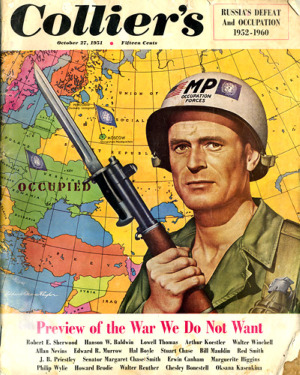
Strange Maps digs up interesting and oddball maps and sometimes more. For example, there’s this map that was the cover of a 1951 issue of Collier’s that was devoted entirely to a hypothetical occupation of the Soviet Union by U.S-led United Nations forces. Conelrad.com has a more complete look at the way Collier’s fictional scenario was played out in the magazine.

Collier's Occupation of USSR Cover

New Version of DokuWiki Out

A new version of DokuWiki — DokuWiki 2009-12-14 — was released over the weekend, mainly fixing a bunch of smaller bugs and adding some small performance improvements, including:

  • Flash Multiuploader
  • license selector
  • compatibility fixes with Flash Player 10
  • internal changes to make farming easier
  • removed old upgrade plugins
  • better support for non-default auth backends in ACL manager
  • jump to edited session after saving
  • much improved Japanese romanization
  • improved XMLRPC interface
  • improved search result display
  • many smaller feature enhancements
  • more plugin events
  • some performance optimizations
  • minor security enhancements
  • many, many bug fixes

I had no problem following the upgrade instructions and took about 10 minutes to upload all the files and have the new version up and running. As always, DokuWiki continues to impress as one of the most straightforward, easiest-to-install and use pieces of software I’ve ever used.