Total Cost of America’s Wars

The other day I ran across a story about government spending that made me wonder how much the United States has spent on the numerous wars it has waged over the last couple centuries. Well, it turns out that in 2010 Stephen Daggett of the Congressional Research Service prepared a report (155k PDF) estimating the military costs of all American Wars beginning with the Revolutionary War and extending to the recent wars in Iraq and Afghanistan.

Based on Daggett’s estimates, U.S. war spending looks something like this:


Military Costs of U.S. Wars, 1775-2010

WarYearsTotal Cost (2011 Constant $)Peak Year of War SpendingWar Cost as % of GDP
in Peak Year of War Spending
American Revolution1775-17832,407 millionNA
War of 18121812-18151,553 million18132.2%
Mexican War1846-18492,376 million18471.4%
Civil War: Union1861-186559,631 million186511.3%
Civil War: Confederacy1861-186520,111 millionNA
Spanish American War1898-18999,034 million18991.1%
World War I1917-1921334 billion191913.6%
World War II1941-19454,104 billion194535.8%
Korea1950-1953341 billion19524.2%
Vietnam1965-1975738 billion19682.3%
Persian Gulf War1990-1991102 billion19910.3%
Afghanistan (includes all Operation Freedom actions)2001-20101,147 billion20081.2%
Iraq2003-2010784 billion20081.0%

Daggett notes a number of challenges with estimating total war costs. Although the costs are expressed in FY 2011 dollars, comparing costs accurately over such a long period of time is difficult at best. With more recent wars, what counts as a direct war expenditure has changed over time and so earlier wars such as Vietnam likely underreport their true cost.

On the other hand, even for current wars the dollar estimate is for ongoing combat and support actions and does “not reflect costs of veterans’ benefits, interest on war-related debt, or assistance to allies.” With the wars in Iraq and Afghanistan, for example, some studies estimate that total veteran benefits costs will actually be large than the cost of the wars themselves.

The Death of E-Readers

Last year I was arguing with a novelist on Twitter about the future of the E-Reader. The novelist’s view was that as the cost of tablets continued to decline, people would choose to buy both a tablet and an E-Reader. As much as I love E-Reader’s, my view was that the E-Reader as we know it is doomed to quickly become a legacy technology.

Sadly, The Wall Street Journal reports that the death of E-Readers is upon us,

Market-researcher IDC recently estimated 2012 global e-reader shipments at 19.9 million units, down 28% from 27.7 million units in 2011. By contrast, IDC’s 2012 tablet forecast is 122.3 million units.

Specialized devices for reading e-books have been hot sellers for five years – but one market-research company forecasts a significant decline in 2014. The WSJ’s Greg Bensinger explains why the introduction of lighter tablets may spell the end of the e-reader era.

IHS iSuppli comes up with different totals, but it sees a similar trend. It estimates that shipments of dedicated e-readers peaked in 2011 and predicts that 2012 shipments slid to 14.9 million units, down 36% from a year earlier. By 2015, it expects unit sales of dedicated e-readers to be just 7.8 million.

I don’t have any special attachment to dedicated e-readers themselves, but rather to the e-ink display technology.

I own a tablet and have read a few books on it, but that glossy glare-filled screen is far from ideal for some serious reading. It is okay for reading web pages, but if I’m going to read a 400 page novel I’m busting out my e-reader.

But I’m definitely part of an extremely small niche market, and once tablets fall below a certain price there won’t be much rationale left for still making them. Dedicated e-ink readers will probably always remain available from niche sellers (much like my beloved Alphasmart Neo), but they will likely vanish as a mainstream product.

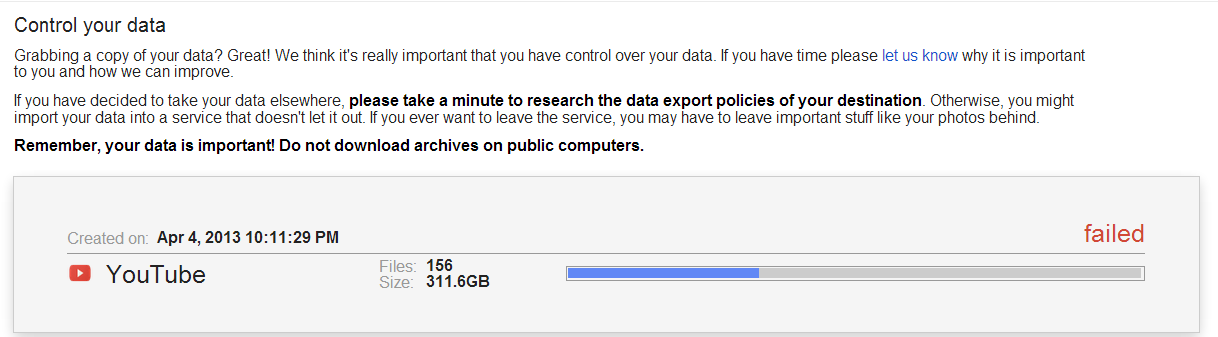
Google Takeout Fail

I didn’t really think Google Takeout would let me download all of my YouTube videos, but if there are size limits, etc., Google should make those clear and give users way to work within them (for example, allowing me to select only a few of the 150+ videos I’ve uploaded). Simply telling me I can download my YouTube videos but doing so in a way that is always going to fail is not helpful to anyone.


Google Takeout Fail