Publishers vs. Users

Robert Scoble does everyone a favor by boiling down the outrage over Google’s Autolink feature to an easily understandable idea,

Anything that changes my content is evil.

Wow. I happen to take the opposite view — as long as changes aren’t forced on users by spyware or tools that are shipped with the browser and turned on by default, I think its great if you want to change my content in a way that better suits your needs. And I do the same thing.

Want to turn images off? Go for it. Want to run a Firefox extension that inserts graphics next to any link that is for a PDF or MP3 file? Be my guest — I use such an extension myself.

In fact, thanks to the beauty of Firefox, I have an extension that modifies Google search pages to add content to them, and another that strips away embedded Flash from sites that use those.

In Scoble’s world that’s evil. Call it Fear of a Linked Planet,

Dossy: we’ll have to agree to disagree. A lot of times my LACK of a link IS editorial. I can see a world where every word is linked. Do you really want that?

So in Scoble’s world an extension for Firefox that automatically created a link for every word to say Dictionary.Com would be the height of evil. Me, I think that’d be a pretty cool tool to have.

As I said before, the past few years have seen any number of content industries suddenly realize they are no longer in control of the experience that their customers have. The advent of things like the Tivo and the iPod have generally been favored by the same people who are not horrified that users might have tools in their browsers to modify their content in ways that suit the individual needs of the person visiting the site rather than the publisher.

To me, Scoble and company come off as silly as the sites I used to visit which tried to disable right-clicking and similar features to keep people from saving the page. Just give it up.

Mea Culpa — KNOW Was Right About Syria, After All

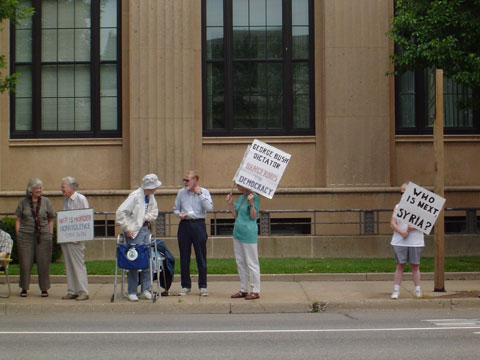
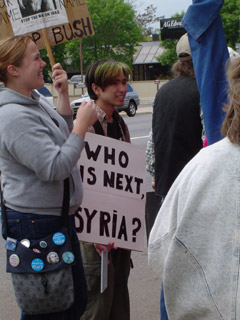
Man, a couple summers ago I was a bit incredulous as I snapped these pictures below,

These are from anti-war protests sponsored by a local group called Kalamazoo Non-Violent Opponents of War. I was making fun of them here and here.

But it turned out these folks were absolutely right about the insidious neocon conspiracy. Now along with elections in Afghanistan and elections in Iraq, Syria is facing massive protests in Lebanon that have already brought down its puppet government there.

Damn those neocons — always unfairly targeting these governments and spreading democracy across the Middle East. Don’t those protesters in Lebanon know that they’re protesting the wrong strongman? It is Bush, after all, who is the real dictator.

PCRM vs. Ohio State University

Physicians Committee for Responsible Medicine was making a lot of noise in February about the National Institutes of Health’s decision to investigate PCRM’s complaint about OSU’s Spinal Cord Injury Techniques Training Course.

The course teaches researchers how to injure the spinal cords of mice and rats so that they can be used in research on spinal cord injuries. The course itself is partially funded by NIH, so the agency’s decision to investigate the course is not surprising. Given that the NIH has previously approved the course, this will likely be a routine investigation unless there are problems with the course that are above and beyond PCRM’s simple objection to conducting this sort of research in animals.

In its press release announcing the NIH’s decision, PCRM takes credit for something that actually hasn’t happened,

In 2002, PCRM was instrumental in stopping NIH-funded experiments by OSU researcher Dr. Michael Podell, who infected cats with feline immunodeficiency virus and injected them with methamphetamine (“speed”) in an attempt to create an animal model for HIV-positive humans using drugs.

And, in fact, Podell made an important discovery — that HIV-like illness in felines progress much faster in cats that were exposed to methamphetamines. Podell hypothesized that this might explain why HIV-related dementia has such a quick onset in human methamphetamine users.

It is true that Podell left Ohio State University in 2002 due to the level of harassment that animal rights activists directed at him, but the research did not stop. It was handed off to another researcher who used tissue cultures to study more closely this effect, but who made it clear that after that study was finished the research would return to using cats in the 4th or 5th year of the study (which would have been 2004 or 2005 — the grant ends May 31, 2005).

As anti-research group Protect Our Earths Treasures noted in 2003,

September 2003, five (5) cats arrive at OSU from Liberty Labs and enter protocol 020047/96A0038.

Why are we concerned? A portion of protocol, 96A0038, was used by Michael Podell to conduct his pilot study which lead to his own protocol – Cats On Meth.

PCRM might have moved on to other things, but the research on felines at OSU apparently continued.

Sources:

NIH to Investigate OSU’s Spinal Injury Course. Press Release, Physicians Committee for Responsible Medicine, February 8, 2005.

Remembrance for the Animals Used In the Labs at The Ohio State University. Protect Our Earths Treasures, Undated, Accessed: February 28, 2005.

Study Suggests It May Be Possible to Transplant Animal Embryonic Stem Cells to Grow New Human Organs

In a study published in February in the Proceedings of the National Academy of Sciences, researchers at the Weizmann Institute of Science published the results of their experiments in implanting embyronic stem cells from pigs into mice.

The researchers wanted to establish at what point it was best to implant the embryonic stem cells, so it took stem cells from varying stages of development of the pig embryo, and implanted them in the liver, pancreas and lungs of immune-deficient mice.

The researchers discovered that transplanting embyronic stem cells at too early or too late a stage would not result in new cell growth, but that if transplanted during the correct window of opportunity, the pig stem cells did lead to cell growth in the mice. Dr. Bernard Herring, at the Diabetes Institute for Immunology and Transplantation at the University of Minnesota, told National Geographic News,

What he [lead researcher Yair Reisner] has shown is that there’s a window of opportunity . If you obtain this tissue at a very defined point in time, then you can see development into islets [portions of the pancreas that secrete hormones like insulin] without risks such as teratoma formation. That’s clearly something that makes us feel very strongly that this could be a real opportunity, one that can be translated into tangible benefits much faster than other technologies.

In a statement about the research, Reisner said,

Considering the ethical issues associated with human embryonic stem cells or with precursor tissue obtained from human abortions, we believe that the use of embryonic pig tissue could afford a more simple solution to the shortage of organs.

This finding helps explain, in part, why previous efforts to transplant pig embryonic stem cells failed, since previous research had harvested the cells at a much later gestational age than what Reisner’s study found was optimal.

Of course there are still a number of major hurdles to overcome before such technologies could be used in human beings even if researchers figure out how to make embryonic stem cells produce cells in human beings, including producing pigs free of viruses that could possibly infect human beings and avoiding an immune response to the transplant of such cells.

Sources:

Pig Stem Cells to Be Used to Grow Human Organs? Stefan Lovgren, National Geographic News, February 15, 2005.

New Organs Could Come from Pig Embryos – Study. Reuters, February 14, 2005.

If All Else Fails, Harass the Pet-Related AIDS Charity

Back in January I mentioned protests by animal rights activists against stores in Guerneville, California.

In response to the protests and threats of a general boycott by the activists against a Guerneville stores, supporters of the stores selling fur rented out a local gay bar and held a Furrr Ball event to satirize the protests and raise money for a good cause.

Initially the money was going to be given to local group Pets Are Loving Support — a volunteer group that helps care for the pets of about 100 AIDS patients in Sonoma County. But PALS turned down the donations. According to the Press Democrat,

The nonprofit has fielded complaints and name-calling from animal-rights fanatics outraged that it would accept money from people poking fun at the Guerneville fur protest. PAL’s board decided it cannot be pulled into politics.

The money was instead donated to the National Animal Interest Alliance (gee, the animal rights activists must be happy to see NAIA get the money rather than some local animal charity).

Anyway, I tracked down this story because I was curious what had happened. Had activists managed to force the stores to stop selling furs? According to a Press Democrat story from mid-February (emphasis added),

But Stefan Howard [one of the leaders of the anti-fur protests], a Guerneville man reached by phone Sunday, spoke on behalf of the critics of fur sales: “It’s sad that our town actually held an event celebrating a product of pure cruelty.”

Animal rights supporters have halted the protests and are seeking mediation, Howard said.

“We have really focused on trying to call for a resolution of this, and sort of heal the rift,” he said. “We’re willing to consider a compromise proposal.

Willing to consider a compromise? It was just last December that Sonoma People for Animal Rights activist Alex Bury compared vintage clothing store owner Mikki Herman, who is Jewish, to the Nazis. According to the Press Democrat,

. . . Herman said the chance for dialogue ended when Bury compared Herman’s used fur coats to the Nazi lampshades made from the skin of Jews.

Herman is Jewish and lost relatives in the Holocaust.

“There is no conversation that can be had with someone who thinks bunny fur is the same as the skin of a Jew,” Herman said. “I come from a long line of people who act on their conscience, and I’ve got not choice but to continue what I’m doing.”

Bury said she didn’t know Herman was Jewish when she made the lampshade comment but would not back away from the description.

“Animals have the same nerve endings. They feel the same pain,” Bury said. “If Hitler made things out of skin . . . and sold lampshades, I wouldn’t want them in my business. That’s how I feel about fur. Total pain and suffering.”

But now, the activists want to reach a “compromise” with people they have compared to the Nazis? Besides, what happened to Bury’s claims that they would not stop the boycott or protests until all the fur was gone.

Source:

‘Furrr Ball’ draws 150. Katy Hillenmeyer, The Press Democrat, February 2005.

Fur protests threaten to split Guerneville. Carol Benfell, The Press Democrat, December 23, 2004.