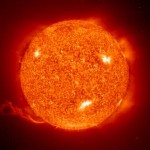
 Is the Sun special? That’s the claim that’s been occasionally made — that the Sun has a number of relatively rare features that are especially conducive to life. For example, it has been claimed the Sun has a relatively small mass or a particular level of iron that make it”fine-tuned” for life.
But a study by scientists at Australian National University suggest there’s really nothing special about the Sun,
With his ANU colleague José Robles and others, [Charles] Lineweaver has now analysed 11 features of the Sun that might affect its ability to have habitable planets. They included its mass, age, rotation speed and orbital distance from the centre of the Milky Way.
Then they compared these with well-measured statistics for other stars to answer the question – overall, does the Sun stand out from the crowd any more than some other randomly chosen star would?
The Sun did stand out in two ways: it is more massive than 95% of nearby stars and its orbit around the centre of our galaxy is more circular than those of 93% of nearby stars.
But when all 11 properties were taken on board, the Sun looked very ordinary. Robles’s team calculates that there would be only about one chance in three that a star selected at random would be “more typical” than the Sun.
What is different about the Earth is the particular orbit that it has around the Sun. Find a planet that is in a similar orbit around another star, and you have something that might be particulary conducive for life. But, if Lineweaver and his colleagues are right, it really doesn’t matter what kind of star that is.