This is an exhaustive list of common cliches found in console RPGs. It would be more amusing if console RPGs didn’t universally suck, but this does a good job of documenting why the suck so bad.
Tag: Videogames
Custom Prince for that Katamari
Last month, I finally got myself one of the custom Katamari’s that Amy’s Babies sells on her Etsy.Com shop.
I was so impressed with the Katamari, that I sent her an e-mail about getting a Little Prince to go along with the Katamari. Amy sent me a reply saying she was working on a pattern for the Katamari DamacyPrince, so I patiently waited. And believe me, the wait was definitely worth it. This is the final result, which looks awesome,

But wait, there’s more. Just as the original custom Katamari has magnets inside of the nodes so it can pick things up, the ends of the arms of the Prince are metal, so you can position the Prince to appear as if he’s rolling the Katamari along,
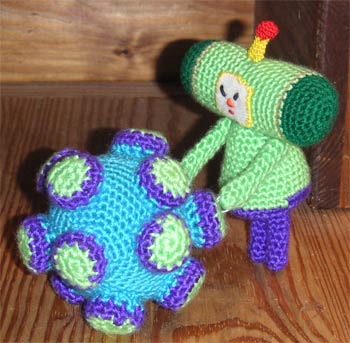
Excellent.
The Rock as Spy Hunter?
I’m not sure what is more disturbing — that someone is making a movie version of the classic arcade game “Spy Hunter” or that the lead will be played by The Rock. Presumably the lead will be played by Ice Cube or Vin Diesel in the inevitable sequel.
My Very Own Katamari
A few months ago I wrote about custom-made magnetic Katamaris for sale on Etsy.
I finally broke down and bought one recently from crotchet wizard Amy’s Babies. I told her to surprise me on the colors and the result was perfect,

About Those Terrorist Video Games
In early May, Reuters ran a story about a hearing of the House Permanent Select Committee on Intelligence where a Defense Department official claimed that terrorist groups were using video games as part of their recruitment efforts. According to the Reuters story,
Tech-savvy militants from al Qaeda and other groups have modified video war games so that U.S. troops play the role of bad guys in running gunfights against heavily armed Islamic radical heroes, Defense Department official and contractors told Congress.
The games appear on militant Web sites, where youths as young as 7 can play at being troop-killing urban guerillas after registering with the site’s sponsors.
“What we have seen is that any video game that comes out … they’ll modify it and change the game for their needs,” said Dan Devlin, a Defense Department public diplomacy specialist.
The basis for this claim was in-game footage of Battlefield 2 that Devlin showed lawmakers. Again, according to Reuters,
“Battlefield 2” ordinarily shows U.S. troops engaging forces from China or a united Middle East coalition. But in a modified video trailer posted on Islamic Web sites and shown to lawmakers, the game depicts a man in Arab headdress carrying an automatic weapon into combat with U.S. invaders.
“I was just a boy when the infidels came to my village in Blackhawk helicopters,” a narrator’s voice said as the screen flashed between images of street-level gunfights, explosions and helicopter assaults.
The only problem is that the evidence turns out to have almost certainly been this Battle Field 2 recording and the “narrator’s voice” mentioned in the Reuter’s piece is dialogue stolen from Team America.
In other words, the House Permanent Select Committee on Intelligence got pwned by a parody passed off by idiot contractors and defense department officials as a genuine terrorist production.
Sources:
Islamists using US video games in youth appeal. Reuters, May 4, 2006.
Michigan Video Game Law Tossed
Back in 2005, our grandstanding governor Jennifer Granholm called for the legislature to pass a bill to ban the sale of “violent” video games to minors. The legislature granted her request, and the bill was signed into law in September of 2005.
This month, U.S. District Court Judge George Caram Steeh issued a permanent injunction against the ban, finding it unconstitutional. In his decision to issue the injunction, Steeh wrote that,
The interactive, or functional aspect, in video games can be said to enhance the expressive elements even more than other media by drawing the player closer to the characters and becoming more involved in the plot of the game than by simply watching a movie or television show. It would be impossible to separate the functional aspects of a video game from the expressive, inasmuch as they are so closely intertwined and dependent on each other in creating the virtual experience.
That’s a fancy way of saying that the interactive nature of video games does not — as Michigan had argued — provide them with less First Amendment protection than other media, such as novels or movies.
Although the Michigan law would have only prevented the sale of games to minors, Granholm showed her true intent in taking on the craptastic “25 to Life” (which Gamespot describes as “a lifelessly generic shooter that, at times, feels like Max Payne without the fun.”)
In an official press release Granholm argued that not only should the game not be sold to minors, but that it should not be stocked at all by Michigan retailers,
Governor Jennifer M. Granholm last week called on retailers across Michigan to support a national boycott of the video game “25 to Life†by not selling the game in their stores. In a letter to the retailers, Granholm said taking the game off store shelves is a critical step in the fight to keep inappropriate and dangerous forms of entertainment out of the hands of our children.
“Taking this game off your shelves is not only the best way to ensure that it does not end up in the hands of children, it also sends a message of support to our law enforcement community that we will not support those who would profit from the production and sale of such games, no matter what the intended audience,” Granholm wrote.
Right, and having Michigan cable companies boycott HBO is the best way to make sure children don’t watch “The Sopranos.”
Sources:
Breaking: Michigan Violent Games Law Thrown Out. GameDaily, April 3, 2006.
Governor Granholm Continues to Fight to Keep Violent and Sexually Explicit Video Games Away from Children. Press Release, March 15, 2006.