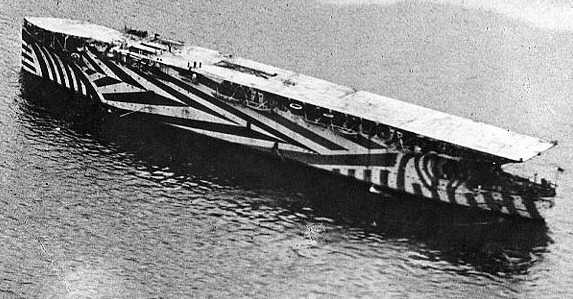
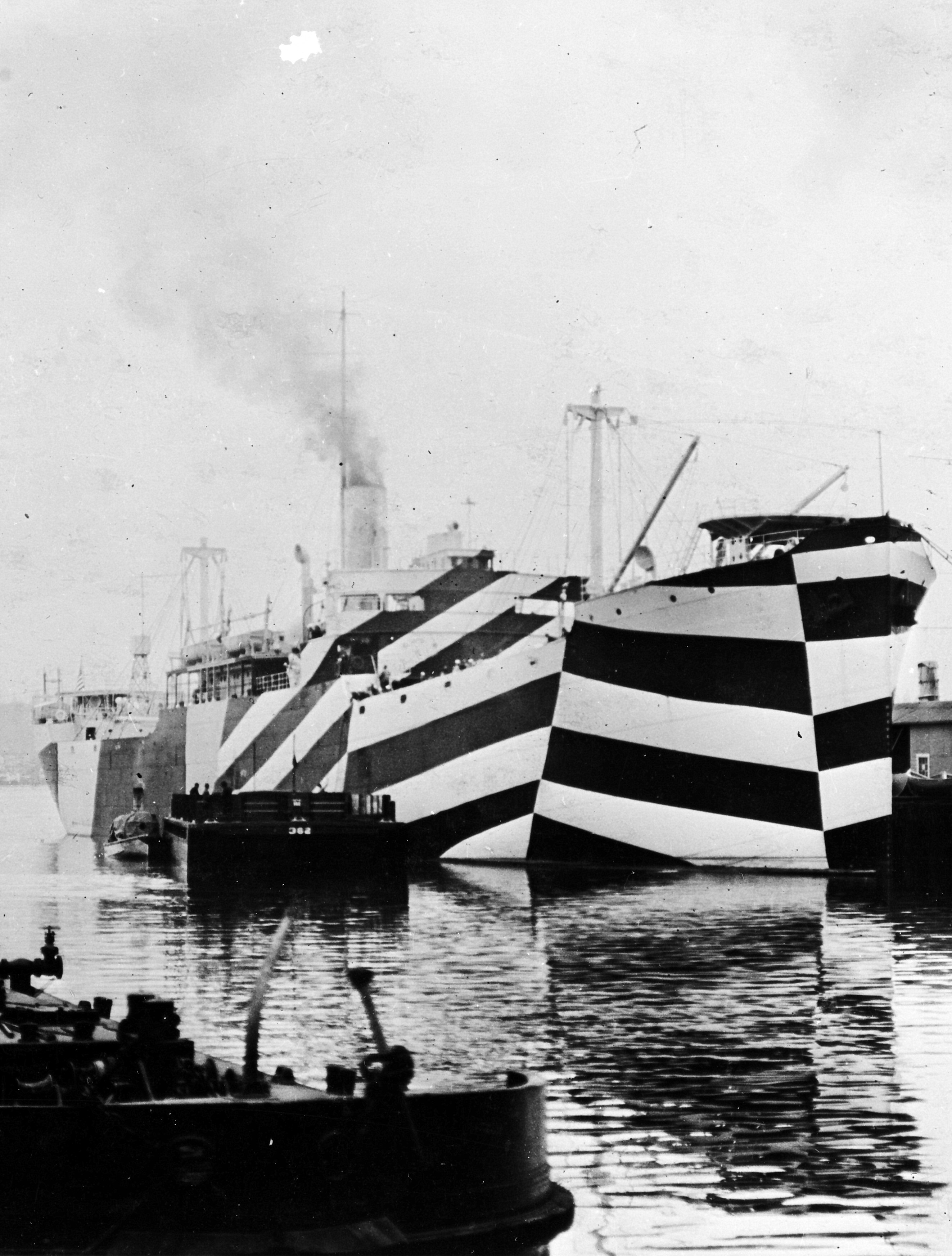
Dazzle camouflage is a type of camouflage used on some ships during World War I that was designed to make it difficult for enemy ships and submarines to determine range, speed and heading. Whether or not it actually worked is debatable,
Dazzle’s effectiveness was highly uncertain at the time of the First World War, but it was nonetheless adopted both in the UK and North America. In 1918, the Admiralty analysed shipping losses, but was unable to draw clear conclusions. Dazzle ships were attacked in 1.47% of sailings, compared to 1.12% for uncamouflaged ships, suggesting increased visibility, but as Wilkinson had argued, dazzle was not attempting to make ships hard to see. Suggestively, of the ships that were struck by torpedoes, 43% of the dazzle ships sank, compared to 54% of the uncamouflaged; and similarly, 41% of the dazzle ships were struck amidships, compared to 52% of the uncamouflaged. These comparisons could be taken to imply that submarine commanders did have more difficulty in deciding where a ship was heading and where to aim. However, the ships painted in dazzle were larger than the uncamouflaged ships, 38% of them being over 5000 tons compared to only 13% of uncamouflaged ships, making comparisons unreliable.
. . .
The American data were analysed by Harold Van Buskirk in 1919. About 1,256 ships were painted in dazzle between 1 March 1918 and the end of the war on 11 November that year. Among American merchantmen 2,500 tons and over, 78 uncamouflaged ships were sunk, and only 18 camouflaged ships; out of these 18, 11 were sunk by torpedoes, 4 in collisions and 3 by mines. No US Navy ships (all camouflaged) were sunk in the period.
By the time World War II happened, technological changes such as aircraft and radar rendered dazzle camouflage less effective, though it was still applied to some ships in the navies of both the Axis and Allies.