A Day at the Zoo

We took the kids to the zoo yesterday. Of course they were the goofiest animals
in the park. First we had to eat as we arrived there shortly after noon.

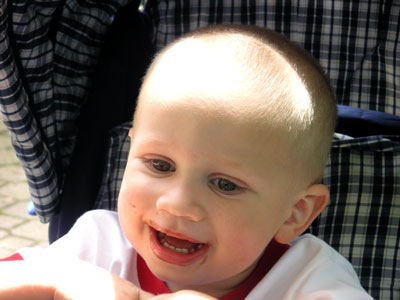
Eating’s no problem for Colin. In fact it is his favorite activity (especially
if it involves chocolate pudding as it does above). If we’re a bit late getting
dinner ready, he will subtly remind us by taking all of the food he can get
his hands on, bringing it into the living room and proclaiming, “Eat!!”

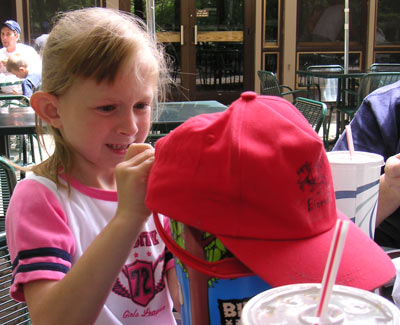
Emma, on the other hand, barely eats at all. Why eat when you could drape your
hat over a small bucket like it was a person? It can take literally a couple
hours to get her to eat sufficiently (she takes medication which suppress appetite
as an unfortunate side effect).


Of course you have to look cool before entering the zoo. Couldn’t put your
cap on just any old way. (As she puts it, “I look like a dude, dad!”)

Using the giraffe-o-scope.

Hmm…Zebras…tastes like horse.

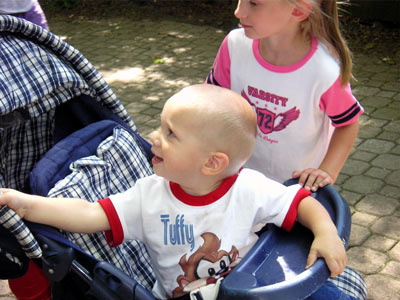
What would visiting the zoo be without a shot sitting on a gigantic steel cow?

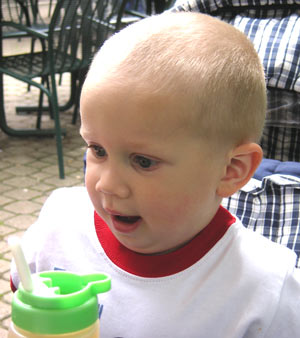
And why look at the animals when you can play peek-a-boo with mom?

John Stossel vs. John Edwards

John Stossel apparently used John Edwards to make a point about the effect that out-of-control lawsuits are having on health care. Early in his career, Edwards made a name for himself representing clients with cerebral palsy in medical malpractice lawsuits.

Edwards’ basic argument went like this — the cerebral palsy suffered by his client was caused by oxygen deprivation which the attending obstetrician could have prevented if he had performed a cesarean section or other medical intervention earlier than he or she did. Edwards was apparently very good at both choosing the best cases to go forward with as well as making his case in court and made himself millions of dollars.

The problem is that this explanation for cerebral palsy and what might be done to prevent it appears more and more bogus. Oxygen deprivation does play a part in a very small number of cases, but the vast majority of the 8,000 or so annual cases of cerebral palsy appear to have other causes. Moreoever, research on the subject is pretty clear that performing cesarean sections doesn’t reduce the likelihood of a baby being born with cerebral palsy. In fact as Stossel notes, the percentage of births done by c-section has climbed steadily since 1970, but the percentage of infants born with cerebral palsy hasn’t changed.

But Stossle then goes on to make a claim about cesearean sections that is just as spurious. According to Stossel,

However, today many C-sections are still done in hopes of avoiding a lawsuit, even though C-sections are a more painful way to give birth, as well as more expensive, requiring a longer hospital stay, and carrying greater health risks.

There are probably more C-sections being performed today due to concerns of lawsuits, but everything else in the above sentence is false.

Contrary to Stossel, studies have found that C-sections are not more expensive than vaginal births. They do cost a bit more upfront, but the cost is lower on average because women having C-sectionse experience fewer long-term complications.

Which brings us to Stossel’s claim that C-sections carry greater health risks. In fact, a recent Health Grades Inc. found that post-natal complications occurred in 8.4 percent of cesarean sections but in 12 percent of vaginal births. A study published in the New England Journal of Medicine found a lower maternal mortality rate for women undergoing c-sections compared to those undergoing a vaginal birth (though maternal mortality rates are extremely low in the United States for vaginal births).

It appears Stossel didn’t bother to interview anyone about the alleged dangers of cesarean sections but simply assumed that since it is a surgical procedure it must be more dangerous than “natural” child birth. Sounds like he’s got the makings of a good trial lawyer there.

Source:

Lawyers and the Little Guy. John Stossle, ABCNews, July 23, 2004.
Kerry vs. Ashcroft on Civil Liberties

Politics creates such odd matchups sometimes. Today it’s John Kerry promising not to let John Ashcroft destroy our civil liberties. But a decade ago, as Reason reminds us, it was Kerry who was trying desperately to restrict civil liberties while Ashcroft defended them,

This isn’t the first time Kerry and Ashcroft have been at odds over civil liberties. In the 1990s, government proposals to restrict encryption inspired a national debate. Then as now, the American Civil Liberties Union (ACLU) and electronic privacy groups locked horns with the DOJ and law enforcement agencies. Then as now, Kerry and Ashcroft were on opposite sides.

But there was noteworthy difference in those days. Then it was Sen. John Ashcroft (R-Mo.) who argued alongside the ACLU in favor of the individual’s right to encrypt messages and export encryption software. Ashcroft “was kind of the go-to guy for all of us on the Republican side of the Senate,” recalls David Sobel, general counsel of the Electronic Privacy Information Center.

And in what now seems like a bizarre parallel universe, it was John Kerry who was on the side of the FBI, the National Security Agency, and the DOJ. Ashcroft’s predecessor at the Justice Department, Janet Reno, wanted to force companies to create a “clipper chip” for the government—a chip that could “unlock” the encryption codes individuals use to keep their messages private. When that wouldn’t fly in Congress, the DOJ pushed for a “key escrow” system in which a third-party agency would have a “backdoor” key to read encrypted messages.

As late as 1997, Reason notes, Kerry was the first co-sponsor to John McCain’s Secure Public Networks Act which would have created a national key escrow registry and solidified the Clinton ban on encryption exports (they should have called this the Encourage Encryption Offshoring Act).

There’s also this Kerry response to a defense of strong encryption that appeared in Wired, in which Kerry alludes to those murder in the first World Trade Center attack and the Oklahoma City bombing,

[O]ne would be hard-pressed,” he wrote, “to find a single grieving relative of those killed in the bombings of the World Trade Center in New York or the federal building in Oklahoma City who would not have gladly sacrificed a measure of personal privacy if it could have saved a loved one.

I guess he actually voted in favor of sacrificing freedom for security before he voted against it.

Source:

John Kerry’s Monstrous Record on Civil Liberties. John Berlau, Reason, July 26, 2004.

UK Fathers Rights Group Disrupts Church of England Service

A UK group calling itself Fathers 4 Justice disrupted a service of the Church of England’s General Synod in order to protest alleged inaction by the church to do more to protect the rights of divorced fathers to see their children.

According to the BBC, the protestors didn’t exactly receive a warm welcome,

Fathers 4 Justice leader Matt O’Connor was earlier rugby tackled and dragged out of the service by church members.

As he picked himself up he shouted: “Remember, half a million children are deprived of contact with their fathers and the church does nothing. Shame on you.”

Twelve protesters were arrested on suspicion of criminal damage and assault.

This is the same group that in May threw condoms filled with purple flower at Tony Blair while he was speaking in the House of Commons (so much for new anti-terrorist security measures in the UK!)

Maybe this sort of stuff plays differently in Great Britain — where animal rights activists and other extremists are allowed to commit gross acts of harassment and violence with little fear of significant punishment — but these sort of extremist tactics suggest that there may be good reasons these folks don’t see their children very often. They certainly do themselves and their cause no favors with such assaults.

Sources:

Fathers’ cathedral protest ends. The BBC, July 12, 2004.

Blair hit during Commons protest. The BBC, May 19, 2004.

Catwoman a Financial as Well as Critical Disaster

Wow — according to BoxOfficeMojo.Com, Catwoman is a financial as well as critical disaster. The film took in less than $18 million this weekend after costing an estimated $135 million to make and market (including a $12.5 million payday for Halle Berry).

Personally, I thought the marketing for the film was absurd and somewhat offensive. Roger Ebert sums the film up this way,

“Catwoman” is a movie about Halle Berry’s beauty, sex appeal, figure, eyes, lips and costume design. It gets those right. Everything else is secondary, except for the plot, which is tertiary. What a letdown.

In other words, take the absurdly adolescent view of female sexuality that (still) tends to permeate comic books, and then turn it up a notch. Yeah, that’s a film I really want to see. (The Catwoman costume looked so stupid and over-sexualized that even the fanboys couldn’t find it in their, uh, hearts to embrace it).

Didn’t these people watch “Spider-Man” and “X-Men” and their sequels? You have to be able to sell the characters as real people or it becomes impossible to suspend disbelief about the whole super power thing.

Men Accused of Raping Three Women in Revenge for Lower Caste Wedding

According to the BBC, tension and conflict arose in an Indian village earlier this year when a young woman from an upper-caste Yadav family eloped with a 19-year old man of the Dalit caste, which is the lowest in India’s bizarre caste system. So several dozen Yadav men did what any self-respecting upper-caste man would — they first paraded the young man’s mother and aunts through the village and then gang raped them.

Police have arrested eight people in the Indian state of Madhya Pradesh for their alleged involvement in the attack. Witnesses told police that about 30 men were involved altogether in the gang rape..

India’s caste system is abolished by law, but, as this incident underscores, it is still solidly entrenched in practice.

Source:

Men held over ‘caste gang-rape’. The BBC, July 10, 2004.