Up-Skirt Filming Banned in Washington State

On May 12, Washington State Gov. Gary Locke signed into law legislation banning so-called “up-skirt” filming of women in public places.

In 2002 two men were arrested and charged with violating Washington’s anti-voyeur statutes after they were caught surreptitiously filming up the skirts of women at and outdoor festival. A state court ruled, however, that such activities were not covered by the anti-voyeur statute (largely, as one Washington state representative put it, because nobody in the legislature imagined anyone would engage in this sort of activity).

Once some initial partisan posturing was out of the way, the law sailed through Washington’s legislature, passing its Senate in an unanimous 97-0 vote in April. It makes up-skirting filming a felony punishable by up to a year in jail.

Source:

Legislature 2003: Locke signs up-skirt camera ban: Violators of voyeurism law face 3- to 12-month term. Steven Friederich, Seattle Post-Intelligencer, May 13, 2003.

‘Up-skirt’ camera ban goes to Locke. Seattle Post-Intelligencer, April 23, 2003.

Law targets ‘Up-Skirt’ filming. Reuters, January 3, 2003.
Military Drug Use

Matt Drudge has an item about an upcoming comedy about the military, “Buffalo Soldiers,” that is generating controversy because it centers on an enlisted man dealing drugs out of a military base. If it’s a low brow comedy, who cares? (Did anyone mistake Stripes for anything but a hilarious low brow comedy?)

That being said, Joaquin Phoenix has this to say about the movie which he stars in,

I don’t know why anyone would be offended. It wasn’t a movie that was intended to offend. And if we don’t show things as they really happen, then what’s that about? Censorship!

Well if the movie is designed to show things as they really happen, it’s a bit odd to set a drug comedy in the U.S. military. In the late 1970s and early 1980s the military had a serious drug problem. The Pentagon responded to this with random drug testing and a whole lot of discharges for those failing such tests.

The result was a steep decline in drug use. In fact, drug use in the military is far lower than it is in the civilian population. This White House fact sheet, for example, reports that only 2.7 percent of military personnel reported using an illict drug in the previous 30 days, compared to a rate of 16.1 percent among civilians 18-25 and 7.0 for those 26-34.

If you’re interested in reporting what really happens at a U.S. military base, it’s a bit odd to focus on a drug ring given the extremely low rate of reported use of illicit drugs in the military.

Would that be censorship?

Anti-War Protest Pictures – June 29, 2003

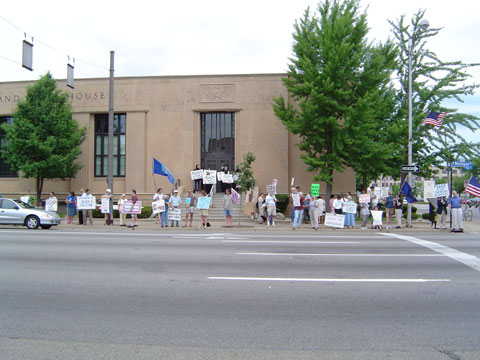
I’m a bit behind in posting pictures of the anti-war protests. These are shots I took on Sunday,
June 29, 2003. This is from protests the local peace group holds every Sunday
in downtown Kalamazoo:

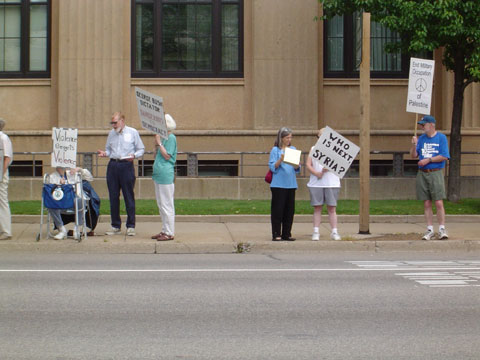
Basic crowd shot. There are a few more people off to the left (no pun intended).

The guy holding the “Disarm U.S.” sign pretty much says it all. Along
with the “Violence is never a solution” sign, all they need is a “U.S.
Out of North American” sign to complete the triumvirate.

Violence is never a solution? You have to wonder why these
folks
bothered to try to smuggle arms at all — they should have known that
violence is never a solution. (Perhaps they support Gandhi’s
solution
to this conundrum).

“Violence is never a solution” is sort of the Mirror World version
of the “Kill them all and let god sort them out” thinking. It’s difficult
to take seriously anyone who seriously holds either idea.

This time around we’ve got a woman worrying about the future of Syria.

If I were her, I wouldn’t be too worried about her Syrian friends — the Syrian
state always seems to find ways to deal with its enemies (but hey, stopping that sort of atrocity would just
be furthering American imperial hegemony!)

The Patriot Act needs to be repealed, but “terrorism on your rights”?
This is why I pretty much refuse to participate in public protests of any kind
— you have to dumb down and sensationalize the message past the point of no
return. (Even Fox gives a more nuanced version of the Patriot Act than this).

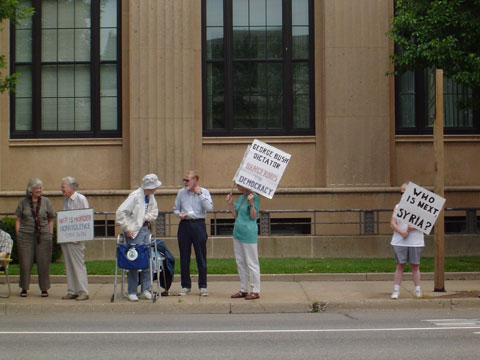
The person in the center is holding a sign reading “George Bush Dictator
Dangerous to Democracy.” Hey, I didn’t vote for him and I don’t plan to
vote for him next time around, but Bush a dictator? Again, this is simply left
wing self-marginalization central.

Note: As a public service, I’ve included all of the photographs I took of the protests on June 29, 2003 here. These are free to use for any purpose provided you credit me, Brian Carnell, as the photographer. Take them, edit them, republish them, whatever.

Todd McFarlane’s Hideous Reimagining of Oz

As if his Mister Miracle statue wasn’t bizarre enough, Todd McFarlane has decided
to launch a series of statues based on a “reimagining” of the Wizard
of Oz. Unlike the figures that are a tie-in to American McGee’s upcoming Oz
videogame, these aren’t tied to any external product — McFarlane apparently
just wanted to screw with Oz.

Not bad, except the lion is supposed to be cowardly. Here he looks like some
lion terminator sent from he future.

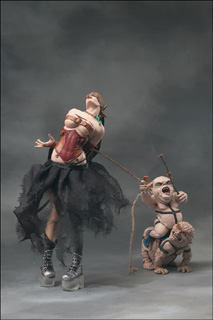
Oooh, what a brilliant mind — take a female character and show her off in
a bondage pose. Yeah, that’s never been done before.

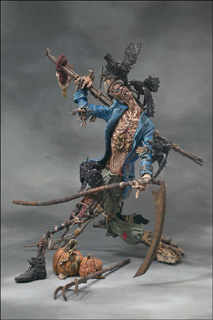
This is supposed to be the wizard. Yeah, it doesn’t make any sense to me either.

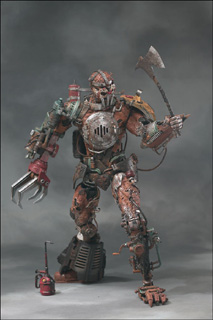
The tin man doesn’t look too bad, though looks like it should be for the unreleased
“Tin Man and the Texas Chainsaw Massacre” book.

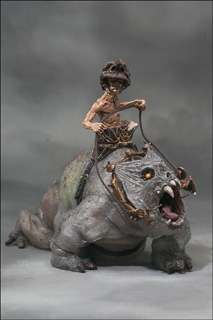
Toto, the fanged mole rat? Whatever.

Breast Cancer Study Finds No Link with EMF Exposure

A study of Long Island women recently found that there was no association between breast cancer and exposure to electromagnetic fields.

The study, published in the American Journal of Epidemiology, examined 576 women with breast cancer and 585 women without the disease. Researchers at Sony Brook University measured the electromagnetic fields in various rooms of the houses of the women, and also mapped the power lines around each house.

Like previous such studies, it found no association between EMF exposure and breast cancer risk. The study also took pains to examine only women who had lived in their houses for at least 15 years, to test if there was any association with long term exposure to EMF.

Dr. M. Cristina Leske, who headed up the six-year, $2.5 million study, said in a press release announcing the results of the study,

The results are reassuring in that residential levels of EMF, such as from electrical wiring in or around the home, were not related to breast cancer. Given these results, we now have valuable information that leads us to conclude that we can now focus on other possible risk factors. Our team is most grateful for the support of the Long Island women, who made our study possible.

Sources:

Study finds no link between breast cancer, power lines. Associated Press, June 25, 2003.

Breast Cancer and Electromagnetic Fields Study. Press Release, Stony Brook University, June 25, 2003.

James Madison University Decides to Ban Distribution of Morning After Pills

The Washington Post had an interesting story in April about James Madison University’s decision to stop the dispensing of the morning after pill in its campus health center after complaints from anti-abortion activists.

The health center had been prescribing and dispensing the morning after pills for eight years. Ann Simmons, a nurse at the health center, told the Washington Post that the Food and Drug Administration classifies morning after pills as contraceptives as opposed to abortion inducing drugs such as RU-486.

But Virginia State Delegate Robert Marshall sent a letter to James Madison University President Linwood Rose objecting to the distribution of the morning after pill. From there, a little politics was added to the mix.

James Madison University board Mark Obenshain is running for Virginia Senate. A local entrepreneur who supports another candidate distributed the letter to antiabortion activists pointing out that candidate Obenshain is a board member.

In April Obenshain then demanded an explanation about the distribution of the morning after pill and then successfully pushed the board to enact a ban on the contraceptive that passed 8-6.

Students at James Madison University obtained almost 3,000 signatures on a petition to ask the board to reverse its ban on the distribution of the morning after pill. That petition was taken up at the June meeting of the board which tersely reported that,

Neither the [Education and Student Life] committee nor the full board took any action on the request.

So for the moment, James Madison University students will have to go to off-campus pharmacies to have their morning after prescriptions filled.

Sources:

Pill ban gives birth to protest. Laura Sessions Stepp, Washington Post, April 24, 2003.

Summary Of Action By JMU Board Of Visitors. Press Release, James Madison University, June 6, 2003.