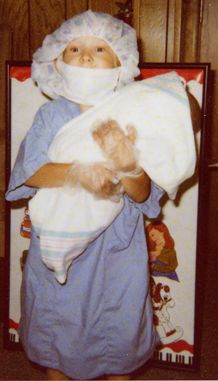
Step Aside Doogie Howser

Part of being a parent is showing picture of your kid doing things that you think are cute. Today my daughter went through a sort of orientation session at the hospital designed to teach young kids about what they can expect when their new baby brother or sister is born.

As part of this they let my daughter dress up like a doctor and practice the proper way to hold a baby (Emma’s still too young to hold an infant that’s not made of plastic, though):

Dan Murphy's Excellent Commentary on AR2002

Dan Murphy, the editor Meat Marketing & Technology magazine, wrote an excellent account of an appearance he made at Animal Rights 2002.

Murphy was invited to give a short speech to activists covering areas where industry and activists might have some common ground. As you might expect, Murphy was largely wasting his time. As he wrote,

Not surprisingly, my remarks had about as much of a lasting impact on the more than 800 diehard activists in attendance as the “lecture” I gave my cat Riley last week about not clawing the couch.

. . .

Unfortunately, the overwhelming attitude among speakers, disciples and exhibitors alike encompassed a migraine-inducing mix of virulent anti-meat propaganda, bizarre animal action campaigns and a few frightening glimpses into the mind and soul of crusaders who have truly lost the plot.

Murphy relayed a long litany of things that the assembled activists were against as well as some choice quotes from people like Ingrid Newkirk (“You just look at animals — just look into their eyes — and you can tell they’re people. It’s that simple.”) and Paul Watson (“There is no way to change our laws without using violence, and we cannot shy away from violence as a crucial arm of the movement. We can all put ourselves on the line. It doesn’t take a four-year degree to call in a bomb threat.”)

But Murphy was brilliant in tearing apart a bizarre claim by the Animal Defense League’s Jerry Vlasak who argued that violence was compatible with the nonviolent outlook of the civil rights movement.

“Dr. [Martin Luther] King said that destroying property doesn’t violate the principle of non-violence,” [Violence] is part of every successful social justice movement.” (Jerry Vlasak, of the Animal Defense League). That last quote angers me.

Narrow-mindedness in the service of one’s chosen mission is at least understandable. But some of the animal rights leadership obviously enjoys selling a not-so-subtly packaged message of violence in service to the cause.

When the pro-violence folks quoted above arrogantly tried to claim King as a spiritual ancestor to the extremists responsible for blowing up trucks, bombing buildings and destroying the property of legitimate business people, I glanced around at the SRO crowd packed into the room, and the mostly young, predominantly female and almost exclusively white audience members were all nodding their heads in earnest agreement.

Were the real Dr. King still alive I can only imagine that he would disagree with far greater conviction. I won’t digress too extensively here, but allow me to share just a couple relevant quotes for those losers who have a dream that King would somehow relish their sick sanctioning of property destruction:

. . .

To suggest that arson in the name of the “cause” would be approved by Dr. King — whose own home was fire-bombed by white bigots passionate about their “cause” — is an ignorant interpretation of history at best.

To invoke the name of Martin Luther King on behalf of violent ALF types who are past even the fringe of legitimacy is a venal, bankrupt attempt at credibility that puts an Orwellian spin on a chapter of American social history about which I doubt more than a handful of the activist types at that Animal Rights meeting have more than an MTV-like video clip awareness of its significance.

In fact, using Vlasak’s perverse version of nonviolence, the fire bombing of King’s house was morally acceptable because nobody was hurt — only property was destroyed. According to Vlasak philosophy, somebody who might burn down a black church or firebomb an abortion clinic is not engaged in violence so long as it is only property that is destroyed.

That these sorts of pedantic arguments actually seem to find widespread acceptance in the animal rights movement is indicative of just how marginal the movement is. Nobody outside the movement buys these sorts of arguments anymore than the buy the argument of extremist anti-abortion advocates that destroying an abortion clinic is simply a valid act of defense on behalf of unborn children.

Source:

Animal Rights conclave window to weird world of act-out activists Dan Murphy, MeatingPlace.Com, July 12, 2002.

FBI Investigating Terrorist Attack Against Seattle Office Buildings

The Seattle News tribune reports that the FBI is leading the search for the individuals who set off military-style smoke grenades in two downtown Seattle office towers on Wednesday, July 10. The terrorist incident appears to have been the work of animal rights activists targeting insurance company Marsh which has offices in both buildings. Marsh has been targeted by Stop Huntingdon Animal Cruelty for providing insurance to Huntingdon Life Sciences.

According to police, notes were found with both bombs though they are not disclosing the contents of those notes.

At 9:34 a.m. a 911 call was placed to report a smoking device on the 20th floor of an office building at 701 Pike Street. At 9:35 a.m., an automatic fire alarm was triggered on the 28th floor of an office building at 1215 Fourth Avenue.

Workers from both buildings were evacuated without incident, but the situation could have been much worse. Since both grenades are incendiary devices, Seattle Fire Chief Gary Morris told The New Tribune that, “We would have had a high-rise fire” if either grenade had come into contact with combustible material.

For its part, SHAC said it was not behind the attack but it expressed its admiration for whoever carried it out,

SHAC is not affiliated with the attack. Although we do support direct action, as long as it does not hurt any animal, human or nonhuman, we do not engage in, organize or fund such activities. However, we do applaud those brave enough to do so.

Seattle Police Chief Gil Kerlikowske noted that the claims by animal rights activist that such attacks aren’t terrorism because they don’t harm people was “incredibly disingenuous.” According to The News Tribune,

Evacuations are inherently risky, he said. He added that the massive mobilization to the two incidents left the rest of Seattle needlessly vulnerable.

And the incidents themselves initially made police and fire officials contemplate some of the terrifying questions of the post-Sept. 11 world, Kerlikowske said: “You’re wondering: How many other devices? Is this a diversionary incident?”

The Seattle Times reported that SHAC, on its web site, welcomed such fear saying that the bombings “smoked [Marsh employees] out of their holes.”

Sources:

Smoke bombs halt workday at offices. Ian Ith and Dave Birkland, Seattle Times, July 11, 2002.

FBI leads problem of Seattle office smoke bombs. David Quigg, The News Tribune (Seattle), July 12, 2002.

Do Children of Vegetarians Have More Birth Defects?

This week researchers from the University of Bristol announced that their study of 8,000 infants found that babies born to vegetarians were up to five times as likely to suffer from some forms of birth defects. But how reliable is this?

This is not the first Bristol study to tie birth defects to vegetarianism. In 1999, Bristol researchers announced a study finding that boys born to vegetarian mothers were five times as likely to suffer from hypospadias, a condition where the opening of uretha occurs at a point below the tip of the penis.

Another study, conducted at Nottingham University, found that whereas the average sex ratio of children born in Great Britain was 106 boys to every 100 girls, in vegetarian women the ratio was only 85 boys to every 100 girls. That study was widely criticized since it is sperm from the male that determines the sex of the child, though the researcher suggested that a vegetarian diet might somehow alter body chemistry to favor sperm carrying DNA for a female (if there is really a connection between vegetarianism and the sex of children, a much likelier explanation is that children born to vegetarian mothers are almost certainly much more likelier to have vegetarian fathers as well).

A major problem with all three of the studies mentioned above is that none of them appears to have been peer reviewed in a serious research journal. The sex ratio research, for example, was published in Practising Midwife. Now, this is probably an excellent journal for what it does, but The Lancet it is not.

Another major problem is that news accounts of these studies never report on the sample size for vegetarians and non-vegetarians. Typically a study of both groups will tend to include far more non-vegetarians than vegetarians, significantly reducing the usefulness of the results. If 4,000 of the babies in the Bristol study had vegetarian mothers, the results are far more interesting than if the study was more like 7,500 non-vegetarians and 500 vegetarians.

The culprit that the researchers finger in all three cases is soya, which is a major source of protein in many vegetarian diets. Animal studies suggest that high consumption of soya exposes mammals to very high levels of estrogen-like compounds, but if soya is really a major problem, then why has soya been eaten regularly by hundreds of millions of people for decades without anyone noticing this before?

What is really needed to resolve this is a well-designed study subjected to peer review. Until then, call me skeptical.

Source:

Vegetarian diet linked to genital defects. Matthew Hill, The BBC, July 2, 1999.

Vegetarian Diet In Pregnancy Linked To Birth Defect. BJU International January 2000;85:107-113.

‘More girl babies’ for vegetarians. The BBC, August 7, 2000.

Meat-free diet puts infants at risk. Europe Intelligence Wire, July 10, 2002.

The Chronic Wasting Disease Controversy

ConsumerFreedom.Com published a review of concerns about chronic wasting disease in deer and elk (often referred to as “mad deer disease.”) Like Mad Cow Disease and Cruetzefeld-Jakobs, CWD involves prions that cause lesions to form in the brain of deer and elk. The current debate is centered around what, if any, risk the disease poses to human beings.

In deer and elk, the disease was first identified in the late 1970s in deer that were held in captivity. The perception, however, is that the disease has spread rapidly with some studies suggesting that as many as 3 percent of deer in some areas may be suffer from CWD.

A major problem in assessing the extent of the risk to human beings is that no one knows how CWD is transmitted. The Mad Cow epidemic was caused when tissues from the central nervous system and brains from cows were fed back to other cows after the rending process. But CWD is clearly infectious in the wild without requiring such an elaborate transmission method, and has also jumped to elk.

As The Center for Consumer Freedom noted, groups such as the Organic Consumers Association and people like John Stauber, author of Mad Cow USA, are claiming that CWD has already killed humans. They point to four cases of young people who died from CJD.

CJD generally kills people in their 60s and 70s, so several cases of the disease among young adults certainly calls for investigation. The Center for Disease Control ruled out Mad Cow Disease as a possible culprit, at which point Stauber and others pointed out that two of the men who died were hunters and a third victim was the daughter of a hunter.

Stauber told The Wall Street Journal back in May that, “I think that we have to assume the worst of CWD — that it could be even more dangerous and costly than mad cow because of its unique ability to spread through the environment and animal to animal.”

This ignores a couple of salient points. First, Stauber never bothers to mention that the CDC also investigated whether or not exposure to CWD might have caused these individuals’ disease, and concluded that there was “no strong evidence for a causal link” between CWD and the deaths of the four people from CJD.

Moreover, Stauber’s claim that CWD can spread quickly from “animal to animal” is a distortion. Obviously it spreads among deer and elk, but there is apparently a species barrier that keeps it from jumping to other mammals. Cows penned in with deer suffering from CWD, for example, do not contract any sort of prion disease from the deer. Besides, the important issue for human beings is whether or not the disease can spread easily from deer/elk to human beings. So far the answer is no.

Even with Mad Cow Disease there is clearly a high species barrier that makes transmission to humans very difficult. Despite all of the claims that potentially tens of thousands of people would die in Great Britain, the number of actual cases of vCJD in the UK has been very small. Traditional food poisoning is a far higher risk to human beings than Mad Cow Disease.

Second, although researchers at the National Institutes of Health’s Rocky Mountain Laboratory were able to use CWD prions to transform healthy human prions into a deadly diseased form, this transformation turned out to be surprisingly difficult to do even under laboratory conditions.

Rather than the sort of hysteria that Stauber and his ilk promote, a better course is that already adopted by state and federal authorities who are proceeding on numerous fronts to find out once and for all how CWD is spread among deer and elk and what, if any, risk of infection it poses to human beings.

Of course, don’t look for animal rights activists to line up behind such research since it largely involves laboratory research with mice and other animals. In fact, it is fascinating to look at animal rights sites that mention Nobel Prize winner Stanley Prusiner’s ongoing research into prions without even a hint that Prusiner is working with laboratory animals.

Sources:

‘Mad deer’ plague baffles scientists. Antonio Regalado, Wall Street Journal, May 24, 2002.

“Mad Cow”: A Review. Center for Consumer Freedom, July 10, 2002.

Study adds to ‘mad cow’ worries. Lou Kilzer, Rocky Mountain News, March 19, 2002.

Study: Deer with CWD considered edible. Larry Porter, The Omaha World-Herald, April 8, 2002.

The Prion Diseases. Stanley B. Prusiner.