The United States used an analog form of mail compression to save on costs and space when sending mail back and forth between soldiers and families during World War II:
V-mail [short for Victory Mail] correspondence was on small letter sheets, 17.8 cm by 23.2 cm (7 by 9 1/8 in.), that would go through mail censors before being photographed and transported as thumbnail-sized image in negative microfilm. Upon arrival to their destination, the negatives would be blown up to 60% of their original size 10.7 cm by 13.2 cm (4 ¼ in. by 5 3/16 in.) and printed.
According to the National Postal Museum, “V-mail ensured that thousands of tons of shipping space could be reserved for war materials. The 37 mail bags required to carry 150,000 one-page letters could be replaced by a single mail sack. The weight of that same amount of mail was reduced dramatically from 2,575 pounds to a mere 45.” This saved considerable weight and bulk in a time in which both were hard to manage in a combat zone.
In addition to postal censorship, V-mail also deterred espionage communications by foiling the use of invisible ink, microdots, and microprinting, none of which would be reproduced in a photocopy.
The system was based on the Airgraph, which was used by British airlines to reduce the weight/cost of mail carried by air.
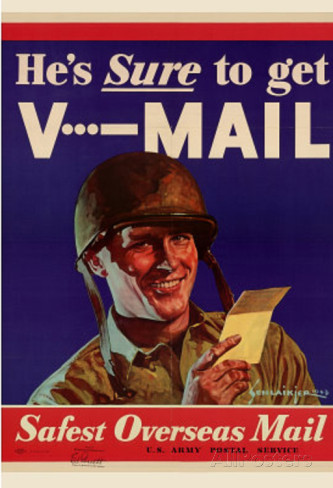
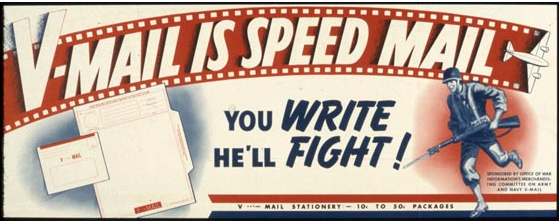
And, since this was World War II, the United States created numerous, excellent propaganda posters encouraging use of the system: