spies_of_the_kaiser
This is an old revision of the document!
Spies of the Kaiser
Plotting the Downfall of England
By William Le Queux: Author of
"The Invasion of 1910"
Contents
IF ENGLAND KNEW
THE PERIL OF ENGLAND
CHAPTER I: HOW THE PLANS OF ROSYTH WERE STOLEN
CHAPTER II: THE SECRET OF THE SILENT SUBMARINE
CHAPTER III: THE BACK-DOOR OF ENGLAND
CHAPTER IV: HOW THE GERMANS ARE PREPARING FOR INVASION
CHAPTER V: THE SECRET OF THE NEW BRITISH AEROPLANE
CHAPTER VI: THE SECRET OF THE NEW ARMOUR-PLATES
CHAPTER VII: THE SECRET OF THE IMPROVED "DREADNOUGHT"
CHAPTER VIII: THE GERMAN PLOT AGAINST ENGLAND
CHAPTER IX: THE SECRET OF OUR NEW GUN
CHAPTER X: THE SECRET OF THE CLYDE DEFENCES
CHAPTER XI: THE PERIL OF LONDON
CHAPTER XII: HOW GERMANY FOMENTS STRIFE
CHAPTER XIII: OUR WIRELESS SECRETS
CHAPTER XIV: PLAYING A DESPERATE GAME
[1]
HURST & BLACKETT'S
FAMOUS 1/3NET NOVELS
Each cloth bound, with picture
wrapper in colours.
The Publishers have pleasure in announcing the issue in
popular form of the very successful novels of
GERTRUDE PAGE
of which
Over a million copies have already been sold.
THE EDGE O' BEYOND 275th Thousand
PADDY, THE NEXT BEST THING 246th Thousand
LOVE IN THE WILDERNESS 188th Thousand
THE SILENT RANCHER 135th Thousand
THE GREAT SPLENDOUR 140th Thousand
THE RHODESIAN 139th Thousand
By AMÉLIE RIVES
(Princess Troubetzkoy)
World's End
By MAURICE LEBLANC
The Teeth of the Tiger
By RICHARD STARR
Married to a Spy
By MARGARET
PETERSON
To Love
Butterfly Wings
By WILLIAM LE QUEUX
The Man from Downing
Street
By WILLIAM LE QUEUX
Secrets of the Foreign
Office
The House of the Wicked
By BEATRICE GRIMSHAW
Red Rob of the Islands
A Story of New Guinea
By COUNTESS BARCYŃSKA
The Honey Pot
By EDNA LYALL
Donovan 300th Thousand
We Two 250th Thousand
London: HURST & BLACKETT Ltd., Paternoster House. E.C.
[2]
[3]
Spies of the Kaiser
Plotting the Downfall of England
By William Le Queux: Author of
"The Invasion of 1910"

LONDON: HURST AND BLACKETT, LTD.
PATERNOSTER HOUSE, E.C.
[4]
[5]
IF ENGLAND KNEW
No sane person can deny that England is in grave
danger of invasion by Germany at a date not far distant.
This very serious fact I endeavoured to place vividly
before the public in my recent forecast, The Invasion of
1910, the publication of which, in Germany and in
England, aroused a storm of indignation against me.
The Government, it will be remembered, endeavoured
to suppress its publication, because it contained many
serious truths, which it was deemed best should be
withheld from the public, and on its publication—in
defiance of the statements in the House of Commons,
and the pressure brought upon me by the Prime
Minister—I was denounced as a panicmonger.
But have not certain of my warnings already been
fulfilled?
I have no desire to create undue alarm. I am an
Englishman, and, I hope, a patriot. What I have
written in this present volume in the form of fiction
is based upon serious facts within my own personal
knowledge.
That German spies are actively at work in Great
Britain is well known to the authorities. The number
of agents of the German Secret Police at this moment
working in our midst on behalf of the Intelligence
Department in Berlin are believed to be over five
thousand. To each agent—known as a "fixed-post"—is
allotted the task of discovering some secret, or of
noting in a certain district every detail which may be
of advantage to the invader when he lands. This[6]
"fixed-agent" is, in turn, controlled by a travelling
agent, who visits him regularly, allots the work,
collects his reports, and makes monthly payments,
the usual stipend varying from £10 to £30 per month,
according to the social position of the spy and the work
in which he or she may be engaged.
The spies themselves are not always German.
They are often Belgians, Swiss, or Frenchmen employed
in various trades and professions, and each
being known in the Bureau of Secret Police by a number
only, their monthly information being docketed under
that particular number. Every six months an "inspection"
is held, and monetary rewards made to those
whose success has been most noteworthy.
The whole brigade of spies in England is controlled
by a well-known member of the German Secret Police
in London, from whom the travelling agents take
their orders, and in turn transmit them to the "fixed-posts,"
who are scattered up and down the country.
As I write, I have before me a file of amazing documents,
which plainly show the feverish activity with
which this advance guard of our enemy is working to
secure for their employers the most detailed information.
These documents have already been placed
before the Minister for War, who returned them without
comment!
He is aware of the truth, and cannot deny it in face
of these incriminating statements.
It is often said that the Germans do not require to
pursue any system of espionage in England when
they can purchase our Ordnance maps at a shilling each.
But do these Ordnance maps show the number of
horses and carts in a district, the stores of food and
forage, the best way in which to destroy bridges, the
lines of telegraph and telephone, and the places with
which they communicate, and such-like matters of[7]
vital importance to the invader? Facts such as these,
and many others, are being daily conveyed by spies
in their carefully prepared reports to Berlin, as well
as the secrets of every detail of our armament, our
defences, and our newest inventions.
During the last twelve months, aided by a well-known
detective officer, I have made personal inquiry
into the presence and work of these spies, an inquiry
which has entailed a great amount of travelling, much
watchfulness, and often considerable discomfort, for
I have felt that, in the circumstances, some system
of contra-espionage should be established, as has been
done in France.
I have refrained from giving actual names and
dates, for obvious reasons, and have therefore been
compelled, even at risk of being again denounced as a
scaremonger, to present the facts in the form of fiction—fiction
which, I trust, will point its own patriotic
moral.
Colonel Mark Lockwood, Member for Epping, sounded
a very serious warning note in the middle of 1908 when
he asked questions of the Minister for War, and afterwards
of the Prime Minister, respecting the presence
of German spies in Norfolk, Suffolk, Essex, and elsewhere.
He pointed out that for the past two years
these individuals, working upon a carefully prepared
plan, had been sketching, photographing, and carefully
making notes throughout the whole of East Anglia.
With truth, he declared that this organised system
of espionage was for one reason alone, namely in
preparation for a sudden raid upon our shores, for
"the Day"—as it is known in Germany—the Day
of the Invasion of England.
The replies given by His Majesty's Ministers were
colourless, though they both actually confessed themselves
unable to deal with the situation! Under[8]
our existing law it seems that a foreign spy is free to
go hither and thither, and plot the downfall of England,
while we, ostrich-like, bury our head in the sand at
the sign of approaching danger.
The day has passed when one Englishman was worth
ten foreigners. Modern science in warfare has altered
all that. All the rifle-clubs in England could not
stop one German battalion, because the German
battalion is trained and disciplined in the art of war,
while our rifle-clubs are neither disciplined nor trained.
Were every able-bodied man in the kingdom to join
a rifle-club we should be no nearer the problem of
beating the German invaders if once they landed,
than if the spectators in all the football matches held
in Britain mobilised against a foreign foe. The Territorial
idea is a delusion. Seaside camps for a fortnight
a year are picnics, not soldiering. The art of navigation,
the science of engineering, or the trade of carpentering
cannot be learned in fourteen days annually—neither
can the art of war.
In response, we have held up to us the strength
of our Navy. But is it really what it is represented
by our rulers to an already deluded public?
Only as recently as March 29, 1909, Sir Edward Grey,
replying to Mr. Balfour's vote of censure in the House
of Commons, was compelled to admit that—
"A new situation is created by the German
programme. When it is completed, Germany, a
great country close to our own shores, will have
a fleet of thirty-three Dreadnoughts, and that
fleet will be the most powerful which the world
has ever yet seen. It imposes upon us the necessity
of rebuilding the whole of our fleet. That is
the situation."
[9]
Germany is our friend—for the moment. But Prince
Buelow now admits that the Kaiser's telegram to
President Kruger was no personal whim, but the outcome
of national policy!
What may happen to-morrow?
WILLIAM LE QUEUX.
[10]
THE PERIL OF ENGLAND
WHO IS RIGHT?
SIR EDWARD GREY
In the House of Commons,
March 29, 1909.
We have been informed
verbally, but quite definitely,
that Germany will
not accelerate her naval
programme of construction,
and will not have thirteen
ships of the Dreadnought
type, including cruisers, till
the end of 1912.
PRINCE BUELOW
In the Reichstag, March 29,
1909.
Great Britain has never
made any proposals which
the German Government
regarded as a suitable
basis for negotiations.
Germany regards the question
of limitation of armaments
as outside the range
of practical politics.
WHAT THE KAISER SAYS:
His Imperial Majesty the German Emperor declared:—
The prevailing sentiment among large sections of the
middle and lower class of my own people is not friendly
to England.—Daily Telegraph, October 28, 1908.[11]
SPIES OF THE KAISER
CHAPTER I
HOW THE PLANS OF ROSYTH WERE STOLEN
"But if the new plans for our naval base at Rosyth
have already been secured by Germany, I don't see
what we can do," I remarked. "What's the use of
closing the stable-door after the horse has been stolen?"
"That's just what we generally do in England, my
dear old Jack," replied my friend. "We still think,
as in the days of Wellington, that one Englishman is
worth ten foreigners. But remember the Boer War,
and what our shameful ignorance cost us in men and
money. Now, as I explained last night in London, the
original plans of Rosyth leaked out some time ago,
and were actually published in certain Continental
papers. In consequence of this, fresh plans have
been prepared and adopted by the Lords of the Admiralty.
It is one of these which Reitmeyer informs
my father is already in German hands."
"But is not Reitmeyer a German himself?" I
asked.
"He's a naturalised Englishman," replied my friend
Ray Raymond, drawing hard at his pipe as he stretched
himself lazily before the fire of the inn-parlour. "It
was he who gave the guv'nor a good deal of the information
upon which he based those questions he
asked in the House."[12]
"The Government refused to admit that German
spies are at work in England," I said.
"Yes, Jack. That's just why I'm down here on the
Firth of Forth—in order to accomplish the task I've
set myself, namely, to prove that German secret agents
are at this moment actively at work amongst us. I
intend to furnish proof of the guv'nor's statements, and
by exposing the methods of these inquisitive gentry,
compel the Government to introduce fresh legislation in
order that the authorities may be able to deal with
them. At present spies may work their will in England,
and the law is powerless to prevent them."
I was standing with my back to the fire facing my
friend, who, a barrister like myself, shared with me a
set of rather dismal chambers in New Stone Buildings,
Lincoln's Inn, though he had never had occasion to
practise, as I unfortunately had.
As he sat, his long, thin legs outstretched towards
the fire, he presented the appearance of the typical
athletic young Englishman, aged about thirty, clean-shaven,
clean-limbed, with an intelligent and slightly
aquiline face, a pair of merry grey eyes, and light
brown hair closely cropped. He was an all-round
good fellow, even though his life had been cast in
pleasant places. Eldest son of Sir Archibald Raymond,
Bart., the well-known Cardiff coal-owner who
sat for East Carmarthen, he had been with me at
Balliol, we had read together, and though he now
shared those dingy London chambers, he resided in a
prettily furnished flat in Bruton Street, while I lived
in rooms round in Guilford Street, Bloomsbury, in my
lonely bachelordom.
He had been adopted as candidate for West Rutland
at the next election, and his party predicted of him
great things. But the long-wished-for General Election
was still afar off, therefore, with commendable[13]
patriotism, he had taken up the burning question of
German spies in England, which had been so lightly
pooh-poohed by both the Prime Minister and the
Minister for War. His intention was, if possible, to
checkmate their activity, and at the same time reveal
to the public the fool's paradise in which we are living
now that "the Day"—as they call it in Germany—is
fast approaching—the day of the invasion of Great
Britain.
— Miles N.E. of Dockyard. Half-closed redoubt
for infantry—Platforms for machine-guns
at angles—Wrought-iron palisading at bottom
of ditch.
G (in plan.) "Ferry Hills" Fort—Earth and
concrete—Very deep ditches, flanked by counterscarp
galleries and a stone caponier—Casemated—Probable
armament—Two 9.2-inch guns, six
7.5-inch guns—Wrought-iron fraise below counterscarp.
H (in plan). Evidently intended for use against
torpedo-boats and destroyers—To mount ten 4-inch
quick-firing guns—Wrought-iron palisading in
ditch well covered from seaward—Gorge closed
by stone wall (two tiers of loopholes for musketry),
flanked by caponiers with machine-guns.
I. A large and formidable work armed with—
Portion of translation of the German spy's report upon the
new naval base at Rosyth.
After Sir Archibald had put the questions in the
House, the purport of which most readers will remember,
he had been the recipient of many letters pointing out
the presence of spies—letters which, if published,
would have no doubt created a great sensation. Many[14]
of these statements Ray and I had, during the past two
months, closely investigated on the spot, and what
we had discovered held us both amazed and alarmed.
Indeed, we had secured evidence that although spies
were openly at work in certain of our eastern counties
collecting all sorts of information which would be of
incalculable importance to an invader, yet the chief
constables of those counties had actually been instructed
from head-quarters to close their eyes to the
movements of inquisitive foreigners!
In the investigations upon which Ray Raymond had
embarked with such enthusiasm, and which I am now
permitted to chronicle in these pages, he had taken
only two persons into his confidence—myself and
Vera, the pretty, fair-haired daughter of Vice-Admiral
Sir Charles Vallance, the Admiral-Superintendent of
Portsmouth Dockyard, to whom he was engaged.
Indeed, from the first I suspected that it had been
her influence that had roused him to action; she who
had promised him her assistance, and who had pointed
out how, by watching and unmasking the spies, he
might render his King and country signal service.
At dusk that day we had, on arrival from King's
Cross, left our baggage with the hall porter of the
North British Hotel in Edinburgh, had travelled from
the Waverley Station to Dalmeny, and descending the
hundred or so steps to the comfortable Hawes Inn,
at the water's edge, had dined there. Thence we had
taken the old ferry-boat over to North Queensferry,
on the opposite shore, where, in the rather bare parlour
of the little Albert Hotel, directly beneath the giant
arms of the Forth Bridge, we were resting and
smoking.
Outside the November night was dark and squally
with drizzling rain; within the warmth was cheerful,
the fire throwing a red glow upon the old-fashioned[15]
mahogany sideboard with its profuse display of china
and the two long tables covered with red cloths.
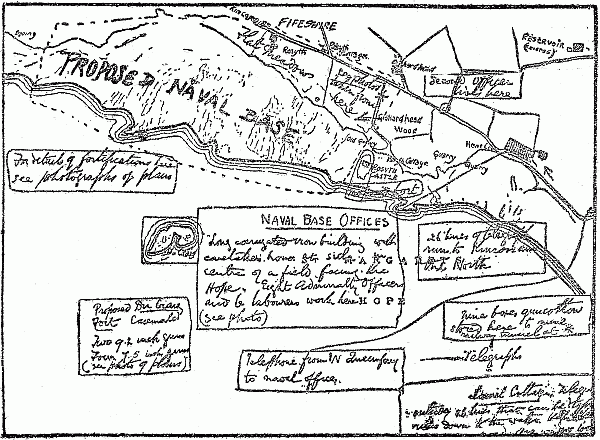 PORTIONS OF MAP OF NEW NAVAL BASE AT ROSYTH DISCOVERED IN
POSSESSION OF A SPY.
PORTIONS OF MAP OF NEW NAVAL BASE AT ROSYTH DISCOVERED IN
POSSESSION OF A SPY.
The notes, here translated from German, were written
on the British Ordnance Map.
[16]
From my boyhood days, I, John James Jacox,
barrister-at-law, had always been fond of detective
work; therefore I realised that in the present inquiry
before us there was wide scope for one's reasoning
powers, as well as a great probability of excitement.
I was thoroughly wiping my gold pince-nez, utterly
failing to discover Ray's reason in travelling to that
spot now that it was admitted that the Germans had
already outwitted us and secured a copy of at least
one of the plans. Suddenly, glancing up at the cheap
American clock on the mantelshelf, my friend declared
that we ought to be moving and at once struggled
into his coat and crushed on his soft felt hat. It then
wanted a quarter to ten o'clock.
In ascending the short, steep hill in the semi-darkness,
we passed the North Queensferry post office, beside
which he stopped short to peer down the dark alley
which separated it from the Roxburgh Hotel. I
noticed that in this alley stood a short, stout telegraph-pole,
carrying about sixty or so lines of wire which,
coming overhead from the north, converged at that
point into a cable, and crossed to the south beneath
the mile-broad waters of the Forth.
Ray was apparently interested in them, for glancing
overhead he saw another set of wires which, carried
higher, crossed the street and ran away to the left.
This road he followed, I walking at his side.
The way we took proved to be a winding one, which,
instead of ascending the steep hill with its many
quarries, from the summit of which the wonderful
bridge runs forth, skirted the estuary westward past
a number of small grey cottages, the gardens of some
of which appeared to run down to the broad waters[17]
whence shone the flashing light of the Beamer and
those of Dalmeny, the Bridge, and of South Queensferry.
The rain had ceased, and the moon, slowly struggling
from behind a big bank of cloud, now produced a most
picturesque effect of light and shadow.
The actions of Ray Raymond were, however, somewhat
mysterious, for on passing each telegraph-pole
he, by the aid of a small electric torch he carried in his
pocket, examined it carefully at a distance of about
six feet from the ground.
He must have thus minutely examined at least
fifteen or sixteen when, at the sharp bend of the road,
he apparently discovered something of which he was
in search. The pole stood close beside the narrow
pathway, and as he examined it with his magnifying-glass
I also became curious. But all I distinguished
were three small gimlet holes set in a triangle in the
black tarred wood about four inches apart.
"Count the wires, Jack," he said. "I make them
twenty-six. Am I correct?"
I counted, and found the number to be right.
Then for some moments he stood in thoughtful
silence, gazing away over the wide view of St. Margaret's
Hope spread before him.
Afterwards we moved forward. Passing along, he
examined each of the other poles, until we descended
the hill to the Ferry Toll, where the high road and
wires branched off to the right to Dunfermline. Then,
taking the left-hand road along the shore, where ran
a line of telephone, we passed some wharves, gained
the Limpet Ness, and for a further couple of miles
skirted the moonlit waters, until, of a sudden, there
came into view a long corrugated-iron building lying
back from the road facing the Forth and fenced off by
a high spiked-iron railing. The entrance was in the
centre, with nine long windows on either side, while[18]
at a little distance further back lay a small bungalow,
evidently the residence of the caretaker.
"This," exclaimed my friend without halting, "is
the much-discussed Rosyth. These are the Admiralty
offices, and from here the tracing of that plan was
obtained."
"A rather lonely spot," I remarked.
"Over yonder, beyond that ruined castle out on
the rocks, where Oliver Cromwell's mother was born,
is the site of the new naval base. You'll get a better
view from the other side of the hill," he said in a low
voice.
"Who lives in the bungalow?" I inquired.
"Only the caretaker. The nearest house is on top
of the hill, and is occupied by the second officer in
charge of the works."
Continuing our way and passing over the hill, we
skirted a wood, which I afterwards found to be Orchardhead
Wood, passed a pair of lonely cottages on the
right, until we reached a lane running down to the
water's edge. Turning into this lane, we walked as
far as a gate which commanded the great stretch of
broad, level meadows and the wide bay beyond.
Leaning over it, he said:
"This is where the new naval base is to be. Yonder,
where you see the lights, is Bruce Haven."
"Tell me the facts regarding the stolen plan as far
as is known," I said, leaning on the gate also and
gazing away across the wide stretch of moonlit waters.
"The facts are curious," replied my friend. "As
you know, I've been away from London a fortnight,
and in those fourteen days I've not been idle. It
seems that when the first plan leaked out and was
published abroad, the Admiralty had two others prepared,
and into both these a commission which came
down here has, for several months, been busily at[19]
work investigating their feasibility. At last one of
the schemes has been adopted. Tracings of it are
kept in strictest secrecy in a safe in the offices down
yonder, together with larger-scale tracings of the
various docks, the submarine station, repairing docks,
patent slips, and defensive forts—some twenty-two
documents in all. The details of the defensive forts
are, of course, kept a profound secret. The safe has
two keys, one kept by the superintendent of the works,
Mr. Wilkinson, who lives over at Dunfermline, and
the other by the first officer, Mr. Farrar, who resides
in a house half a mile from the offices. The safe cannot
be opened except by the two gentlemen being present
together. The leakage could not come from within.
None of the plans have ever been found to be missing
and no suspicion attaches to anybody, yet there are
two most curious facts. The first is that in July last
a young clerk named Edwin Jephson, living with his
mother in Netley Road, Shepherd's Bush, and employed
by a firm of auctioneers in the City, was picked
up in the Thames off Thorneycroft's at Chiswick. At
the inquest, the girl to whom the young man was
engaged testified to his strangeness of manner a few
days previously; while his mother stated how, prior
to his disappearance, he had been absent from home
for four days, and on his return had seemed greatly
perturbed, and had remarked: 'There'll be something
in the papers about me before long.' On the body
were found fourteen shillings in silver, some coppers,
a few letters, and a folio of blue foolscap containing
some writing in German which, on translation, proved
to be certain details regarding a fortress. A verdict
of suicide was returned; but the statement in German,
placed by the police before the Admiralty, proved to
be an exact copy of one of the documents preserved
in the safe here, at Rosyth."[20]
"Then the Admiralty cannot deny the leakage of
the secret?" I remarked.
"No; but the mystery remains how it came into
the young fellow's possession, and what he was about
to do with it. As far as can be ascertained, he was
a most exemplary young man, and had no connection
whatever with any one in Admiralty employ," replied
Ray; adding, "the second fact is the one alleged by
Reitmeyer, who was, in confidence, shown a photograph
of one of the larger plans."
"Then spies are, no doubt, at work here," I said.
"That cannot be denied," was his reply. "This
neighbourhood opens up a wide field of investigation
to the inquisitive gentry from the Fatherland. Knowledge
of the secrets of the defences of the Firth of
Forth would be of the utmost advantage to Germany
in the event of an invasion. The local submarine
defences and corps of submarine miners have been
done away with, yet the entrance of the estuary is
commanded by strong batteries upon the island of
Inchkeith, opposite Leith; the Forth Bridge is defended
by masked batteries at Dalmeny at the one
end and at Carlingnose at the other, while upon Inchgarvie,
the rock beneath the centre of the bridge, is
a powerful battery of six-inch guns. The true strength
of these defences, and the existence of others, are, of
course, kept an absolute secret, but Germany is equally
anxious to learn them, as she is to know exactly what
our plans are regarding this new naval base and its
fortifications."
"But if the new base were established, might not
the Forth Bridge be blown into the water by the
enemy, and our fleet bottled up by the wreckage?"
I ventured to remark.
"That's just the point, Jack," my friend said;
"whether the Rosyth works are carried out or not,[21]
the Germans would, without doubt, use their best
endeavours to blow up the bridge; first in order to
cut direct communication between north and south,
and secondly, to prevent British ships using St. Margaret's
Hope as a haven of refuge."
"And even in face of the document discovered upon
the auctioneer's clerk, the Government deny the
activity of spies!"
"Yes," said Ray in a hard voice. "A week ago
I was up here, and examined the safe in the offices
we've passed. I was only laughed at for my pains.
I must admit, of course, that no document has ever
been missing, and that the safe has not been tampered
with in any way."
"A complete mystery."
"One which, my dear Jack, we must solve," he
said, as we retraced our steps back to North Queensferry
station, where we luckily caught a train back
to Edinburgh.
Next morning we travelled again to Dalmeny, and
in the grey mist hired a boat at the slippery landing-stage
opposite the Hawes Inn. Refusing the assistance
of the boatman, Ray took off his coat and commenced
to row to the opposite shore. His action
surprised me, as we could easily have gone over by
the steam ferry. It was high tide, and by degrees as
we got into mid-stream he allowed the boat to drift
towards one of the sets of four circular caissons in
which the foundations of the gigantic bridge, with its
bewildering masses of ironwork, were set.
Against one of them the boat drifted, and he placed
his hand upon the masonry to prevent a collision.
As he did so, his keen eyes discerned something which
caused him to pull back and examine it more
closely.
As he did so, a train rumbled high above us.[22]
With curiosity I followed the direction of his gaze,
but what I saw conveyed to me nothing. About two
feet above high-water mark a stout iron staple had been
fixed into the concrete. To it was attached a piece
of thin wire rope descending into the water, apparently
used by the bridge workmen to moor their boats.
Having carefully examined the staple, Ray rowed
round to the other three caissons, a few feet distant,
but there discovered nothing. Afterwards, with my
assistance, he pulled back to the Dalmeny side, where,
at the base of one of the high square brick piers of the
shore end of the bridge, the third from the land, he
found a similar staple driven. Then we returned to
the pier and crossed to North Queensferry.
My friend's next move was to enter the post office
and there write upon a yellow form a telegram in
German addressed to a person in Berlin. This he
handed to the pleasant-faced Scotch postmistress,
who, on seeing it in a strange language, regarded him
quickly.
Ray remarked that he supposed she did not often
transmit messages in German, whereupon she said:
"Oh, yes. The German waiter up at the Golf Club
sends them sometimes."
"Is he the only German you have in North Queensferry?"
he inquired casually.
"I've never heard of any other, sir," replied the
good woman, and then we both wished her good-day
and left.
Our next action was to climb the Ferry Hill at the
back of the post office, passing the station and Carlingnose
Fort, until we reached the club-house of the
Dunfermline Golf Club, which commands a fine prospect
over the wide estuary eastward.
No one appeared to be playing that morning, but
on entering the club we were approached by a fair-headed,[23]
rather smart-looking German waiter. His
age was about thirty, his fair moustache well trained,
and his hair closely cropped.
I made inquiry for an imaginary person, and by that
means was enabled to engage the man in conversation.
Ray, on his part, remarked that he would be staying
in the neighbourhood for some time, and requested
a list of members and terms of membership. In
response, the waiter fetched him a book of rules, which
he placed in his pocket.
"Well?" I asked, as we descended the hill.
"To me," my friend remarked, "there is only one
suspicious fact about that man—his nationality."
The afternoon we spent out at the naval offices,
where I was introduced to the Superintendent and
the second officer, and where I stood by while my
friend again examined the big green-painted safe,
closely investigating its lock with the aid of his magnifying
glass. It was apparent that those in charge
regarded him as a harmless crank, for so confident
were they that no spy had been able to get at the
plans that no night watch had ever been kept upon
the place.
Through five consecutive nights, unknown to the
caretaker, who slept so peacefully in his bungalow,
we, however, kept a vigilant watch upon the place.
But in vain. Whatever information our friends the
Germans wanted they seemed to have already obtained.
Ray Raymond, however, continued to display that
quiet, methodical patience born of enthusiasm.
"I'm confident that something is afoot, and that
there are spies in the neighbourhood," he would say.
Nearly a fortnight we spent, sometimes in Edinburgh,
and at others idling about North Queensferry
in the guise of English tourists, for the Forth Bridge
is still an attraction to the sightseer.[24]
Upon the German waiter at the Golf Club Ray was
keeping a watchful eye. He had discovered his name
to be Heinrich Klauber, and that before his engagement
there he had been a waiter in the basement café
of the Hôtel de l'Europe, in Leicester Square, London.
His movements were in no way suspicious. He
lived at a small cottage nearly opposite the post office
at North Queensferry with a widow named Macdonald,
and he had fallen in love with a rather pretty dark-eyed
girl named Elsie Robinson, who lived with her
father in the grey High Street of Inverkeithing. As
far as my observations went—and it often fell to my
lot to watch his movements while Ray was absent—the
German was hardworking, thrifty, and a pattern
of all the virtues.
One evening, however, a curious incident occurred.
Ray had run up to London, leaving me to watch
the German's movements. Klauber had returned to
Mrs. Macdonald's about eight, but not until nearly
eleven did he come forth again, and then instead of
taking his usual road to Inverkeithing to meet the
girl Robinson, he ascended the hill and struck across
the golf-course until he had gained its highest point,
which overlooked the waters of the Forth towards the sea.
So suddenly did he halt that I was compelled to
throw myself into a bunker some distance away to
escape detection. Then, as I watched, I saw him
take from his pocket and light a small acetylene lamp,
apparently a bicycle-lamp, with a green glass. He
then placed it in such a position on the grass that it
could be seen from far across the waters, and lighting
a cigarette, he waited.
The light on the Oxcars was flashing white and red,
while from distant Inchkeith streamed a white brilliance
at regular intervals. But the light of Heinrich
Klauber was certainly a signal. To whom?[25]
He remained there about half an hour, but whether
he received any answering signal I know not.
Next night and the next I went to the same spot,
but he failed to put in an appearance. Then, in
order to report to Ray, I joined the morning train
from Perth to London.
On arrival at New Stone Buildings I telephoned to
Bruton Street, but Chapman, his valet, told me that
his master had slept there only one night, had received
a visit from a respectably dressed middle-aged woman,
and had gone away—to an unknown destination.
Therefore I waited for a whole week in anxiety and
suspense, until one morning I received a wire from
him, despatched from Kirkcaldy, urging me to join
him at once at the Station Hotel in Perth.
Next morning at nine o'clock I was seated on the
side of his bed, telling him of the incident of the
lamp.
"Ah!" he exclaimed after a pause. "My surmises
are slowly proving correct, Jack. You must
buy a bicycle-lamp down in the town and a piece of
green glass. To-night you must go there at the same
hour and show a similar light. The matter seems
far more serious than I first expected. The enemy is
no doubt here, in our midst. Take this. It may be
handy before long," and he took from his kit-bag a
new .32 Colt revolver.
By this, I saw that he had resolved upon some bold
stroke.
That evening, after an early dinner at the hotel,
we took train to North Queensferry, and on alighting
at the station he sent me up to the golf-links to show
a light for half an hour; promising to meet me later
at a certain point on the road to Rosyth.
I gained the lonely spot on the golf-course and duly
showed the light. Then I hastened to rejoin my[26]
friend at the point he indicated, and found him awaiting
me behind some bushes.
Almost at the moment we met, a female figure came
along beneath the shadow of a high wall. She was
a poorly dressed girl, but the instant she addressed
my friend I recognised by her refined voice that it
was Vera, the dainty daughter of the Admiral
Superintendent.
"Elsie is waiting down by the Ferry Barns," she
said quickly, in a low whisper, after greeting me.
"Heinrich has not kept his appointment with her."
"You have the note?" he asked. "Recollect
what I told you concerning the man Hartmann."
"Yes," she replied. Then, addressing me, she said,
"Take care of these people Mr. Jacox. They are
utterly unscrupulous"; and she again disappeared
into the darkness.
Ray and I turned and again walked back in the
direction of Rosyth. But when we had gone a little
distance he told me to approach the naval offices
carefully, conceal myself in the bushes, and watch until
he joined me. On no account was I to make any sign,
whatever I might witness.
Though intensely cold the night was not very dark,
therefore I was not long in establishing my position at
a spot where I had a good view of the offices. Then I
leaned upon a tree-trunk and waited in breathless expectation.
I touched my father's old repeater which
I carried and found it to be a quarter past midnight.
For over an hour I remained there, scarce daring
to move a muscle.
Suddenly, however, upon the mud at the side of the
road I heard soft footsteps, and a few moments later
two figures loomed up from the shadow. But when
about forty yards from the offices they halted, one
of the men alone proceeding.[27]
With great caution he climbed the spiked railing,
and crossing rapidly to the main door of the offices
he unlocked it with a key and entered, closing the
door after him. As far as I could distinguish, the
man wore a short beard, and was dressed in tweeds
and a golf cap. Holding my breath, I saw the flashing
of an electric torch within the building.
Fully twenty minutes elapsed before he reappeared,
relocked the outside door, and clambering back over
the railings, rejoined his waiting companion, both
being lost next second in the darkness.
I longed to follow them, but Ray's instructions had
been explicit—I was to wait until he arrived.
Half an hour later, hearing his low whistle, I emerged
from my hiding-place to meet him and tell him what
I had seen.
"Yes," he said, "I know. We have now no time to
lose."
And together we hurried back over the road towards
North Queensferry.
At the same spot where Vera had met us, we found
her still in hiding. My friend whispered some words,
whereupon she hurried on before us to the sharp
bend in the road where stood the telegraph-pole
which had attracted Ray on the night of our first
arrival.
We drew back in the shadow, and as we did so I
saw her halt and pull the bell beside a small gate in a
high wall. Behind stood a white-washed cottage,
with a good-sized garden at the rear. One end of the
house abutted upon the pathway, and in it was one
small window commanding a view of the road.
Vera, we saw, had some conversation with the old
woman who answered her ring, and then went in, the
gate being closed after her.
Together we waited for a considerable time, our[28]
impatience and apprehension increasing. All was
silent, except for a dog-cart, in which we recognised
Mr. Wilkinson driving home from the station.
"Curious that Vera doesn't return," Ray remarked
at last, when we had waited nearly three-quarters of
an hour. "We must investigate for ourselves. I
hope nothing has happened to her."
And motioning me to follow, he very cautiously crept
along the muddy path and tried the gate. It had been
relocked.
We therefore scaled the wall without further ado,
and, standing in the little front garden, we listened
breathlessly at the door of the house.
"Get back there in the shadow, Jack," urged my
friend; and, as soon as I was concealed, he passed
his hand along the lintel of the door, where he found
the bell-wire from the gate. This he pulled.
A few moments later the old woman reappeared at
the door, passing out towards the gate, when, in an
instant, Ray and I were within, and flinging open a
door on the left of the narrow passage we found ourselves
confronted by the exemplary waiter Klauber
and a companion, whose short beard and snub nose I
recognised as those of the man who so calmly entered
the naval offices a couple of hours before.
For them our sudden appearance was, no doubt, a
dramatic surprise.
The elder man gave vent to a quick imprecation
in German, while Klauber, of course, recognised us
both.
In the room was a large camera with a flashlight
apparatus, while pinned upon a screen before the
camera was a big tracing of a plan of one of the chief
defensive forts which the spies had that night secured
from Rosyth, and which they were now in the act of
photographing.[29]
"A lady called upon you here an hour ago," exclaimed
Ray. "Where is she?"
"No lady has called here," replied the bearded
German in very good English, adding with marvellous
coolness, "To what, pray, do we owe this unwarrantable
intrusion?"
"To the fact that I recognise you as Josef Scholtz,
secret agent of the German Naval Intelligence Department,"
answered my friend resolutely, closing the
door and standing with his back to it. "We have met
before. You were coming down the steps of a house
in Pont Street, London, where lives a great friend of
yours, Hermann Hartmann."
"Well?" asked the German, with feigned unconcern,
and before we could prevent him he had torn the tracing
from the screen, roughly folded it, and stuffed it into
his pocket.
"Hand that to me," commanded my friend quickly.
But the spy only laughed in open defiance.
"You intended, no doubt, to replace that as you
have done the others after photographing them. Only
we've just spoilt your game," Raymond said. "Both
Mr. Wilkinson and Mr. Farrar are, I see from the list,
members of the Golf Club where you"—and he looked
across to the waiter—"are employed. On one occasion,
while Mr. Wilkinson was taking a bath after a game, and
on another while Mr. Farrar was changing his coat and
vest, you contrived to take wax impressions of both
the safe keys and also that of the door of the offices.
The keys were made in Glasgow, and by their means
the plans of our new naval base and its proposed
defences have been at your disposal."
"Well—there's no law against it!" cried Scholtz.
"Let me pass."
"First give me that tracing," demanded my friend
resolutely.[30]
"Never. Do your worst!" the German replied,
speaking with a more pronounced accent in his excitement,
while at the same moment I saw that he held
a revolver in his hand.
In an instant Ray drew his own weapon, but, instead of
covering the spy, he pointed it at a small, strong wooden
box upon the floor in the opposite corner of the room.
"Gott—no!" gasped the man, his face blanching
as he realised Ray's intention. "For Heaven's sake
don't. I—I——"
"Ah!" laughed my friend. "So it is as I thought.
You two blackguards, with some of your friends, I
expect, have been secretly preparing for the destruction
of the Forth Bridge on 'the Day'—as you are so fond
of calling it. The staples are already driven in, and
the unsuspicious-looking wire ropes, attached to which
the boxes of gun-cotton and other explosives are to
be sunk between the four caissons, are all in readiness.
The boat from a German merchant vessel off Leith,
signalled at intervals by your assistant Klauber, has
been bringing up box after box of that dangerous stuff
and landing it at the bottom of this garden; so that
within an hour of receiving the code-word from your
chief, you would be able to wreck the whole bridge
and blow it into the water!"
The spy endeavoured to pass, but seeing Ray's determined
attitude, held back, and my friend compelled
him to lay down his weapon.
"Jack," said my friend, "just see what's in that
box."
I at once investigated it, and discovered within only
innocent-looking tin boxes of English biscuits. The
three tins at the top I lifted out and placed on the
floor, but those below I found were filled with circular
cakes of what looked like felt, about an inch in thickness,
each with a hole through it, and with a small[31]
cavity for the reception of the detonator. I showed
it to Ray, pointing out that, packed with it, were several
smaller tins, like boxes of cigarettes.
"Yes. I see!" he exclaimed as I opened one.
"Those are the detonators, filled with fulminate of
mercury."
"Let us pass!" cried both the spies.
"Not before you are searched shall you leave this
house!" was the quick reply. "If you resist, I shall
fire into one of those boxes of detonators, and blow
you to atoms."
"And yourselves also!" remarked Klauber, his
face pale as death.
"It will at least prevent our secrets falling into your
hands, and at the same time bring the truth home to
the British Government!" was my friend's unwavering
answer.
Next moment both men made a dash towards the
door, but I had drawn my weapon and was upon my
guard. There was a flash, followed by a deafening
report, as Ray fired at the box, aiming wide on purpose.
Then the two spies, seeing that they had to deal with
a man who was a patriot to his heart's core, realised
that their game was up.
Sullenly Scholtz put down his weapon, and I searched
both men.
From the pocket of the exemplary waiter I drew
forth a rough plan, together with some scribbled notes
in German, which afterwards proved to be a description
of the forts on Inchkeith, while from the pocket
of Scholtz I secured the tracing he had stolen from
Rosyth.
Then we allowed both the secret agents of the Kaiser
to pass out, much to the consternation and alarm of
the deaf old Scotchwoman, who had, at their request,
posed as the occupier of the cottage, but who, in perfect[32]
ignorance of what was in progress, had acted as their
housekeeper.
A swift examination of the premises revealed no
trace of Vera. But we found in the cellar below the
room where we had found the spies a great store of
gun-cotton and other high explosives of German
manufacture, intended for the wrecking of the bridge;
while in an old battered portmanteau in one of the
upstairs rooms we also found, all ready for conveyance
to Germany, a quantity of prints from the photographic
negatives in the room below—photographs of nearly
the whole of the plans of Rosyth, and more especially
of its proposed forts—which the men had been in the
habit of abstracting at night and replacing in the safe
before dawn.
Ray Raymond was in active search of something
else besides, and at length discovered what he sought—two
German military telegraph instruments, together
with a complete and very ingenious arrangement for
the tapping of wire.
"By Jove!" exclaimed my friend, who took a keen
interest in all things electrical. "This will now come
in very handy!"
And on going outside to the telegraph pole against
the wall, he clambered up it and attached wires to two
of the insulators. Then descending, he screwed a little
brass box upon it into those same three holes in the
black wood which had attracted him on the night of our
arrival, and a moment later began manipulating the key.
"Good!" he exclaimed at last. "I've picked up
Inverkeithing, and asked them to send the police over
at once. We mustn't leave the place and risk the spies
returning for any of their paraphernalia. The disappearance
of Vera, however, worries me. I sent her
here with a note purporting to come from the chief
of the German Secret Service in England, Hermann[33]
Hartmann; but she has vanished, and we must, as
soon as the police arrive, go in search of her."
So completely had we unmasked the spies that I
stood puzzled and amazed.
Ray, noticing my attitude, made explanation.
"Several of my surmises in this case proved entirely
correct," he said. "My first suspicion was aroused
that if spies were about, they would probably prepare
for tapping the telegraph lines, and, as you know, I
soon discovered evidence of it. Then those staples
in the foundations of the bridge gave me a further
clue to the work in progress, a suspicion greatly
strengthened by the signal light shown by the man
Klauber. The two men who held the safe keys being
members of the Golf Club aroused a theory which
proved the correct one, and on tracing back the career
of the waiter I made a remarkable discovery which
left no doubt as to his real profession. It seems that
while employed at the Café de l'Europe in London, he
lodged at the house of Mrs. Jephson, in Shepherd's
Bush, and became extremely friendly with the widow's
son. Now you'll remember that a few days before
the poor fellow's death he was absent mysteriously,
and on his return he told his mother in confidence
that there would shortly be something in the papers
about himself. Well, the truth is now quite plain.
During his absence he evidently came up here. Young
Jephson, who knew German, had found out that his
German friend was a spy, and had no doubt secured
the document afterwards found upon him as evidence.
Klauber was ignorant of this, though he suspected
that his secret was out. In deadly fear of exposure, he
then plotted to silence the young Englishman, inducing
him to walk along the towing-path between Hammersmith
and Barnes, where he no doubt pushed him into
the river. Indeed, I have found a witness who saw[34]
the two men together in King Street, Hammersmith,
on the evening of the poor fellow's disappearance.
The plan which Reitmeyer saw is, I find, fortunately
one of the discarded ones."
"Extraordinary!" I declared, absorbed by what
he had related. "But while you've wrested from
Germany the secrets of some of our most important
defences, you have, my dear Ray, temporarily lost
the woman you love!"
"My first duty, Jack, is to my King and my country,"
he declared, sitting on the edge of the table in the
spies' photographic studio. "I have tried to perform
it to-night, and have, fortunately, exposed the German
activity in our midst. When the police arrive to
view this spies' nest, we must at once search for
her who is always my confidante, and to whose
woman's wits and foresight this success is in no small
measure due."
CHAPTER II
THE SECRET OF THE SILENT SUBMARINE
"It's a most mysterious affair, no doubt," I remarked.
"Has anything further been discovered?"
"Yes, Jack," replied my friend Ray Raymond,
rolling a fresh cigarette between his fingers. "On
investigation, the mystery grows more complicated,
more remarkable, and—for us—much more interesting."
We were seated together in our dismal chambers in
New Stone Buildings, Lincoln's Inn, one wet afternoon
about six weeks after the Forth Bridge affair. With
us, lolling in the shabby old easy chair beside the fire,[35]
sat Vera Vallance, in a big black hat, with her muff
and coat thrown aside. Her disappearance at North
Queensferry had been of only brief duration, for we
had discovered her hiding at the bottom of the long
garden, close to the water's edge, watching the landing
of two small boxes from a boat. It appeared that
the two men, Scholtz and Klauber, on receipt of the
note purporting to come from their director, Hermann
Hartmann, in London, had asked her to wait in an
adjoining room while they wrote a reply. But from
there she had slipped out, and concealed herself in the
garden to wait and watch.
Half an hour ago she had come to my gloomy chambers
with her fiancé, in order, as he explained, to
consult with us. She was at present on a visit to her
married sister who lived in Argyll Road, near Kensington
High Street, hence they were daily in each other's
company.
"You see, Jack, very little has been allowed to leak
out to the papers," Ray exclaimed as he lit his cigarette
and took up a position with his back to the fire. "As
soon as I read of the discovery I ran down to Scotland
Yard, saw Evans, and explained my theory. He was
inclined to agree with me, and at once gave orders
that no facts were to be given to the Press. Upon
complete secrecy, our success now depends."
"I only know what I've read in the papers," I
remarked.
"Tell us the whole facts, Ray," urged the pretty
fair-haired girl, who sat with her veil raised and her
long white gloves laid across her knees.
"Well, dear, they are briefly as follows," he replied,
with an affectionate glance at her. "Last Thursday
afternoon, on the arrival at 4.51 of a train from Guildford
at Vauxhall, the ticket-collector discovered lying
on the floor of a third-class compartment a middle-aged,[36]
respectably dressed man in an apparently dying
condition. The police were called, and he was conveyed
to St. Thomas's Hospital, where it was found that he
was suffering from a severe fracture of the skull, the
wound having been inflicted probably with a loaded
stick or a life-preserver. There was a severe cut over
the right eye and a great gash down the left cheek.
The man was unconscious, and still remains so. The
doctors have grave doubts whether, even if he recovers,
his mind will not be permanently affected.
In all probability he will never regain his right
mind."
"Terrible!" ejaculated Vera.
"Yes. A case of attempted murder, no doubt,"
he said. "But what first attracted my notice was
the statement that the man had been identified as
Max Steinheim, a German hairdresser employed in
a shop in New Bond Street, who had been missing for
nearly two months. He resided in Hargwynne Street,
Stockwell, and as he owed a considerable sum to his
landlady, she had given notice to the police of his
disappearance. It was she who had identified him
in the hospital."
"That's as far as the information conveyed by the
newspapers carries the affair," I remarked.
"Exactly. But we are able to proceed a little
farther, to a matter which must be closely investigated,"
continued Raymond. "On the arrival of the
train at Waterloo the compartment, which showed
signs of a desperate struggle, was searched, and under
the seat was discovered a small piece of paper tightly
screwed up into a small ball as though somebody
wished to get rid of it unobserved. Upon it, in a
distinctly foreign hand, and in violet ink—which, by
the way, is seldom used by Englishmen—were traced
some cryptic memoranda, a copy of which I have[37]
here," and he handed for our inspection a piece of
paper which presented this appearance:
J 11864! 19505
Kingscliffe
12.15 train St. Pancras
M.R. Weldon and Corby 1 mile
Royal Pier 18
6.11
248 and 392
Harpur Street 2.30
? 8.88 M. 88
Elmar 39 X clock.
"You've endeavoured to decipher it, of course,"
I remarked, as both Vera and I gazed at the puzzling
array of numerals and words.
"I have. For the past three days I've indeed done
nothing else. Unfortunately the result is not very
reassuring," he answered. "Deciphered by one of
the little-known codes, the figures 19505 stand for
'January 24th,' which is four days before the murderous
assault. Kingscliffe is the name of a village in
Northamptonshire, on the North Western line between
Peterborough and Rugby. The 12.15 from St. Pancras
is a restaurant train for Derby, and takes passengers
to Weldon and Corby station, by changing at Kettering,
and the distance '1 mile' would bring the traveller
to the village of Great Weldon."
"Royal Pier sounds like the name of a hotel," I
remarked.
"No doubt. But there are a good many Royal
Pier hotels in England, so there we are confronted
with a difficulty. To what 6.11 refers I cannot conceive,
while Harpur Street, which is off Theobalds
Road, I visited yesterday, but I find there are no such[38]
numbers as 248 or 392. The next line is unintelligible,
but if I read the last line aright it is an appointment
made beneath the clock at Charing Cross Station at
six."
I drew hard at my pipe. That strange document
presented to me a very complicated puzzle.
"It seems to refer to some district in Northamptonshire,
yet he was attacked coming up from Guildford,
on the South Western line!" Vera remarked. "Is
your only suspicion based upon the fact of the injured
man's nationality, Ray?"
"That, combined with other circumstances," he
replied. "As soon as I read the first announcement
in the papers, I went down to Guildford and there
ascertained that the injured man arrived at the Angel
Hotel in a motor-car about one o'clock. The chauffeur
remarked to the ostler that he had come up from the
south coast, and after having a drink he started off
on the return journey. Steinheim had luncheon upstairs,
took his coffee and cigarette in the little room
below, and idled about, telling the lady bookkeeper
of the hotel that he was expecting a friend. The
friend in question did not, however, arrive, therefore
he walked down to the station, and left at 4.13 for
London. A porter remembers seeing him alone in
the compartment, and it seems quite certain that, on
starting from Guildford, he was still alone. The train
was an express, and timed not to stop anywhere from
Guildford to Vauxhall, but, from the railway officials,
I find that it was pulled up by signal about a mile
from Esher, in which time he may have been joined
by some one from the adjoining compartment."
"Then your theory is that the man who attacked
this mysterious German got back again to his carriage,
and alighted at Vauxhall," I said.
"I certainly think so, for the driver says that outside[39]
Clapham Junction the signals were against him,
and he pulled up."
"It's a pity he has not sufficiently recovered to
make any statement."
Ray smiled grimly.
"He would never do that, I think," he said. "It
is to his advantage to conceal the facts, if my deductions
prove correct."
"Are those all the known circumstances?" I inquired,
much interested.
"There is one other. A week after the man's disappearance
from Stockwell, his landlady received a
letter bearing the postmark of Crawley in Sussex,
telling her not to trouble on his account. He wrote:
'I am engaged upon an important mission, but shall
return home within ten days, when I will pay all I
owe you. Do not trouble after me. Burn this letter
as soon as you have read it.—Max Steinheim.' The
other fact I learned from the man's employer, an
Englishman in New Bond Street. It appears that
to the establishment there often came a stout, well-dressed,
prosperous-looking German gentleman who
waited for Steinheim to shave him, or cut his hair,
and on such occasions it was noticed that they exchanged
whispered words in their own tongue."
"Well?" asked Vera, looking up at her lover.
"The stout German's description tallies exactly
with that of Hermann Hartmann."
"Ah! I see," I remarked. "You've certainly not
been idle, Ray." And with my eyes fixed upon that
puzzling array of figures and words, I added, "If we
could only decipher the whole of these we might
elucidate the truth."
"The injured man's knowledge of Hartmann, the
crafty chief of the German Secret Service in London,
is certainly suspicious," Vera remarked. "But cannot[40]
some information be gathered from the landlady at
Hargwynne Street? He may have had visitors there."
"And if he did, they would speak in German, which
the good lady could not understand," her lover replied
thoughtfully, contemplating the end of his cigarette.
"There could be no harm in seeing the good lady,"
the girl remarked. "I'll go over to-morrow and have
a chat with her."
"And in the meantime Jack and I will pursue another
line of inquiry," remarked my friend.
Vera rose, a tall, fair-haired, and sweet-faced figure
in black, and seating herself at the table, served us our
tea. She was no stranger at our chambers, and as
an Admiral's daughter, the question of German spies
in England, which her lover had taken up so strongly,
interested her most keenly. The Forth Bridge peril had
already impressed a great and serious truth upon the
Government, but Ray Raymond's success had only whetted
his appetite for further exploration and discovery.
Therefore on the following morning I called at his
chambers in Bruton Street—a tastefully furnished
bachelor suite, the art green and blues of which were
scarcely in keeping with his serious, earnest character—and
together we drove in a taxi-cab to St. Thomas's
Hospital, where, in the accident ward, we stood at
the bedside of the mysterious Steinheim. His head
was enveloped in surgical bandages, but during the
night he had regained consciousness. To the questions
we put to him, however, we obtained no satisfactory
replies. His mind seemed to be a perfect blank as to
what had occurred.
Ray read the copy of those cryptic figures upon the
scrap of paper found in the railway carriage. When
my friend pronounced the name of the station "Weldon
and Corby," the invalid's big grey eyes started from
his head as he exclaimed in German:[41]
"Ah! Yes—yes. At Weldon. She was at
Weldon!"
Who was "she"? In vain we tried to wring from
him some reply to this question, but, alas! in vain.
Mention of Hermann Hartmann, the ingenious and
fearless secret agent who controlled so cleverly the
vast army of German spies spread over our smiling
land of England, brought no responsive expression
to the man's white, drawn face. It was indeed apparent
that his intention was to hold back at all hazards the
truth regarding the murderous attack upon him.
Perhaps he himself was guilty of some offence, or
perhaps he intended to hold his peace then and to
retaliate at a moment when his assailant thought
himself most secure.
He was a big, burly, strong-featured man, just the
type of heavy-limbed German who might be expected
to bear a murderous malice against any who did him
injury.
"I feel more than ever convinced that Hartmann
is at the bottom of the curious affair," Ray declared,
as we walked together across Westminster Bridge
and I crossed with him to the St. Stephen's Club, at
the corner of the Embankment. "As far as I can
discover, the man was always in possession of ample
funds. Yet to his landlady he was careful never to
reveal that he had money. There was, no doubt,
some hidden reason for this, as well as for the letter
he wrote to the woman after his departure."
"The mystery surrounding the affair grows more
fascinating as we proceed," I declared.
"And if the deduction I have made this morning
proves to be the correct one, Jack, the mystery will
still increase. There's some very crooked business
in progress, depend upon it."
That afternoon I had to make an application in the[42]
Chancery Court, therefore it was not until after dinner
that I again sat in one of the green velvet chairs in his
art-green sitting-room.
Contrary to his usual habit, he had not dressed, but
still wore the brown tweed suit which he had had on
in the morning.
"You've brought what I asked you over the
'phone?" he inquired, as soon as I entered.
"Yes," I replied, opening the well-worn leather
brief bag which I carried, and displaying a dark
lantern, a coil of strong silk rope, and a small but
serviceable jemmy. All that burglarious outfit belonged
to my friend.
"Right," he exclaimed, stroking his smooth-shaven
chin. "Have a pipe. We'll leave here about ten.
We are going to spend the night in Pont Street."
And he pointed to a silver flask and a paper of sandwiches
upon the sideboard. "Vera has seen the landlady
in Stockwell, but can make nothing of her. She's
as deaf as a post. She returned home to Portsmouth
to-night."
We smoked together until ten, he consuming cigarette
after cigarette in that quick, nervous manner
which showed the volcano of excitement raging within
him.
"I can't think why the mention of Weldon and
Corby should have so excited our friend this morning.
To me it seemed as though he retained rather bitter
memories of the place."
"And there was a woman in the case, without a
doubt."
"I think, Jack, I shall go down there and have a
look round as soon as I have a chance. From the
ordnance map this place seems quite a small one. The
station is at Corby, while Little Weldon and Great
Weldon are about a mile distant."[43]
"There's just a chance, of course, that you might
pick up something there," I remarked.
"And yet what I surmise leads me in entirely an
opposite direction. There are no defences or secrets
in Northamptonshire, remember."
Once more he took from his writing-table the piece
of paper whereon was a copy of the strange array of
figures found in the railway carriage at Waterloo.
But at last he shook his head and laid it aside with a
sigh. The mystery remained as complete as ever.
"There's a good deal that's suspicious about Hartmann.
I suppose that's why we are going to Pont
Street?" I remarked.
"Yes. As I've explained, he's believed to be a money-lender
with an office in Cork Street, and is registered
as such, in order that no one should be surprised at
the constant callers at his house. He receives visits
from all sorts and conditions of men—and women,
but observation which I have placed upon the house
has convinced me that the majority of these people
are German agents of whom he is the guiding spirit
and paymaster, and among whom he is all-powerful.
Payment is made through him for all confidential
services rendered to the Fatherland."
"And the police do not suspect it?"
"My dear fellow, have not the police received orders
from our Government to close their eyes to the doings
of these gentry? England is the paradise of the spy,
and will remain so until we can bring pressure to bear to
compel the introduction of fresh legislation against them."
Soon after half-past ten a taxi-cab deposited us in
Sloane Street, and together we turned into Pont
Street, walking leisurely past a medium-sized red-fronted
house approached by a flight of steps leading
to a deep portico. There was a light in the first-floor
window of what was evidently the drawing-room[44]
but the rest of the house of the arch-spy of Germany
was in darkness.
As we passed the house, my friend examined its
highly respectable exterior. Then we passed on to
the end of the thoroughfare, in order to attract no
attention. A constable passed us, and in order to
avoid being noticed we walked together for some
distance. Presently, however, Ray turned back, and
gaining the house adjoining Hartmann's, ran swiftly
up the steps into the shadow of the portico, I following
at his heels.
In a few seconds he had opened the door with a
latch-key he carried in his hand, and next moment
we were within the wide, echoing hall, for the house
was empty, and to let.
"I called upon the agent, and had a look over this
place a few days ago," he explained. "On that
occasion, I had the key in my hand for a moment,
and obtained an impression of it," and switching on
his electric torch he showed the square hall with the
flight of stairs ascending from it.
Gaining the big drawing-room, Ray crossed to the
long French window on the left and gazed cautiously
out upon the street below.
As he did so I noticed the figure of a man in a dark
overcoat and felt hat cross from the opposite pavement
and ascend the stairs of the house next door. Ray
glanced at his watch, which he could see by the light
of the street lamp outside. Noticing the time, he
became reassured.
"You see, Jack, that from here runs a balcony leading
to that of Hartmann's house. We must creep along
it and try and get a peep of our friend at home. I've
watched that drawing-room window for a long time,
and I believe that he makes it his business room."
Carefully he unfastened the French window, and[45]
bending low so as to escape the observation of any
person passing by, we both crept along the narrow
balcony until, by swinging from one balustrade to the
other, we found ourselves standing over Hartmann's
portico.
Even from where we stood we could hear voices.
Forward we crept again until we were outside the
windows of the drawing-room, crouching so that no
inquisitive policeman could detect us.
The blind of the window at which I listened did not
fit well, therefore, through the small crack, I was
enabled to peer within. The room was a large, well-furnished
one with a fire burning brightly; near it
stood a large roll-top writing-table at which sat a
fat, flabby, sardonic-faced man of about fifty-five.
He had grey eyes full of craft and cunning, a prominent
nose, and a short-cropped grey beard. Ray
whispered that it was the great Hartmann.
Near the fire, seated nervously on the extreme edge
of a chair, was a respectably dressed man, a German
evidently, with his hat in his hand. The man presented
the appearance of a hard-working mechanic, and was
obviously ill at ease.
We watched them in conversation, but could not
distinguish one single word of what was said. All
we could gather was that the fat man was overbearing
in his manner, and that the visitor was most humble
and subservient against his will.
For a full half-hour we watched, but unable to gather
anything further, we were compelled to return to the
house next door and regain the street, where for still
twenty minutes longer we waited for the visitor's exit.
When at last he came forth we followed him to the
corner of Knightsbridge, opposite the Hyde Park Hotel,
where he boarded a motor-bus, from which he eventually
descended at the corner of Gray's Inn Road[46]
walking thence to a house in Harpur Street, Bloomsbury,
where we later on discovered he lodged, under
the name of Leon Karff.
The nature of the mission entrusted to this man, if
one had actually been entrusted to him, was a mystery,
yet it was a curious fact that "Harpur Street" appeared
upon that scrap of paper which to us was such
an enigma.
Next morning at six o'clock, I was already idling,
at the corner of Harpur Street and Theobalds Road,
but not until three hours later did the foreigner emerge
and walk toward Holborn. Thence he took a motor-bus
back to Sloane Street, and calling upon Hartmann,
spent another half an hour with him.
And afterwards he went straight home. It was then
about noon, and having an engagement in Court, I
was compelled to relinquish my vigil. But at a little
after five Ray entered our chambers, exclaiming:
"As I expected! That man Karff has been to see
Steinheim in the hospital. I was there awaiting him,
believing that he might visit him. Apparently the
injured man has given him certain instructions."
"About what?"
Ray shrugged his shoulders in blank ignorance.
Then he said, "We have advanced one step toward
the solution of the problem, my dear Jack. But we
have not gone very far."
He took the copy of the cryptogram from my
writing-table and again examined it. The figures
"6.11" puzzled him. Many times he referred to them.
Four days passed, during which we kept strict
observation upon Karff and followed him wherever he
went. On the fifth day, Ray having spent all the
morning watching him, to relieve him I walked along
the Theobalds Road a few minutes before one and
paused, as usual, before the oil shop at the corner.[47]
There was no sign of my friend, and though I waited
through the whole of that cold afternoon and evening,
continuing my wearisome vigil till midnight, yet he
did not come.
Much surprised, I returned to New Stone Buildings,
where I found a telegram from Ray, sent from Waterloo
Station at three o'clock, telling me that all was
right, and urging me to await further information.
This I did. For a whole week I possessed myself
in patience, not knowing where Ray was or what had
befallen him. That he was on the trail of a solution
of the mystery was evident, but he sent me no word
of his whereabouts.
It was apparent, however, that he was no longer in
London.
Eleven days after his disappearance I one afternoon
received another telegram, which had been handed in
at Chichester, asking me to go at once to the Queen's
Hotel at Southsea, where he would meet me at ten
o'clock that night.
At the hour appointed I awaited him in my bedroom
overlooking Southsea Common and the harbour, and
at last he joined me. I saw by the serious expression
upon his face that something unusual had happened.
"The fellow Karff has realised that I'm following
him, Jack. Therefore you must take the matter up.
He's in the service of a greengrocer in Queen Street,
close to the Hard. I haven't yet discovered his game."
Thus there was left to me a very difficult matter, a
mystery which I exerted every effort to unravel. For
the next fortnight I watched the fellow incessantly,
being relieved sometimes by the pretty daughter of
the Admiral Superintendent, whose home was fortunately
in the Dockyard. In all weathers and at all
times we watched, but we failed to discover anything.
Ray remained at the hotel impatient and inactive,[48]
and I must admit that more than once I was inclined
to believe that he had been mistaken in his surmises.
Leon Karff was, as far as we could discover, a hard-working
foreigner, driven by force of circumstances
into adopting the lowly calling of a greengrocer's assistant.
His employer supplied with fruit and vegetables
the officers' messes of several of the ships in the Dockyard,
and on infrequent occasions he drove in the light
cart with his master when on his rounds taking orders.
This round at last he was in the habit of making
three times a week.
One Saturday morning, as I was idling along the
Hard, I saw Karff and his master, a man named
Mitchell, drive in past the policeman at the main
gate. But though I waited for over three hours to
watch their exit, they did not reappear.
Much surprised at this, I walked round to the Unicorn
Gate, at Landport, where, on making judicious inquiries
of the policeman on duty, I learnt that Mitchell had
driven out—but alone! His assistant, he said, had
been sent back on foot with a message through the
main gate just when the dockyard men or "maties,"
as they are called, were leaving work at midday.
Now having stood at that gate when the throngs
had poured forth, I was quite certain he had not
emerged. But I kept my own counsel, and returned
to Southsea, deep in my own reflections.
On taking counsel with Ray, he at once telephoned
to Vera at Admiralty House, and an hour later we all
three discussed the situation, it being arranged that
the Admiral's daughter should contrive to admit us
to the Dockyard that night, when all was quiet, in
order that we might institute a search for the missing
German.
Therefore, just before half-past eleven, we halted
before the small private door in the Dockyard wall,[49]
used by the Admiral-Superintendent and his household,
and as the clock struck the door opened, revealing
Vera. Next instant we were within the forbidden zone.
The night was frosty and a good deal too bright to
suit our purpose. Vera gave some instructions to her
lover, pointing to a row of long, dark sheds with sloping
roofs on the opposite side of the Dockyard, saying:
"If he's inside, he's almost certain to be hidden
somewhere near No. 4 shed. But be careful of the
police; they are very watchful over yonder."
And after refastening the gate she disappeared into
the darkness.
In the deep shadows we both crept noiselessly forward,
negotiating in safety a pair of lock-gates in the open,
and pursuing our way until in the vicinity of the shed
which the Admiral's daughter had pointed out we
discovered an old boiler, in which we both secreted
ourselves.
Hardly had we crept inside when we heard the
measured tramp of a policeman, who passed actually
within a few feet of us. From the round hole in which
we lay we could see Gosport—a pale row of lamps
across the harbour.
We waited there, scarcely daring to whisper, until
at last the clock struck one. If Karff was in the
vicinity of that shed beside which we were secreted,
he made no sign. All was silent. Once the shrill
siren of a ship out at Spithead broke the quiet. Then
its echoes died away.
"I really think we might have a careful look round,"
Ray suggested after a long silence.
With great care, therefore, we both emerged from
our hiding-place, and keeping well within the shadows,
passed round shed No. 4, which we found was completely
closed in from view, its door being strongly
barred and padlocked.[50]
Unable to see anything, we decided to halt in the
darkness behind a heap of scrap-iron and to listen for
any sound of movement.
The cutting wind chilled us both to the marrow,
for a white rime had gathered on the ground. The
only sound we heard was that of the measured footsteps
of another constable, which advanced and then
died away again. There was, however, no sign of the
German spy.
"To get in by the door yonder would be impossible.
Therefore, he would try the roof," my companion
remarked.
"You're right," I said. "You remain down here
and watch while I try and get up above."
So I left him, and after considerable difficulty succeeded
in gaining the roof of the shed adjoining,
crouching in the gutter between the sloping roofs of
the two sheds.
On each side of me sloped upwards skylights which
lighted the interiors of the building-sheds, but all
were thickly coated with a composition of dockyard
dust and soot, which had been poured forth from
many a warship's funnel as well as from the dozens
of furnaces around. All was dark below; therefore
I could see nothing.
I had been in my elevated position for fully twenty
minutes before I was prompted to creep along to the
further end of the gulley, where, to my surprise, I
saw that close to where I stood two panes of glass had
been neatly removed and laid aside.
Through the hole I gazed down into the interior
of the shed, when I was startled to see the small glow
of an electric lamp in the hand of the man of whom
we were in search.
He was standing beside the long, spindle-shaped
hull of a new submarine boat which lay on a very[51]
elevated set of stocks on the far side of the shed.
Another boat similar, but not so nearly complete, lay
at the bottom of the dock alongside her.
As Karff with his electric lamp moved slowly and
noiselessly along, carefully examining England's
newest submarine, which rumour had said was the
most silent and perfect craft of its kind, I was able
to make out vaguely that, differing considerably from
photographs of other submarines I had seen, the boat
on the elevated stocks had a bow which ran out into
a kind of snout, while instead of the usual small circular
or oval conning-tower she had what looked like
a long, narrow superstructure running along the
greater part of her length. This, however, was much
higher forward than aft. She seemed, too, to have
a great number of propellers.
I watched the man Karff making some rapid
memoranda, and so occupied was he with his work
that he never looked upward. Had he done so, he
would certainly have detected my head against the sky.
In a manner which showed him to be fully acquainted
with the construction of submarine vessels, he moved
to and fro, examining both boats. Then, after about
half an hour's minute investigation, he seated himself
upon a bench and with his little lamp shaded to throw
no reflection he took out a piece of paper and leisurely
made a rough sketch of England's newest war-craft,
both side and horizontal views.
Leaving him thus occupied, I descended to Ray,
and finding him secreted near the water's edge, described
what I had discovered.
"Good!" he exclaimed. "So I was not mistaken
in that cryptogram after all! We will allow the fellow
to complete his work and then compel him to disgorge his
notes. They will furnish us with very excellent evidence."
So we waited, keeping our eyes fixed upon the spot[52]
where he must descend, and hardly daring to breathe
lest we should prematurely alarm him.
The Dockyard clock chimed three, but the spy had
not emerged. After another half-hour of watchful
silence I saw that Ray began to be anxious. At last
the bell rang out four, and scarcely had the last sound
died away when we were startled by a splash near
us, and next moment discerned a man in white shirtsleeves
swimming away.
"Why! That's him!" I gasped. "He's cut a
way out of the side of the shed!"
But next moment a boat shot forth from the darkness
pulled by a woman who had apparently been
waiting close by. The woman was Vera!
In a moment we were both down the steps and
pulling in the boat towards the swimming man, who,
we saw, was being rapidly approached by a second
boat which had also been in waiting until the chiming
of the clock.
The spy was exerting every muscle to reach the
boat, but we soon overtook him.
Ray called upon him in German to surrender, but
he refused, and kept on. Quickly, however, we cut
him off from the boat which he was trying to reach,
while the rower, seeing the discovery of his friend,
pulled away into the darkness.
For some time the spy struggled on, but at last,
abandoned and exhausted, he was compelled to obey
us and come aboard in order to save his life.
Half dead and helpless he submitted to our search,
when in his belt, preserved in an oilskin pocket, we
discovered the memoranda and the drawing which I
had seen him prepare.
The man, sullen and half drowned, refused to make
any statement, though he could speak English well
and write it perfectly, as shown by the note on his[53]
plan of the new boat; therefore we landed him at the
Stony Steps across at Gosport. Before we left him
we gave him to understand that if he did not at once
leave the country he would be arrested. Yet so absurd
is our law that I doubt whether we could have given
him in charge even though we had wished!

The letters refer to the notes which were also found, and which ran as follows: AA, Conning Tower; BB, Telephone Buoys;
CC, Hatchways; D, Lifeboat (detachable); E, Rudder; FF, Wells with Horizontal Propellers; GG, Planes; H, Hatch from
Diving Chamber; II, Wheels in Recesses; K, Detachable Safety Weight in Recess; L, Tiller; T T T T, Torpedo Tubes;
P P P P, Propellers.
I. Side View (in awash position). II. Horizontal position (from above). Scale, 1/2 inch to 12 feet." title="" />
LEON KARFF'S ROUGH DRAWING OF THE NEW BRITISH SUBMARINE.
The letters refer to the notes which were also found, and which ran as follows: AA, Conning Tower; BB, Telephone Buoys;
CC, Hatchways; D, Lifeboat (detachable); E, Rudder; FF, Wells with Horizontal Propellers; GG, Planes; H, Hatch from
Diving Chamber; II, Wheels in Recesses; K, Detachable Safety Weight in Recess; L, Tiller; T T T T, Torpedo Tubes;
P P P P, Propellers.
I. Side View (in awash position). II. Horizontal position (from above). Scale, 1/2 inch to 12 feet.
[54]
We rowed back across to the landing-stage at Portsmouth
Harbour Station, and after we had seen Vera
safely home we returned together to the "Queen's"
at Southsea, where, in the secrecy of Ray's bedroom,
we examined the spy's plan of the new submarine,
and read his memoranda, which were in German, but
which translated were as follows:
"Report by Leon Karff, late foreman-fitter
at Kiel Dockyard, on Submarine
'F 2,' now building in Shed No. 4, Portsmouth
Dockyard.
"This boat would appear to me to be of about
700 tons displacement when complete, possibly
rather over. She is, as far as I am able to measure,
about 180 feet long with an extreme beam a little
forward of amidships of 20 feet. She is fitted
with three propeller shafts with three small four-bladed
propellers on each. As she is provided
with what appear to me to be some kind of turbine
engines, I imagine that the centre shaft is for
going astern only. The propellers on this shaft
seem to be attached in such a way that they could
be 'feathered' by suitable gearing on board so
as not to retard the vessel's way when going
ahead. The engines of this boat are of a type
which I have never before seen. I imagine that
they are a combination of the new 'gas-producer'
engine and the turbine system, the explosion of[55]
the combined gas and air being split up and passing
into the turbine through a number of different
channels simultaneously. This would be a very
economical system if the necessary power can
be obtained, and would be much safer for use
below than petrol engines.
"The boat is evidently intended to operate
a good deal in an 'awash' position, for there is
fairly thick armour-plating over the greater part
of the upper side of the bow, while the fore end
of the superstructure is made of two 6-inch Krupp
steel plates meeting at an acute angle, and so
forming a kind of stem when the boat is moving
in this way. The space enclosed between these
two plates is evidently intended to be used as
the conning-tower. Here there are a periscope,
steering-wheel, voice-tubes, and everything necessary
for the control of the vessel. There are
two horizontal propellers or fans, which seem to be
driven by electricity derived from an installation
of accumulators, and which are certainly intended
to secure horizontal immersion, so the vessel will
not plunge or dive, but immerse herself horizontally
by means of these propellers, which, by the
way, work in vertical shafts running completely
through the boat, one forward and the other aft,
as was the case in the Nordenfeldt, Waddington,
and other early submarines.
"Forward there is an air-lock and diving-chamber,
as in the 'Lake' boats, so that divers
can get in and out of the vessel whilst under
water. It would also afford a means of escape
for the crew in the case of accident. This is
further provided for by a detachable boat or
caisson at the after end of the superstructure
capable of holding ten men, I should say, or[56]
possibly a dozen. There are also appliances which
I suppose are telephone buoys for communicating
with the surface. There are six torpedo tubes
fitted, one forward, one aft, and the others two
on either broadside. And there seems to be provision
for six other torpedoes of the 18-inch type.
"There is a long rudder for ordinary steering,
and four horizontal ones or planes which are
placed abreast the horizontal screws and which,
I imagine, act automatically in conjunction with
them, as they seem to gear up with the shafts
for these propellers. There is a big safety detachable
weight which fits loosely into a recess
amidships, and four broad wheels with ball bearings
which do not fold up as in the 'Lake' boats,
but always protrude nearly half their diameter.
After all they would not obstruct her way when
water-borne more than a keel—or very little
more. They are quite independent and unconnected
with the interior of the vessel, which
while resting on them would receive forward
impetus from her propellers. In the 'awash'
position she would offer a very small and almost
invulnerable target."
"Well," I said, marvelling at what we had translated.
"What induced you to believe that the cryptogram
had any reference to the new submarine."
"Those figures '6.11' puzzled me greatly," he
replied; "but at last I deciphered them as 'F. 2'—F
being the sixth letter of the alphabet—the number
of our newest and most formidable submarine, which
was being kept such a strict secret by the Admiralty.
'Royal Pier' is the name of the hotel in which Steinheim
stayed at Southsea, and 18 the number of his
room. From facts I elucidated, it was made plain[57]
that Max Steinheim was about to embark upon the
investigation, being in secret communication with
Hartmann, and was to meet Karff at Charing Cross
Station. This Steinheim had already, by an ingenious
device, secured from a private of engineers named
James Ward—whom I have seen—certain information
regarding the new boom defences of Portsmouth
Harbour. Ward, whose home is at Great Weldon,
suddenly discovered to his horror that the man was
a German spy, followed him to Guildford, attacked
him in the train, and left him for dead. For that
reason Steinheim has refused to make any statement
to the police. When I saw Ward a week ago, he explained
how innocently he had fallen into the trap
which the cunning Steinheim had laid for him."
"The evidence you have here in black and white
will surely prove convincing," I remarked. "You
will go and see Steinheim again, I suppose? He is
still in the hospital."
"No. We shall remain silent. To show our hand
will only place Hartmann on the alert. To do that
is needless. We have prevented the plan of our new
submarine going to Germany, and for the present
that is sufficient."
And my friend drew up the blind and gazed out
upon the rosy dawn across the water.
CHAPTER III
THE BACK-DOOR OF ENGLAND
"Well, that's rather curious," I remarked, closing
the door of the old oak-panelled smoking-room at
Metfield Park, and returning to where my friend Ray
Raymond was seated.[58]
"Was anyone outside the door?" he asked, quickly
on the alert.
"Mrs. Hill-Mason's German maid. You remember,
Vera pointed her out yesterday."
"H'm! and she was listening—after every one
else has gone to bed!" he remarked. "Yes, Jack,
it's curious."
It was past one o'clock in the morning. Two
months had passed since the affair down at Portsmouth,
but we had not been inactive. We were sitting
before the great open fireplace where the logs were
blazing, after the rest of the men had taken their
candles and retired, and had been exchanging confidences
in ignorance of the fact that the door remained
ajar. I had, however, detected the frou-frou of a
woman's skirt, and creeping across to the door had
seen the maid of one of the guests disappearing down
the stone passage which led to the great hall now in
darkness.
Metfield Park, three miles from Melton Constable,
in Norfolk, the seat of the Jocelyns, was a fine old
Tudor place in the centre of a splendid park, where
the pheasant shooting was always excellent. Harry
Jocelyn, the heir, had been with us at Balliol, hence
Ray and I usually received invitations to the shooting
parties. On this occasion, however, Vera Vallance
with her aunt, Mrs. Mortimer, had been invited, much
to Ray's satisfaction.
Among the party was a well-known naval officer,
captain of a first-class cruiser, two military officers,
and several smart women, for both Sir Herbert and
Lady Jocelyn moved in a very smart set. Several of
the ladies had joined us in the smoking-room for
cigarettes, and the conversation around the fire had
been mainly the usual society chatter, until at one
o'clock every one had left for bed except our two selves.[59]
Over the great fireplace were the arms of the Jocelyns
carved in stone, with the date 1573, and in the corner
near the window was a stand of armour upon which
the dancing flames glinted ever and anon. Through
the long uncurtained window shone the bright moon
from over the park, and just as I reseated myself the
stable clock chimed the half-hour.
We had been there four days, and the sport had
been excellent. On the previous day Ray had excused
himself on account of the bad weather, and had spent
the hours mostly with Vera.
It was of how he had employed his time that he
had been telling me when I had discovered the
eavesdropper.
"I wonder why our conversation should prove so
interesting to that maid?" he remarked thoughtfully,
gazing into the fire. "She's rather good-looking for
a German, isn't she?"
"Yes," I said. "But who is this Mrs. Hill-Mason?
She seems a rather loud and buxom person, fond of
the display of jewellery, dark, somewhat oleaginous,
and devoted to bridge."
"Harry says his mother met her in Cairo last winter.
She's one of the Somerset Masons—half-sister to the
Countess of Thanet."
"Oh, she is known, then?"
"Of course. But we must get Vera to make some
inquiry to-morrow as to where she obtained her maid,"
declared Ray. "The woman is interested in us, and
we must discover the cause."
"Yes, I somehow mistrust her," I said. "I met
her crossing the hall just before dinner, and I detected
a curious look in her eyes as she glanced at me."
"Merely your fancy, Jack, old chap—because she's
German," he laughed, stretching his long legs.
"Well, what you were telling me about Vera and[60]
her discovery has alarmed me," I said, tossing away
the end of my cigar.
"Yes, she only returned last week from Emden,
where she's been visiting her old German governess,
who, it seems, is now married to an official in the construction
department of the German Admiralty. From
her friend she was able to learn a lot, which will, no
doubt, cause our Lords of the Admiralty a bad quarter
of an hour."
"What would the British public think if they were
told the truth—that Germany is rapidly building a
secret fleet?" I said.
"Why, my dear fellow, the public would simply
say you were a liar," he laughed. "Every Englishman
fancies himself top-dog, even though British diplomacy—apart
from that of our excellent King—is the
laughing-stock of the Powers. No," he added, "the
truth is out. All yesterday I spent with Vera, preparing
the information which she forwarded to the
Admiralty to-night. I registered the letter for her
at the village post office. The authorities owe her a
very deep debt for succeeding in obtaining the information
which our secret service has always failed to get.
She, an admiral's daughter, is now able to furnish
actual details of the ships now building in secret and
where they are being constructed."
"A matter which will, no doubt, be considered very
seriously by the Government," I said.
"Oh, I suppose they treat the whole thing lightly,
as they always do. We invite invasion," he sighed as
he rose, adding: "Let's turn in now. To-morrow we'll
keep an eye upon that unusually inquisitive maid."
That night the eyes of the German maid haunted
me. I could not rid myself of their recollection.
Was it that this hunting down of German spies was
getting on my nerves?[61]
Next day we were shooting Starlings Wood, about
five miles distant, but Ray having "cried off" one
day, could not do so again. Therefore, at his suggestion,
I made an excuse and remained at home with
the ladies. The morning I spent walking through
the park with Vera, a smart, sweet-faced little figure
in her short tweed skirt and furs, with her bright and
vivacious chatter. From her I learnt some further
details concerning her visit to Emden.
"Ray is most excited about it, Mr. Jacox," she
was saying. "Of course, I had to make my inquiries
with great caution and discretion, but I managed to
find out what I wanted, and I sent all the details to
the Admiralty yesterday."
Then as we went along the wide beech avenue I
told her of the curious incident in the smoking-room
on the previous evening.
"Ray was telling me about it just before breakfast,"
she said, turning her splendid eyes to mine. "I have
already made some inquiries of Mrs. Hill-Mason, and
it appears that the maid Erna Stolberg was recommended
to her by a friend when she was in Dresden
last year. She's a most exemplary person, and has
a number of friends in England. She was previously
with a French baronne."
"Mrs. Hill-Mason often moves in a military set,
doesn't she?" I remarked. "Somebody last night
stated that she's the widow of a general, and is well
known down at Aldershot."
"I believe so."
"If Mrs. Hill-Mason visits at the houses of military
officers, as it seems she does, then this inquisitive
maid would be afforded many opportunities for
gathering information. I intend to watch her," I
said.
"And so will I, Mr. Jacox," replied the admiral's[62]
daughter, drawing her astrachan collar tighter about
her throat.
Half an hour later we drove in the wagonette out to
the shooting-party in the woods, where a merry luncheon
was served in a marquee. I, however, returned
to the house before the rest of the party and
haunted the servants' hall. With Williams the butler
I was on friendly terms, and finding him in the great
hall, began to make inquiries regarding the guests'
servants.
"You've got a German woman among them, haven't
you?" I remarked.
"Yes, sir," was his reply. "A rather funny one
she is, I fancy. She goes out alone for walks after
she's dressed her mistress for dinner, and is out sometimes
till quite late. What she does wandering about
in the dark nobody knows. But it ain't for me to say
a word, sir; she's a visitor's maid."
I held my own counsel, but resolved to watch.
Tea in the great hall, over which Lady Jocelyn
presided, proved the usual irresponsible function, but
when I went to my room to dress for dinner I became
convinced that certain papers in my suit-case had
been turned over and investigated.
That night I did not go in to dinner. I heard the
gong sound, and when the company had gone in, I put
on thick boots, overcoat, and cap, and passed through
the back way along the old wing of the house, through
the smoking-room, and out upon the drive.
Behind some holly bushes where I could see any
one leave by the great paved courtyard where the
servants' entrance was situated, I concealed myself
and waited in patience. The night was dark and
overcast. The stable chimes had rung out half-past
eight, but I still remained until, about twenty minutes
later, footfalls sounded, and from out the arched[63]
entrance to the courtyard came a female figure in a
close-fitting hat and long dark ulster.
She passed close by me, under the light of the lamp, and
I saw it was the fair-haired woman for whom I was waiting.
Instead of walking straight down the avenue to the
lodge-gates, she struck along a footpath which led for
a mile across the park, first skirting the lake—the
fishpond of the monks who lived there before the
Dissolution; then, passing under the dark shadow of
a spinney, led to a stile by which the high park wall
could be negotiated and the main road to East Dereham
reached.
As she went forward so I followed. I knew the
path well. I watched her ascend the stile and cross
the wall into the road. Then I crept up and peered
over into the darkness. She had turned to the right,
and I could discern her waiting at the roadside about
thirty yards away.
From my place of concealment I could hear her slow
footsteps as she idled up and down in the darkness,
evidently waiting for some one.
I think about ten minutes passed when I heard the
whir of a motor-car approaching, its big glaring headlamps
shedding a stream of white brilliance over the
muddy road. As it approached her it slowed down
and stopped. Then I distinguished it to be a big
Limousine, the occupant of which opened the door,
and she entered with a word of greeting.
I stood peering into the darkness, in surprise and
disappointment at not catching sight of the person
with whom she was keeping these nightly appointments.
As soon as the door had banged the driver drove across
the road, backed, and turning, sped away in the direction
he had come.
But while he was turning I had gained the road,
advancing beneath the hedgerow in an endeavour[64]
to see the number of the car. But I was baffled. It
was covered with mud.
Afterwards, much disappointed, and certainly hungry,
I made my way back across the park to the Hall, where,
after managing to get a snack from Williams, I joined
the party at bridge.
That night the woman Stolberg returned at five
minutes to eleven, and later, when Ray went upstairs
with me, I described what I had seen.
Next night, instead of following her out, I waited
at the spot at half-past ten, when, sure enough, the
car returned ten minutes later and deposited her.
The number plates, however, were obliterated by the
mud both front and back—purposely it seemed to me.
The man within shook her hand as she alighted, but
I could not see his face. Was he some secret lover?
Apparently she went no great distance each evening,
going and coming from the direction of Holt.
On the following day I took several opportunities
of watching the woman at close quarters. Her eyes
were peculiarly set, very close together, her lips were
thin, and her cheek-bones rather high. Otherwise
she was not bad-looking. Mrs. Hill-Mason had, of
course, no idea of her maid's nocturnal motor-rides.
Whether the woman had any suspicion that she
was being watched I know not; but on the next night
when Ray took a turn at keeping an eye upon her, she
did not go out, but on the next she went, and Ray
followed her to the park wall, but saw nothing more
than I had done.
All this time, of course, Vera was greatly interested
in the result of our observations. Through her own
maid, Batson, she discovered the room occupied by
the German, and to this I made my way, at considerable
risk, one morning while the maid was busy attending
upon her mistress. I had a good look through her[65]
belongings, finding in her trunk a small, flat tin box,
japanned dark green, strong, and secured by a lock of
well-known make. What, I wondered, did it contain?
Could I have but seen the number of the mysterious
car I could have discovered the identity of her nocturnal
visitor.
The same day that I discovered the tin box in her
trunk, Mrs. Hill-Mason, however, returned to London,
taking with her the mysterious Fräulein.
Three days more went by, and I was about to dismiss
the affair as a combination of curious circumstances.
Vera and her aunt had left to pay a visit in Worcestershire,
and Ray I were due to go up to town that
morning, when he entered my room, saying abruptly:
"I'm not going to London yet, Jack. I shall go
over to Cromer instead."
"Cromer!" I echoed. "Hardly the time of year
for the seaside."
That same grey chilly afternoon, in the grey falling
light, we sat upon one of the seats of the pier at Cromer
gazing seaward, towards where the German coast
lay beyond the indistinct horizon. The place was
deserted save for ourselves. On the cliff behind us
stood the long red façade and many gables of the
Hotel de Paris, where we had put up, while in the
background rose the square old church tower, the
landmark of mariners from Haisborough Gat to the
Dowsing.
"There's just a chance of us falling upon something
interesting about here," Ray was saying, as he pressed
the tobacco into his pipe, and by the expression upon
his keen clean-shaven face I saw that he had scented
the presence of spies. "Has it never struck you,"
he went on, "that the east coast, where we now are
is the most vulnerable spot in England, and the first
objective of the Kaiser's army? Every soldier and[66]
sailor in Germany dreams of 'the Day'—the day
when he will set foot upon this shore. For some years
past our Intelligence Department has known of the
German plans for our invasion. There are several,
but in each one a dash, and a surprise landing along
this coast of Norfolk and of Suffolk and Essex is the
first step. Knowledge of this prompted Lord Roberts
to resign his seat on the National Defence Committee
and make those stirring speeches pointing out our
country's peril."
"And what thanks did the country give him?" I
interrupted. "People only laugh at him for his
trouble!"
"Yes," said my friend bitterly, "the public are
ignorant, therefore they do not heed. They talk
glibly about the strength of our navy, forgetful that
the German diplomacy is the cleverest and most cunning
in the world. When 'the Day' dawns there will
be no suspicion of war, and certainly no declaration
of hostilities. Before we have realised that war is
in the air, the enemy will have their feet firmly planted
upon British soil."
"And if the enemy intend landing along this shore,
it is certain that spies are active here, gathering all
information likely to be of service to the invader."
"That's exactly why I've come here, my dear Jack,"
my friend said. "We know that our eastern counties
have been divided into districts by the Germans, and
in each one or more secret agents are busily at work
taking notes of food supplies, forage, blacksmiths'
shops, motor-cars for transport, the destruction of
telegraphs and telephones, positions for artillery, and
the best mode of advance south to London. One
may rest assured that the ordnance map is being very
much amplified just now."
That evening we spent idly in the hotel, and next[67]
day, hiring a motor-car, we drove through Runton
to Sheringham and over the hills three miles further
towards the back-door of England—the place neglected
by those responsible for our defences, and by the
public alike—Weybourne.
The road from Sheringham ran down a steep hill,
called the Fox Hill, to the little village that lay cosily
at some distance from the sea. Passing the church
we turned sharply to the right, and in a few minutes
found ourselves against a large front with a wide open
beach beyond.
Having alighted, we walked along beside the surf
for some distance, out of hearing of our chauffeur,
when my friend exclaimed:
"Here is one of the spots which the Germans have
chosen for landing. Look at it! Everything is in
favour of a hostile force. That range of hills we've
just come over at the back would be occupied by the
landing force at once, and thus they would command
the whole country from Kelling, which you see to
the right, away south beyond Cromer, down to Baxton
beyond Mundesley."
With my back to the long rolling breakers I gazed
away landward at the long line of hills stretching in
each direction. It was, indeed, an ideal spot for an
enemy to effect a landing, with deep water right up
to the land.
"Because of the confidence we have in our fleet
and our wonderful diplomacy this place is no longer
watched," Raymond remarked, standing beside me
muffled in his motor-coat, for the wind was intensely
cold. "Yet in days gone by, by reason of the facilities
which nature has provided for the landing of hostile
forces, it was carefully guarded whenever the invasion
of England was believed to be imminent."
After we had strolled some distance along the beach,[68]
where the grey-green waters were breaking into foam,
my friend suddenly halted and, taking a piece of paper
from his pocket, stood with his back to the sea and
made a sketch of the irregular contour of the blue
hills facing him from the coastguard at Salthouse on
the right to the rising ground behind Upper Sheringham
on the left—the positions which are to be first
occupied by the enemy in their attack upon us.
He made no explanation of the reason of his action,
therefore I stood by watching in silence.
At last we returned to the car and drove inland to
Weybourne village, a sleepy old-world little place
from which the sea has receded. As we turned into
the main road he ordered the man to pull up, and,
descending, looked about him, first at the lines of
telegraph-wire running beside the road, and then we
both strolled through the village. My companion's
eyes were everywhere. He appeared to be making
mental notes of every feature of the obscure little
place.
Just as we were returning to the car he suddenly
halted, saying:
"You go on. A thought has just occurred to me."
And, turning, he walked back to the small village post
office situated next door to an inn, and was absent
for nearly a quarter of an hour.
"As I suspected!" he remarked beneath his
breath as he rejoined me. "That inn is kept by a
German!"
Then we travelled along to Cley-next-the-Sea, and
thence by way of Candlestick Hill and through the
wooded country around Holt, back to Sheringham,
where we lunched at the "Burlington."
His manner had changed. He had again become
serious and thoughtful. A cycling map of the district
which he had bought in Cromer that morning he[69]
brought out, and as we sat together in the smoking-room
he spread it upon the table and began measuring
distances with a slip of folded paper.
The car was at the door at four o'clock, and we were
in the act of moving off, when by mere chance I looked
up at the second floor of the hotel. What I saw caused
me to hold my breath.
A face was at one of the windows watching us.
I nudged my friend, and cried, "Look!"
But when he raised his head it had gone. Indeed,
the white face had only showed there for a single
instant, yet it was a countenance that I too well
remembered, it was unmistakable—that of Fräulein
Stolberg!
I told Ray as we whirled along into the town. But
he only grunted in surprise, and remarked that we
were going to Beccles.
Why was that woman there instead of being with
her mistress, who, we had ascertained, was now visiting
at Cheltenham?
Our way lay first back to Cromer, where we joined
the direct Norwich road by way of Aylsham, but about
four miles after passing Cromer the road divided. The
left-hand one ran to our destination, but at Ray's
orders we took the right-hand one, and in the darkening
twilight struck across a wide heath, which I afterwards
learnt was called Roughton Heath, until we passed
an old windmill, and entered the small crooked village
of Roughton. We passed beyond the place for a
quarter of a mile, and then descending, walked forward
until we came to a good-sized, comfortable, old-fashioned
house, probably of the days of Queen Anne,
that lay behind a high red-brick wall.
Through the iron gates I noticed, as we paused,
a wide lawn in front, with steps leading up to a portico,
and behind a large orchard and meadow. The blinds[70]
were already down, but in several of the windows
lights showed, and the place looked well kept up.
It differed but little from hundreds of other old-fashioned
houses in the country, but it evidently held
considerable attraction for Ray, because as we passed
beyond the gates, and out of sight of any one in the
house, he took out his electric torch and carefully
examined the muddy roadway.
"See!" he exclaimed, pointing to tracks that ran
in and out of the gateway. "The car's home is here!"
"What car?"
"The car which used to meet the German maid at
Metfield," was his matter-of-fact reply. "For the
present we know sufficient. We must look sharp if
we are to be in Beccles before eight. If we're not
there before, it will be of no use."
So we hurried back to our own car, and our driver,
by taking a by-path, brought us out upon the main
road again at Thorpe Market, and just after half-past
seven we pulled up before the hotel in the old Suffolk
market town of Beccles, under the shadow of the
stumpy square old church tower.
The car was garaged, and after a drink we went
forth for a walk along the quiet old-world streets,
until suddenly upon a corner we came to the post
office, a large old-fashioned two-storied house with
steep tiled roof.
"Wait about here," my companion said; "a
dark-haired man in a light grey overcoat and golf-cap
will probably come to post a letter just before
eight. He has a dark brown beard, and usually wears
a white muffler. When he comes follow him, and see
where he goes. He may know me, so I must keep out
of sight."
Therefore I lit my pipe, and idled up and down,
keeping the letter-box in view. In the window,[71]
directly above it, was a clock which showed it then
to be a quarter to eight. I took a pretended interest
in the small shops near, until about four minutes to
the hour a closed motor-car swung round from the
direction of the Public Hail, and pulled up before
the post office.
From it two men alighted—one a youngish fair-haired
man, and the other, dark-bearded and much
older, wore a thick grey overcoat and a white muffler.
He was the man of whom I was in search.
I entered the office directly after the pair, on pretence
of buying stamps, but already the elder of the
two had handed in a letter to be registered, the address
of which I failed to discern.
Both seemed to be in a great hurry, for as soon as
the receipt was written out they re-entered the car
and drove back in the direction they had come, leaving
me standing helpless on the opposite side of the road.
Immediately I returned to the hotel where Ray was
waiting, and reported to him, whereupon he seized
his hat, and walking with me back to the post office
halted in the centre of the road examining the wheel-tracks,
which were still quite plain upon the damp
roadway.
Then, as he walked back, he said:
"Do you know, Jack, that this town Beccles has
been decided upon by the Germans as the head-quarters
of the Army Corps which lands at Weybourne? It's
a natural position, standing upon high ground and
commanding the whole of the surrounding country.
Signals made from that church tower yonder could be
seen very far afield."
Then, as we sat together in the coffee-room of the
hotel, eating a hasty meal, he remarked:
"We'll go back to Cromer to-night, but I shall go to
town to-morrow. You'll wait till my return, won't you?"[72]
So I was left alone for nearly a week; and on his
return he announced that we must at once shift our
quarters to Lowestoft. So south we went that same
night, arriving at midnight, and putting up at the
many-balconied Empire Hotel.
The town interested my companion not at all, but
from there we went forth each day on long motor
excursions, scouring the whole country as far south
as Aldborough and as far west as Bury St. Edmunds.
All the roads round Southwold, Bungay, Saxmundham,
Stow Market, and many other towns we reconnoitred,
apparently always with the same object—to discover
wheel-tracks of a mysterious car.
The garages of every town Ray visited alone, but
his inquiries always met with the same negative result.
Late one afternoon, however, when on the road
between Wymondham and Diss, he suddenly shouted
to the driver to stop, and jumping out, examined the
track of wheels. The road, however, was hard at
that spot, and it was some time before he could decide
whether the car had travelled north or south.
"They've gone north!" he declared with satisfaction;
therefore we continued to follow them towards
Wymondham, where they had drawn up at the "Old
Green Dragon," and gone forth again, striking into
a by-road which led to Bracon Ash.
"Ha!" he cried, when he saw this, "so they're
busy at work—that's plain!"
But by this time the light had faded, and much to
our chagrin we were again compelled to give up the
hunt, and find our way over by Hempnall, and so
through Bungay back to Lowestoft.
Next day we were early back again at the spot,
but heavy rain had unfortunately fallen all night, so
the tracks had been obliterated.
After another week of unsuccessful journeying we[73]
were, one day, about half-way between Norwich going
towards Aylsham, when my friend's keen eyes caught
sight of a wheel-track coming out of a narrow by-road.
We halted, and descending he examined them
minutely, declaring that they were what we were in
search of, and quite fresh.
Therefore, considerably excited, we were soon upon
the trail, following the car through Aylsham and North
Walsham until, on the road that led towards the sea
at Happisburgh, it suddenly turned into another
byway.
Here Ray decided to pull up and follow on foot,
which we did for nearly two miles, until we saw before
us the railway line which runs between North Walsham
and Yarmouth. We had left the road, for there,
pulled up before us, was the car I had seen at Beccles,
and on ahead were the two men, one of whom I recognised
by his grey coat and white muffler.
They were beneath the railway bridge, carefully
examining it.
"They're marking that down on their plan for
destruction," remarked Ray between his teeth. "All
these connections will be destroyed when they land.
But, by heaven! we'll be even with them yet!"
We watched them in secret for a full half-hour, as
they examined the railroad at several points, and
when they had driven off we followed them along a
road where ran six lines of telegraph into Happisburgh.
"Those wires," remarked Ray, "form one of the direct
cables to Germany. They pass through Beccles, so
you may rest assured that they've surveyed it well!"
At Happisburgh the tracks turned to the left, and
thence again to the right to Walcot, but just as we
were passing over a low hill we saw that the car on
before us had stopped. The two men were photographing[74]
the country from Paston, inland towards
Witton.
We drew up and watched their movements.
Then they went on, and we followed, parting company
with their tracks at the cross-roads, they going
westward, while we struck north, until we found ourselves
once again in Cromer for the night.
That evening we made an amazing discovery at the
hotel. Erna Stolberg was staying there alone under
the name of Madame Hirsch! Ray first saw her
seated in the reading-room, and called me. I peered
in at the door and recognised her in a pale blue silk
blouse and black net skirt, lying back in a chair reading
an illustrated paper. She was evidently quite unsuspicious
of our presence.
Ray was sorely puzzled. Next morning he sent a
wire to Mrs. Hill-Mason's house in Charles Street,
and before noon had received a reply from her at
Bournemouth saying that Fräulein Stolberg had left
her service a fortnight before.
"German spies are pretty active in East Anglia,
old chap, as you've seen with your own eyes," he
remarked to me.
In order that the woman should not notice us, we
told the chauffeur to meet us out on the Norwich road,
after which we travelled to quaint old Aylsham, where
we idled away the day, spending the afternoon playing
billiards at the "White Horse."
More than once during the day my companion
examined the road outside for traces of wheel-tracks,
but there were none like those of the car of those secret
agents of Hermann Hartmann.
I noticed that Ray had brought with him a small
brown brief-bag, an unusual thing for him to carry.
But that morning he had placed it in the car with
instructions to the chauffeur to move it on no account.[75]
At four o'clock that afternoon he received a telegram,
which he read through twice, and placed on
the fire, remarking:
"From Vera. She's received the thanks of the
Admiralty for her report. They promise to make
inquiry. Probably they'll send somebody over who
can't speak a word of German!"
We dined at half-past six off cold meat and pickles,
but not until midnight did we set out upon the road,
travelling north in the direction of Cromer, until we
came to the cross roads at Hanworth, where we halted
and Ray got down to examine the road. Wheel-tracks
were there leading back to Roughton, and
these we followed until, near the entrance to the village,
now in complete darkness, we descended, Ray lifting
out his precious bag.
"You've got your revolver?" he asked, when we
had gone a hundred yards or so.
I replied in the affirmative, for nowadays I always
carried it.
"Well, we are going to get into that house at
Roughton I pointed out to you," he said. "I intend
to have a look round."
"You mean to break in? Suppose we're caught!"
I exclaimed.
"Bah! Spies are always cowards. Leave that
to me."
So we went on until, having passed through the
silent village, we entered a road where the bare trees
met overhead, rendering it almost pitch-dark, and
presently approached the house.
Not a light showed anywhere. Whoever were its
occupants, they had retired.
For nearly half an hour we concealed ourselves in
the bushes opposite, watching in patience, for the
night was as yet young. In the distance we fancied[76]
we heard the sound of wheels, but they did not advance;
therefore we agreed that it was only fancy.
After waiting what seemed to me hours, Ray switched
on his electric lamp to see the time. It was then nearly
two o'clock, so we decided to take another step forward.
We crossed the road and tried the iron gate. It
was locked.
There was nothing for it but to scale it, and as I
was in the act of clambering up I was startled by a
strange voice behind me—a woman's voice raising
an alarm!
Ray, who was standing behind me, closed with the
unwelcome stranger in an instant, and placed his hand
forcibly over her mouth while I sprang back to assist
him. That moment was an exciting one.
"Put your handkerchief in her mouth, man!" he cried.
"Don't you see who it is—the woman Stolberg!"
Quick as thought I took out my handkerchief
and stuffed it into her mouth while he held her. Then
I gripped her arms, while Ray produced the thin silk
rope which he usually carried on such expeditions
and with it bound her tightly hand and foot.
She struggled violently, cursing us in German the
while, but all in vain. So at length we disposed of her
comfortably against a tree-trunk in a field opposite,
to which Ray very deftly secured her. She had evidently
driven over from Cromer on some important
errand to her friends and had stopped the cart some
distance away from the house.
Cautiously we negotiated the high iron gate, and
creeping noiselessly across the lawn, gained the window
on the left of the entrance. Ray flashed his light
upon it, and noting that the fastening was only an
ordinary one, promptly commenced work upon it
by inserting one of his burglarious tools between the
sashes. In a few moments it sprang back with a click,[77]
and lifting the sash slowly and pushing aside the holland
blind, he swung himself into a comfortably furnished
sitting-room, I following quickly at his heels.
In that dead silence I could hear my heart throbbing.
We were actually in the house of the spies!
The room, which contained nothing of interest to
us, smelt strongly of tobacco, while upon the table
lay a big German pipe. Still gripping his leather
bag Ray carefully opened the door, and crossing the
wide old-fashioned hall, opened another door, when
we found ourselves in an old-fashioned dining-room,
the sideboard of which was decorated with some very
nice antique blue china. From this apartment we
visited the drawing-room and another smaller reception-room,
and then, creeping on tiptoe, we ascended the old
well staircase which once creaked horribly beneath me.
Here we were confronted with a serious problem.
We knew not in which room the spies were sleeping.
Ray halted at the top of the stairs to take his
bearings, and after some hesitation resolved to first
investigate the room over the one by which we had
entered. He tried the door. It was locked on the
inside. Somebody was within.
So we crept across to the opposite side. Here the
door was also locked, but a flash from the torch revealed
that there was no key inside. It was a locked
room, and Ray determined to see what lay beyond.
Therefore, with infinite care not to make a sound, he
drew from his pocket some skeleton keys, one of which
slid back the bolt, and in a moment we were within.
The torch, an instant later, revealed an amazing
state of things. Pinned down to the large deal table
before the window was a huge map of the district from
Weybourne towards Yarmouth, about five feet square,
made up of various sections of the six-inch ordnance
map, and literally covered with annotations and[78]
amplifications in German, written in red ink. Upon
strings stretched across one end of the room were a
number of photographic films and prints in process
of drying, while strewn about the place were rough
military sketches—the result of the labours of many
months—a couple of cameras, measuring tapes, a
heliograph apparatus, a portfolio full of carefully
drawn plans with German explanations beneath, and
a tin box, which, when opened, we found to contain
a number of neatly written reports and memoranda
in German, all ready for transmission to Berlin!
Ray seized a whole handful of these papers—a translation
of one of which is here reproduced—and stuffed
them into his pocket, saying:
"These will prove interesting reading for us later
on, no doubt."
EAST COAST OF ENGLAND—DISTRICT VI.
Memoranda by Captain Wilhelm Stolberg, 114th
Regiment Westphalian Cuirassiers, on special
duty February, 1906—December, 1908.
WEYBOURNE—Norfolk—England. (Section
coloured red upon large scale map. Photographs
Series B, 221 to 386.)
In Sheringham and Cromer comprised in this
District are resident forty-six German subjects,
mostly hotel servants, waiters, and tradesmen, who
have each been allotted their task on "the Day."
Arms:—a store of arms is in a house at Kelling
Heath, where on receipt of the signal all will
secretly assemble, and at a given hour surprise
and hold up the coastguard at all stations in
their district, cut all telegraph and telephones
shown upon the large map to be destroyed, wire[79]
in pre-arranged cipher to their comrades at
Happisburgh to seize the German cable there,
and take every precaution to prevent any fact
whatsoever leaking out concerning the presence
of our ships.
Men:—Every man is a trained soldier, and has
taken the oath of loyalty to your Imperial Majesty.
Their leader is Lieutenant Bischoffsheim, living
in Tucker Street, Cromer, in the guise of a baker.
Explosives for Bridges:—These have been
stored at Sandy Hill, close to Weybourne Station,
marked on map.
Landing Place:—Weybourne is the easiest
and safest along the whole coast. The coast-guard
station, on the east, has a wire to Harwich,
which will be cut before our ships are in sight.
In Weybourne village there is a small telegraph
office, but this will at the same time be seized
by our people occupying an inn in the vicinity,
a place which will be recognised by the display
of a Union Jack.
Wires:—Eight important wires run through
here, five of which must be cut, as well as the
trunk telephone. Direct communication with
Beccles is obtained.
Beach:—Hard, and an excellent road runs
from the sea to the highway south. For soundings,
see notes upon British soundings. Admiralty
Chart No. 1630 accompanying.
Forge:—There is one at the end of the village.
[80]
Provisions:—Grocers' shops in village are
small, therefore do not contain much stock.
There are plenty of sheep and oxen in the district
towards Gunton. (See accompanying lists of
amount of live stock upon each farm.)
Motor-Cars:—(List of owners and addresses
attached)...
A specimen of the notes of German spies.
But just at that moment in stepping back I unfortunately
knocked over a frame containing some glass
negatives, which fell from a shelf with a loud crash.
We both stood breathless. There was a quick
movement in the room adjoining, and we heard men's
voices shouting to each other in German.
"Stay here," Ray said firmly. "We must not
show the white feather now."
Almost as the words left his mouth we were confronted
by the two men whom we had seen surveying
the railway line.
"Well!" cried Ray, gripping his precious bag
and facing them boldly, "you see we've discovered
your little game, gentlemen! Those notes on the
map are particularly interesting."
"By what right, pray, do you enter here?" asked
the bearded man, speaking in fairly good English.
"By the right of an Englishman, Herr Stolberg,"
was Ray's bold reply. "You'll find your clever wife
tied up to a tree in the field opposite."
The younger man held a revolver, but from his face
I saw that he was a coward.
"What do you mean?" demanded the other.
"I mean that I intend destroying all this excellent
espionage work of yours. You've lived here for two
years, and have been very busy travelling in your[81]
car and gathering information. But," he said, "you
were a little unwise in putting upon your car the new
Feldmarck non-skids, the only set, I believe, yet in
England. They may be very good tyres, but scarcely
adapted for spying purposes. I, for instance, noticed
the difference in the tracks the wheels made one
evening when you met your wife outside Metfield Park,
and that is what led me to you."
"You'd destroy all my notes and plans!" he gasped,
with a fierce oath in German. "You shall never do
that—you English cur!"
"Then stand aside and watch!" he cried, withdrawing
from the room on to the landing. "See,
look here!" and he opened his bag. This caused both
men to withdraw from the room to peer inside his bag.
With a quiet movement, however, Ray flung a small
dark object into the centre of the room, and in an
instant there was a bright blood-red flash, and the
whole place was one mass of roaring flames, which,
belching from the door, caused us all to beat a hasty
retreat. In a moment the place was a furnace.
The spies shouted, cursed, and fired their revolvers
at us through the thick smoke, but we were quickly
downstairs and out in the road.
"That will soon drive out the rats," laughed Ray,
as we watched the flames burst through the roof and
saw the two men escape half dressed through the
window we had opened.
And as, with the red glare behind us, we hurried
back to the spot where we had left our car, Ray
remarked, with a laugh of triumph:
"Stolberg bought that place two years ago with
money, no doubt, supplied from Berlin, so he's scarcely
likely to come upon us for incendiarism, I think. It
was the only way—to make one big bonfire of the
whole thing!"[82]
CHAPTER IV
HOW THE GERMANS ARE PREPARING FOR INVASION
"We're going down to Maldon, in Essex," Ray Raymond
explained as we drove along in a taxi-cab to
Liverpool Street Station late one grey snowy afternoon
soon after our return from Norfolk.
He had been away from London for three weeks,
and I had no idea of his whereabouts, except that
one night he rang me up on the telephone from the
Cups Hotel, at Colchester.
An hour ago he had returned to New Stone Buildings
in the guise of a respectable mechanic in his Sunday
clothes, and, full of bustle and excitement, urged me
to run across to Guilford Street and assume a similar
disguise. Then, each with his modest bag, we had
hailed a motor-cab and given the man instructions
to drive to the Great Eastern terminus.
"You've read the affair in this evening's paper, I
suppose?" my companion asked; "the mystery at
Button's Hill?"
"Yes," I replied. "Are we about to investigate
it?"
"That's my intention, my dear Jacox," was his
quick reply, as he handed me his cigarette-case. Then,
ten minutes later, when we were seated together alone
in a third-class carriage slowly leaving London, he
turned to me, and with a deep earnest look upon his
face, said:
"There's much more behind what appears in the
papers regarding this curious affair—depend upon
it, old chap. I've wired to Vera to be prepared to[83]
come to Maldon on receipt of a telegram. The facts,
as far as are at present known, are these," he went
on as he slowly lit another cigarette: "At an early
hour this morning a farm labourer, on his way to work
between Latchingdon and Southminster, discovered,
lying in a ditch, the body of James Pavely, aged forty-three,
a well-known fisherman and pilot. His head
had been crushed by savage blows, his clothes were
soaked with blood, and he was nearly buried beneath
the snow. The labourer alarmed the police, and the
body was conveyed to Southminster. Pavely, who
was very popular at the waterside at Maldon, was
unmarried, and until recently had been rather well-to-do,
but for the past few months bad luck is said
to have persistently pursued him, and he had been
left without a boat, even without a share in a boat,
and more recently he had been out of a job altogether.
Now," he added, with a keen look, "I want to fix that
point in your mind. For months, ever since the
summer, he has been known to be on the verge of
starvation, yet the police have found in his trousers'
pocket a handkerchief in which, carefully tied up,
were forty-nine sovereigns!"
"His savings?" I suggested.
"No," declared my companion conclusively.
"But if he was murdered, why wasn't the money
taken?" I queried.
Ray smiled, his face assuming that sphinx-like
expression by which I knew that he had formed some
theory—a theory he was about to put to the test.
"The reason we have to discover, Jacox," he said
vaguely. "The dead man is a pilot," he added;
"and in Maldon are many German spies."
"But I don't see that the fact of Pavely pursuing
the honourable calling of pilot would arouse the enmity
of any secret agent," I remarked.[84]
"We shall see," was my friend's response; and he
became immersed in his paper.
On reaching the prosperous little town of Maldon
we left our bags in the cloak-room. The snow was
lying thickly, but it was no longer falling. A sharp
frost had set in, rendering the roads very slippery.
In the darkness infrequent lights glimmered here and
there in the quaint old streets and among the barges
and coasting vessels which lay along the Hithe. The
tide was nearly full, and the river covered with half-congealed
snow and ice. Few passengers were abroad
that wintry evening, but as we passed a small low-built
public-house called the "Goat and Binnacle,"
at the waterside, we could hear that there were many
customers within, all of whom seemed to be talking
at once.
The red-curtained windows reflected a ruddy chequer
upon the trampled snow, and men were coming up by
twos and threes from the river craft, one and all
wending their way to that low-browed house which
seemed to be doing such a roaring trade.
"Let's take a look inside," Ray suggested in a
whisper. "We might hear something."
So together we turned back, and entered the low-built,
old-fashioned place.
Within, we found them all discussing the mysterious
death of Jim Pavely.
Mostly English were the bronzed, weather-beaten
men of the sea and the longshoremen who were smoking
and drinking, and talking so earnestly, but a few
foreigners were among them. There were two or
three Frenchmen, dapper fellows in well-made pea-jackets
and berets, who had rowed ashore from the
big white yawl flying the tricolour, which had been
lying off Heybridge waiting, so we heard, for a change
from the present icy weather before going to sea again;[85]
and there were also a fair number of Swedes and Norwegians
from the two timber-ships whose spars, we
had noticed, towered above the rows of smaller and
stumpier masts belonging to the local and coasting
craft which lay alongside the Hithe. Then there
was the first mate of one of the timber-ships, supposed
by most of those present to be a German. At any
rate, he seemed to be trying hard to carry on a conversation
with the fair-haired landlord, an undoubted
immigrant from the Fatherland.
From one of the seafaring customers with whom I
began to chat, I learned that the keeper of the place
was named Leopold Bramberger, and that he had
been established in that little river-side hostelry rather
more than a year, and was now a well-known and
more or less respected inhabitant of the borough of
Maldon. He had made a little money—so it was
generally understood—in the course of some years'
service at the Carlton Hotel in London as waiter.
And a good waiter he certainly was, as many people
living in that part of the country could testify; since
he found time to go out as "an extra hand" to many
a dinner-party; his services being much appreciated
and bringing him in quite a comfortable little addition
to what he made by the sale of drink down by the
Blackwater. But he did not seem very anxious to
talk with his compatriot; indeed, so frequent were
the demands made for "another pot of four 'arf,"
"two of gin 'ot," "another glass of Scotch," and
other delectable beverages, that he and his better
half had all they could do to grapple with the wants
of their customers.
From the conversation about us we gathered that
the dead man, though previously somewhat abstemious,
had lately become rather a constant frequenter of
the "Goat and Binnacle," and though no one had[86]
seen him actually drunk, there were not a few who
could testify to having seen him in a state very nearly
approaching, in their opinion, to "half-seas-over."
"Well, I' give suthing to lay my 'ands on the blackguard
as 'as done for pore Jim," remarked a burly
longshoreman to his neighbour. "'E'd never done
no one a bad turn, as I knows on, and a better feller
there wasn't between 'ere an' 'Arwich."
"No there wasn't," came quite a chorus. Jim
Pavely, whatever his misfortunes, was evidently a
favourite.
"And no one wouldn't have any idea of robbin'
pore Jim," interposed another customer; "every
one knows that there's bin nothin' on 'im wuth stealin'
this many a day—pore chap."
"Except that forty-nine pound," remarked the
German landlord, in very good English.
"As for that," exclaimed a little man sitting in the
chimney-corner, "I see Belton, the constable, as I
were a-coming down here a quarter of an hour ago,
an' he says as how there wasn't no signs of any attempt
at robbery. Jim had his old five-bob watch in 'is
pocket, not worth pawnin'; the sovereigns and some
silver were in his trousers."
"Ah! That's the mystery!" exclaimed more than
one in surprise. "Why no one wouldn't have thought
as Jim 'ad seen the colour o' gold this three months
past."
"Come on in and shut the door," cried some one,
as a new-comer entered the tap-room, followed by an
icy blast and a shower of snow, which was again falling.
"Why, it's Sergeant Newte!" exclaimed the
publican, as a burly man in a dark overcoat entered,
carefully closed the door, and moved ponderously
towards the bar. A sudden hush fell upon the assembly,
all eyes and ears being turned towards the representative[87]
of the law. All felt that the plain-clothes man
bore news of the tragedy, and waited anxiously for the
oracle to speak.
"Well, sir," asked Bramberger, "and what can I
have the pleasure of serving you with? It isn't often
we have the honour of your company down here."
"I won't have anything to-night, thanks," answered
the man. "It isn't a drink I'm after, but just
a little information that I fancy you, or some of these
gentlemen here, may be able to give me. Every one
knows that James Pavely was a pretty frequent customer
of yours, and what I want to find out is, when
he was last in here?"
"Let me see. Last night about seven, wasn't it,
Molly?" returned the landlord, turning to his wife.
"No, by the by, he came in and had something about
a quarter to nine. That's the last we saw of him, poor
fellow."
The sergeant in plain clothes produced his notebook.
"Who else was in the bar with him?"
"Nobody in particular. Some of the hands from
the barges, I fancy. He just had his drink and passed
the time of day, as you may say, and was off in five
or ten minutes."
"Eh, but you're making a mistake there, Mr. Bramberger,"
spoke up a voice near by; and the officer
turned sharply in the direction of the speaker.
Urged on by those standing round him, Robert
Rait, a big longshoreman, came slowly to the front.
All eyes were upon him, which caused him to assume
a somewhat sheepish aspect.
"Well, Sergeant, true as I'm standing 'ere, I see
pore Jim come out of this 'ere bar just after twelve
last night along with that young gent as is learnin'
farming over Latchingdon way."
At this every one grew interested.[88]
"Are you sure of what you say?" asked the officer
sharply.
"Sartin sure. I were sittin' on my barge a-smokin'
my pipe, an' I 'eard the clock over at the church,
behind 'ere, strike twelve. I don't know why, but I
remember I counted the strokes. Five minutes later
out come Pavely with the young gent, who I've often
seen in this bar afore, an' they walked off round by
the Marine Lake. They never took no notice o' me.
They was too busy a' talkin'."
As the policeman slowly rendered this into writing,
most eyes sought Bramberger, who, feeling that he
was the object of an attention perhaps not too favourable,
remarked:
"Ah, yes. I believe I'm wrong, after all. It was
twelve o'clock I meant—not nine."
"And what about this young gent?" queried the
constable quickly. "Who is he, anyway? Was he
here with Pavely?"
"He might have gone out with him, I didn't take
particular notice of him," the German replied.
"But who is he?"
"Oh, you know him well enough. He's often in
Maldon. It's young Mr. Freeman, who's learning
estate work with Mr. Harris, near Southminster. He
does drop in here now and again."
"Yes, I know him. A fellow-countryman of yours,
ain't he?"
"No; he's English. I'd know a German well enough."
"Well, I've heard him speak. Mr. Jones, the
schoolmaster, told me once he thought he spoke with
a German accent," replied the officer.
"So he do, Sergeant," spoke up a sailorman, "now
you mention it. I'm often in Hamburg, an' I know
the German accent."
"You don't know anything about that forty-nine[89]
pounds, I suppose?" asked the blundering local
sergeant of police, for, as is usually the case, the aid
of New Scotland Yard had not been invoked. The
police in our small country towns are always very loath
to request assistance from London, as such action is
admission of their own incompetence. Many a murder
mystery could be solved and the criminal brought
to justice by prompt investigation by competent
detectives. But after blunt inquiries such as those
now in progress, success is usually rendered impossible.
Raymond exchanged glances with me and smiled.
How different, I reflected, were his careful, painstaking,
and often mysterious methods of investigation.
"Those sovereigns in 'is 'andkerchief are a puzzle,"
declared the man Rait, "but somehow I fancy there's
been a bit o' mystery about pore Jim of late. Teddy
Owen told me a week ago 'e see 'im up in London, a-talkin'
with a foreigner on the platform at Liverpool
Street."
"Where is Owen?" asked the sergeant eagerly.
"Gone over to Malmö on a Swedish timber-ship,"
was Robert Rait's reply. "'E won't be back for a
couple of months, I dare say."
This statement of the man Owen was to Raymond
and myself very significant and suspicious. Could
it be that the pilot Pavely had sold some secret to a
foreign agent, and that the money he carried with
him on the previous night was the price of his treason?
It was distinctly curious that the assassin had not
possessed himself of that handkerchief full of sovereigns.
We lingered in the low-pitched inn for yet another
half-hour, my companion accounting for our visit by
telling one of the men a fictitious story that we had
been sent to install the electric light in some new
premises at the back of the old church. We heard
several more inquiries made by the sergeant, and[90]
many were the wild theories advanced by those seafaring
loungers. Then, having listened attentively
to all that passed, we retraced our steps to the station,
obtained our bags, and drove to the King's Head Hotel,
where we duly installed ourselves.
"There's something very big behind the cruel
murder of the pilot—that's my belief!" declared
Raymond before we parted for the night. "Nobody
here dreams the truth—a truth that will be found as
startling as it is strange."
I told him of my suspicions that the publican Bramberger
was a spy. But he shook his head, saying:
"Don't form any immature conclusions, my dear
Jacox. At present the truth is very cunningly concealed.
It remains for us to lift the veil and expose
the truth to the police and the public. Good-night."
Three days passed. Ray Raymond remained
practically inactive, save that we both attended the
inquest at Southminster as members of the public and
listened to the evidence. The revelation that a man
apparently in a state of great destitution carried forty-nine
sovereigns upon him struck the coroner as unusual,
and at his direction the jury adjourned the inquiry for
a week, to allow the police to make further investigation.
As soon as this was decided my companion at once
became all activity. He found the man Rait, a big,
clumsy seafarer, and questioned him. But from him
he obtained nothing further. With the publican
Bramberger he contrived to strike up a friendship, loudly
declaring his theory that the motive of the murder
of poor Pavely was jealousy, it being now known that
he had been courting the pretty daughter of an old
boatman over at Burnham.
My position was, as usual, one of silent obedience.
Hither and thither I went at his bidding, leaving to
his, the master mind, the gradual solution of the[91]
mystery. He was one of those secretive men who
delighted in retaining something up his sleeve. The
expression upon his face was never indicative of what
was passing within his mind.
The adjourned inquest was held at last, and again
we were both present at the back of the room. The
police practically admitted their inability to solve the
mystery, and after a long deliberation the twelve tradesmen
returned a verdict of "wilful murder," leaving
the constabulary to further prosecute their inquiries.
Nearly a fortnight had passed since the sturdy North
Sea pilot had been so cruelly done to death, and many
were the new theories advanced nightly in the smoke-room
of the "Goat and Binnacle."
I still remained at the "King's Head," but Raymond
was often absent for whole days, and by his manner
I knew the spy-seeker to be busy investigating some
theory he had formed.
He had been absent a couple of days, staying over
at the "White Hart" at Burnham-on-Crouch, that
place so frequented by boating men in summer, when
one afternoon I ran over to Chelmsford to call upon a
man I knew. It was about ten o'clock at night when
I left his house to walk to the station to catch the last
train, when, to my surprise, I saw close to the Town Hall
a smart female figure in a black tailor-made gown and
big black hat, walking before me, accompanied by a
tall, thin, rather well-dressed young man in breeches
and gaiters, who seemed to be something of a dandy.
The girl's back struck me as familiar, and I crossed
the road and went forward so as to get a glance at her
face beneath the street-lamp.
Yes, I was not mistaken. It was Vera Vallance!
Her companion, however, was a complete stranger to
me—a well-set-up, rather good-looking young fellow,
with a small black moustache, whose age I guessed[92]
to be about twenty-eight or so, and whose dark eyes
were peculiarly bright and vivacious. He walked with
swaggering gait, and seemed to be of a decidedly horsey
type.
From their attitude it appeared that they were intimate
friends, and as they walked towards the station,
I watched his hand steal into her astrachan muff.
The incident was certainly puzzling. Was this
man Vera's secret lover? It certainly seemed so.
Therefore, unseen by her, I kept close vigilance
upon the pair, watching them gain the platform where
stood the train by which I was to travel back to Maldon.
He entered a first-class carriage, while she remained
upon the platform. Therefore it was evident that
she was not accompanying him.
The train moved off, and, with a laugh, she actually
kissed her hand to the stranger. Then I sat back in
my corner greatly puzzled and disturbed. Surely
Ray Raymond could not know of these clandestine
meetings?
I was well aware how devoted my friend was to her.
Surely she was not now faithless to her vow!
It was not my place to speak, so I could only
patiently watch the progress of events.
The dark-eyed man alighted with me at Witham,
but did not enter the Maldon train. Therefore I lost
sight of him.
Three days later I caught sight of him in the main
street at Maldon, still in gaiters and riding-breeches,
and wearing a black and white check coat and crimson
knitted vest. Unnoticed, I watched him come forth
from a saddler's shop, and after making several purchases,
he strolled to my hotel, the "King's Head,"
where he was met by an elderly clean-shaven man of
agricultural type, with whom he had luncheon in a
corner of the coffee-room.[93]
Ray was still absent. Would that he had been
present, and that I dared to point out to him the man
who had apparently usurped his place in Vera's heart!
At three o'clock, after his friend had left, the young
man sat for some time writing a letter in the smoking-room,
and afterwards called the boots and gave it to
him, with orders to deliver it personally.
Then he left for the station apparently on his return
to Witham.
After I got back to the "King's Head" I sought
James, the boots, and inquired the addressee of the
letter.
"I took it round to Mr. Bramberger at the 'Goat
and Binnacle,' sir," was the servant's reply.
"You know the young gentleman—eh?"
"Oh yes, sir. He's Mr. Freeman, from Woodham
Ferris. He's what they call a 'mud-pupil' of Mr. Harris,
Lord Croyland's agent. He's learning estate-work."
"And he knows Mr. Bramberger?"
"I suppose so. I've often taken notes for him
to the 'Goat and Binnacle.'"
I was silent, recollecting the curious allegation
made by the man Rait, that he had seen the dead man
in Freeman's company.
Some other questions I put to the boots, but he
could tell me but little else, only that young Freeman
was undoubtedly a gentleman, that he spent his money
freely, and possessed a large circle of friends in the
district.
I learned that he lived in a small furnished cottage
outside the dull little town of Woodham Ferris, and
that he had an elderly man-servant who generally
"did" for him.
Had I been mistaken in Vera's motive? Had she
become acquainted with him as part of a preconceived
plan, some ingenious plan formed by that[94]
fearless hunter of the Kaiser's spies, who was my most
intimate friend?
Yes, I could only think that I had sorely misjudged her.
Hearing nothing from Raymond on the following
day, and noticing that the sensation caused by the
death of the pilot had, by this time, quite subsided,
I went again over to Chelmsford and lunched at the
old-fashioned "Saracen's Head."
To my satisfaction, I learned that Vera had been
staying there for the past ten days, and was still there.
Whereupon I left the hotel and watched it during the
remainder of that afternoon.
At dusk she came forth neat and pretty as usual, her
face with its soft fair hair half concealed by her flimsy
veil. At the door of the hotel she hesitated for a
second, then she strolled to the other side of the town,
where, at an unfrequented corner, she was joined by
the dark-eyed man Freeman.
From the warm manner of his greeting it was apparent
that he was charmed by her, and together they strolled
along the quiet byways, she allowing him to link his
arm in hers.
Knowing her ready self-sacrifice wherever the
interests of her lover were concerned, I could only
surmise that her present object was to watch this man,
or to learn from him some important facts concerning
the mystery which Ray was so silently investigating.
Therefore, fearing to be observed if I followed the pair
along those quiet thoroughfares, I turned on my heel,
and half an hour later left Chelmsford for Maldon.
That same night, soon after eleven, Ray Raymond
returned to the "King's Head," arriving by the last
train from London.
"We must keep a wary eye upon that publican
Bramberger, Jacox," he whispered when we were alone
together in my bedroom. "You must deal with him.[95]
Frequent the 'Goat and Binnacle,' and see what's in
progress there."
"Vera is at Chelmsford, I see," I remarked casually.
"Yes," he said, "she's already on friendly terms
with Freeman. You've seen her, I suppose?"
I responded in the affirmative.
"Well, to-morrow I shall leave here again, to reappear
in Maldon as a river-side labourer," he said.
"You will retain your rôle of electrician, and patronise
the homely comforts of our friend Bramberger's house."
He spoke with that clear decision which characterised
all his actions, for in the investigation of any
suspicion of the presence of spies, he first formed his
theory, and then started straight away to prove it to
his own satisfaction.
Next day soon after one o'clock I re-entered the
low-built little river-side inn and found within a few
bargemen and labourers gossiping, as such men will
gossip. The landlord who served me eyed me up and down
as though half inclined to recognise me, so I recalled the
fact that I had been in his house a week or so ago.
Whereupon he immediately became communicative,
and we had a friendly glass together. I told him that
I had concluded my job—in order to account for my
hours of idleness in the days that were to follow—and
I then became a regular customer, seldom leaving
before the house closed.
Bramberger was one day visited by the German
mate of the timber-ship which had just come in, the
man of his own nationality who had been in the bar
on the night of our arrival at Maldon, and who seemed
to be well known to his usual customers, for apparently
he made regular visits from across the North Sea.
I noticed that during the afternoon they were closeted
together in the landlord's private room, and during
the evening they drank in company.[96]
The return of this German at once aroused my suspicions,
therefore at ten o'clock, instead of returning to
the "King's Head," I concealed myself at the waterside
and there waited. It was an intensely cold vigil,
and as the time crept by, and the church clock struck
hour after hour, I began to fear that my suspicions
were unfounded.
At last, however, from the timber-craft lying in
the Blackwater came a boat noiselessly into the deep
shadow, and from it landed two men, each carrying a
heavy box upon his shoulder. They walked straight
over to the "Goat and Binnacle," the side door of
which opened noiselessly, and having deposited their
loads, they returned to the boat. This journey to
and fro they repeated four times. Then they rowed
away, and though I waited the greater part of the night,
they did not return.
I reported this in a note I sent round to Ray at his
lodging in the poorer quarter of the town, and in reply
I received a message that he would meet me at the
river-side at eleven that night.
Part of that evening I spent smoking in the inn,
and an hour after closing-time I came upon my friend
with whispered greeting at the appointed spot.
"Have you seen Freeman?" was his first question,
and when I replied in the negative, he told me that
he had just been admitted by Bramberger.
"You've got your revolver, I suppose?" he asked.
"I always carry it nowadays," was my reply.
"Well, old chap, to-night promises to be exciting."
"Why!" I exclaimed. "Look! There are three
men lurking under that wall over yonder!"
"I know," he laughed. "They're our friends.
To-night we shall avenge the death of the poor pilot
Pavely. But remain silent, and you'll see!"
I noted that the three dark figures concealed near[97]
us were water-side labourers, fellows whose rough-looking
exteriors were the reverse of reassuring. Yet
I recollected that every man who worked on the Blackwater
or the Crouch was a patriot, ready to tear the
mask from the spies of England's enemies.
We must have waited in patience fully three hours,
when again from the timber-ship lying in the Blackwater
came the laden boat, and again were similar
boxes landed and carried in the shadow up to the inn,
the door of which opened silently to receive them.
Wherever the Customs officers or police were, they
noticed nothing amiss.
The two men had made their second journey to the
"Goat and Binnacle," when Ray Raymond suddenly
exclaimed:
"We're going to rush the place, Jacox. Have
your gun ready"; and then he gave a low whistle.
In a moment fully a dozen men, some of whom I
recognised as Customs officers in mufti and police in
plain clothes, together with several longshoremen,
emerged from the shadow, and in a moment we had
surrounded the public-house.
The door had closed upon the two men who carried
up the boxes, and a demand that it should be reopened
met with no response. Therefore a long iron bar was
procured from somewhere, and two policemen working
with it soon prised the door from its hinges.
The lights within had all been suddenly extinguished,
but finding myself in the little bar-parlour with two
others of the party, I struck a vesta and relit the gas.
Two of the mysterious wooden cases brought from
the ship were standing there.
We heard loud shouts in German, and a scuffle upon
the stairs in the darkness, followed by a shot. Then
a woman's scream mingled with the shouts and curses
of my companions, and I found myself in the midst[98]
of a wild mêlée, in which furniture and bottles were
being smashed about me. My friends were trying to
secure Bramberger and Freeman, while both were
fighting desperately for their lives.
Ray made a sudden spring upon the young man
who had been so attracted by Vera Vallance, but for
his pains received a savage cut in the arm from a knife.
The man stood at bay in the corner of the smoke-room
with half a dozen of us before him. The fellow had
set his jaws fiercely, and there was murder in his black
eyes. Bramberger, however, had already been secured,
and handcuffs had been slipped upon him by the
police.
"Now," cried Ray Raymond, "tell your story,
Richardson. These two blackguards must hear it
before we hand them over." And I noticed that near
me were two policemen, who had covered Freeman
with their revolvers.
From among us a rough man in a shabby pea-jacket,
whom I had seen once or twice in that inn, came
forward, and without a word of preliminary exclaimed:
"Jim Pavely, the poor fellow whom these accursed
foreigners murdered, was my brother-in-law. The
night before he was killed he slept at my house. He
was drunk, but he told me something that at first I
didn't believe. He told me that on the previous day,
spending so much time about this place, he had
stumbled on the fact that a certain German timber-ship
was in the habit of bringing up among its cargo
a quantity of saccharine which was smuggled ashore
at night and stored in the cellars below here. He had
had words with the landlord Bramberger, but the
latter had made him promise to keep his secret till
next morning, when he would pay him a certain sum
to say nothing to the Customs officers. Next afternoon
at four o'clock he went to the 'Goat and Binnacle'[99]
to receive the money, and I entered after him, intending
to assist him in getting all he could out of the German.
But that fellow Freeman, yonder—whom I know to
be also a German—was with his compatriot, and the
three had consultation together in the back room.
Half an hour later Jim Pavely came back to my house
and showed me fifty pounds, and a written agreement
signed by Bramberger to pay one hundred and fifty
pounds more in gold in Calais, on condition that he
remained abroad and held his tongue."
Then the informer paused.
"Go on," I urged. "What then?"
"Pavely told me something—something he had
discovered. But I foolishly laughed his statement
to scorn. He added that he was to sail in a French
schooner that night, and that Freeman, who was in
partnership with Bramberger, was to go over to Latchingdon
with him that evening and introduce him to
the skipper, who would land him at Calais. When
he had gone, the story he had told me struck me as
very astounding; therefore I resolved to follow him.
I saw him come with Freeman out of this place just
after midnight, and I followed them. When they
got to Button's Hill, on that lonely stretch of road,
I saw with my own eyes Freeman suddenly attack him
with a life-preserver, and having smashed his skull
before I could interfere, he stole the German's undertaking
from his pocket."
At this, the man accused, standing in the corner
covered by several revolvers, turned livid. He tried
to protest, but his voice was only faint and hollow
before the living witness of his crime.
He had collapsed.
"My first impulse was to denounce the assassin,
but what the dead man had told me caused me to
hesitate, and I resolved to first get at the truth, which[100]
I have done with Mr. Raymond's aid," Richardson
went on. "The story of the schooner was true," he
added, "except that it was a steam schooner-rigged
yacht which was about to land some stuff for another
depôt at Burnham."
"What stuff?" I asked quickly.
"Ammunition ready for the German army when it
lands upon this coast. It was that fact which Pavely
had discovered and told me. After agreeing to keep
the secret of the saccharine, it seems that he discovered
that the boxes really contained cartridges,
a fact which he urged me to communicate to the War
Office after he had secured the German's bribe."
"Yes," declared Raymond, "the extensive cellaring
under this place is packed to the ceiling with ammunition
ready for the Day of Invasion. See this, which
has just been brought!"
After prising open one of the boxes, many rounds
of German rifle-cartridges were revealed. "That man
Freeman before you, though brought up in England
and passing as an Englishman, is, I have discovered,
a German agent, who, in the guise of estate-pupil,
has been busy composing a voluminous report upon
supplies, accommodation, forage, possible landing-places,
and other information useful to the invader.
His district has been the important country between
the Blackwater and the Crouch, eastward of Maldon
and Purleigh. Bramberger, who is also in the German
Secret Service, has been accumulating this store of
ammunition as well as forwarding his coadjutor's
reports and plans to Berlin, for, being German, it
excited no suspicion that he posted many bulky letters
to Germany. He is often in direct communication
with our friend in Pont Street. My secret investigations
revealed all this, Jacox, hence I arranged this
raid to-night."[101]
"You'll never take me!" cried Freeman in defiance.
But next moment these men, all of them constables
in plain clothes, closed with him.
For a moment there was another desperate struggle,
when with startling suddenness a shot rang out, and
I saw Bramberger drop to the floor like a stone at
my feet.
Freeman had wrested a weapon from one of his
assailants and killed his fellow-spy; while, next instant,
without reflection, he turned the revolver upon himself,
and, before they could prevent him, had put a
shot through his own brain, inflicting a wound that
within half a minute proved mortal.
When we searched the cellars of the "Goat and
Binnacle" we found no fewer than eighty-two cases
of rifle cartridges; while next morning, in a small
cottage within a stone's-throw of the "White Hart"
at Burnham, we discovered sixty-odd cases of ammunition
for various arms, together with ten cases of gun
cotton and some other high explosives. Also we
found six big cases full of proclamations, printed in
English, threatening all who opposed the German
advance with death. The document was a very
remarkable one, and deeming it of sufficient interest,
I have reproduced it in these pages.
DECREE CONCERNING THE POWER OF
COUNCILS OF WAR.
WE, GOVERNOR-GENERAL OF EAST
ANGLIA, by virtue of the powers conferred
upon us by His Imperial Majesty the German
Emperor, Commander-in-Chief of the German
Armies, order, for the maintenance of the
internal and external security of the counties
of the Government-General:—
[102]
Article I.—Any individual guilty of incendiarism
or of wilful inundation, of attack, or of
resistance with violence, against the Government-General
or the agents of the civil or military
authorities, of sedition, of pillage, of theft with
violence, of assisting prisoners to escape, or of
inciting soldiers to treasonable acts, shall be
PUNISHED BY DEATH.
In the case of any extenuating circumstances,
the culprit may be sent to penal servitude with
hard labour for twenty years.
Article II.—Any person provoking or inciting
an individual to commit the crimes mentioned in
Article I. will be sent to penal servitude with hard
labour for ten years.
Article III.—Any person propagating false
reports relative to the operations of war or political
events will be imprisoned for one year, and fined
up to £100.
In any case where the affirmation or propagation
may cause prejudice against the German
army, or against any authorities or functionaries
established by it, the culprit will be sent to hard
labour for ten years.
Article IV.—Any person usurping a public
office, or who commits any act or issues any order
in the name of a public functionary, will be imprisoned
for five years, and fined £150.
Article V.—Any person who voluntarily
destroys or abstracts any documents, registers,
archives, or public documents deposited in public
offices, or passing through their hands in virtue
of their functions as government or civic officials,
will be imprisoned for two years, and fined
£150.
[103]
Article VI.—Any person obliterating, damaging,
or tearing down official notices, orders, or
proclamations of any sort issued by the German
authorities will be imprisoned for six months,
and fined £80.
Article VII.—Any resistance or disobedience
of any order given in the interests of public security
by military commanders and other authorities,
or any provocation or incitement to commit such
disobedience, will be punished by one year's imprisonment,
or a fine of not less than £150.
Article VIII.—All offences enumerated in
Articles I.—VII. are within the jurisdiction of
the Councils of War.
Article IX.—It is within the competence of
Councils of War to adjudicate upon all other
crimes and offences against the internal and external
security of the English provinces occupied
by the German Army, and also upon all crimes
against the military or civil authorities, or their
agents, as well as murder, the fabrication of false
money, of blackmail, and all other serious offences.
Article X.—Independent of the above, the
military jurisdiction already proclaimed will
remain in force regarding all actions tending to
imperil the security of the German troops, to
damage their interests, or to render assistance
in the Army of the British Government.
Consequently, they will be PUNISHED BY
DEATH, and we expressly repeat this, all persons
who are not British soldiers and—
(a) Who serve the British Army or the Government
as spies, or receive British spies, or
give them assistance or asylum.
[104]
(b) Who serve as guides to British troops,
or mislead the German troops when
charged to act as guides.
(c) Who shoot, injure, or assault any German
soldier or officer.
(d) Who destroy bridges or canals, interrupt
railways or telegraph lines, render roads
impassable, burn munitions of war, provisions,
or quarters of the troops.
(e) Who take arms against the German troops.
Article XI.—The organisation of Councils
of War mentioned in Articles VIII. and IX. of
the Law of May 2, 1870, and their procedure are
regulated by special laws which are the same as
the summary jurisdiction of military tribunals.
In the case of Article X. there remains in force
the Law of July 21, 1867, concerning the military
jurisdiction applicable to foreigners.
Article XII.—The present order is proclaimed
and put into execution on the morrow of the day
upon which it is affixed in the public places of
each town and village.
THE GOVERNOR-GENERAL OF EAST ANGLIA.
Copy of the German Proclamation found in the Secret Store of Arms
at Burnham-on-Crouch.
The affair caused the greatest consternation at the
War Office, at whose instigation it was instantly hushed
up by the police for fear of creating undue panic.
But the truth remains—a very bitter, serious, and
significant truth—of Germany's hostile intentions at a
not distant date, a date when an Englishman's home
will, alas! no longer be his castle.[105]
CHAPTER V
THE SECRET OF THE NEW BRITISH AEROPLANE
"If we could only approach the Military Ballooning
Department we might, perhaps, learn something,"
I remarked. "But I suppose that's quite out of the
question?"
"Quite," declared Ray. "We should receive no
information, and only be laughed at for our trouble."
"You don't think that the new Kershaw aeroplane
can be the one now being tried by the Royal Engineers
with so much secrecy on the Duke of Atholl's estate?"
"I think not," was his prompt reply. "My reason
briefly is because I have discovered that two Germans
stayed at the Blair Arms Hotel, at Blair Atholl, for
six weeks last summer, and then suddenly disappeared—probably
taking with them the plans of the airship
about which there has been so much secrecy."
"I don't quite follow you," I said.
"No, there is still another fact. A month ago
there arrived in England a man named Karl Straus,
a lieutenant of the Military Ballooning Department
of the German Army stationed at Düsseldorf. He
paid several visits to our friend Hartmann in Pont
Street, and then disappeared from London. Now,
why did he come on a special mission to England?
For one reason. Because of the failure of Germany's
hope, the Zeppelin airship, combined with the report
that our new Kershaw aeroplane is the most perfect
of the many inventions, and destined to effect a revolution
in warfare. The Kershaw, which was only
completed at South Farnborough two months ago,
is now being tried in strictest secrecy. Vera was told[106]
so by an engineer officer she met at a dance at Chatham
a short time ago."
"And it is being tried here in the north somewhere,"
I added, as together, seated in a "forty-eight Daimler,"
we ascended Glen Garry from Blair Atholl—which we
had left a couple of hours before—and sped along over
the wild, treeless Grampians towards Dalwhinnie. The
March morning was bitterly cold, and snow covered
the ground, rendering the Highland scenery more
picturesque and imposing. And as we preferred an
open car to a closed one, the journey was very cold.
Our inquiries in Blair Atholl had had a negative
result. In the long, old-fashioned Blair Arms Hotel
Ray had made a number of searching inquiries, for
though two officers of the Ballooning Department
lived there, and had been conducting the experiments
in Blair Park, it was plain that the machine had never
yet taken flight. So the pair of mysterious Germans,
whose names we discovered in the visitors' book, had
either obtained the details they wanted or had left
the neighbourhood in disgust.
It was at my friend's suggestion that we had hired
the car from Perth, and had now set out upon a tour
of discovery in the wildest and least frequented districts
of the Highlands—some of which are in winter
the most unfrequented in all Great Britain. Something—what
I know not—had apparently convinced
him that the tests were still in progress.
"And where the trials are taking place we shall, I
feel certain, find this inquisitive person Karl Straus,"
he declared. "From Berlin, through a confidential
source, I hear that it was he who obtained the German
General Staff photographs and plan of the new French
aeroplane that was tried down in the Basque country last
May. He's an expert aeronaut and engineer, and speaks
English well; our object is to discover his whereabouts."[107]
In pursuance of this quest we visited the various
hotels on our way north. The "Loch Ericht" at
Dalwhinnie we found closed, therefore we went on
to Newtonmore, and by taking luncheon at the hotel
there ascertained that there were no visitors who might
be either British military officers or German spies.
In the gloomy, frosty afternoon we, a month after
the affair down at Maldon, sped up the Speyside through
dark pine forests and snow-covered moorland till we
found ourselves in the long grey street of Kingussie,
where we halted at the Star Hotel, a small place with a
verandah, very popular in summer, but in winter
deserted.
Leaving me to warm myself at the fire, Ray crossed
to the telegraph office to despatch a message, and
afterwards I saw him enter a small shop where picture
post-cards were sold. For a quarter of an hour he
remained inside, and then went to another shop a
few doors further down.
Afterwards he rejoined me, and as we remounted
into the car I saw that his face wore a dark, puzzled
expression.
"Anything wrong?" I inquired, as we sped away
through the firs towards Loch Alvie and Aviemore.
"No," he replied. Then, after a pause, he asked,
"You once used to ride a motor-cycle, didn't you, Jack?"
I replied in the affirmative; whereupon he said
that it would be necessary for me to hire one, an
observation which somewhat mystified me. And for
the next hour we roared along over the loose, uneven
road through Aviemore, where the chief hotel was, of
course, closed, and on over Dulnan Bridge, that paradise
of the summer tourist; then turning to the right
past the post office, until we were soon "honk-honking"
up the wide main street of Grantown.
Here in summer and autumn the place is alive with[108]
tourists; but in winter, with its tearing winds and
gusty snowstorms, the little place presents a very
different appearance. The excellent "Grant Arms,"
standing back from the road at the further end of
the town, is, however, one of the few first-class hotels
in the Highlands open all the year round. And here
we put up, both of us glad to obtain shelter from the
sleet which, since the twilight had faded, had been
cutting our faces.
While I sat before the big smoking-room fire with
a cigarette, after we had been to our rooms to remove
the mud from our faces, Ray was bustling about the hotel,
eagerly scanning the visitors' book, among other things.
Our quest was a decidedly vague one, and as I sat
staring into the flames I confess I entertained serious
misgivings.
When I went forth into the hall to find my friend,
I was told that he had gone out.
A quarter of an hour later he returned, saying:
"I've seen a garage along the street; come with
me and hire a motor-cycle. You'll probably want it."
"Why?" I asked.
"Wait and see," was his response; therefore I put
on my hat and coat and walked with him to the garage,
about half-way along the street, where I picked out a
good strong machine which was duly wheeled back
to the hotel.
That night, among the eight or nine guests assembled
for dinner, there was not one who had any resemblance
either to a German spy or an officer of the Military
Balloon Factory at South Farnborough.
In the days following we used our map well, scouring
the whole of the Spey side to the Bridge of Avon, and
on to Rothes, while westward we drove by Carrbridge,
over the Slochd Mor to Loch Moy and across to Daviot.
We explored the steep hills of Cromdale and Glen[109]
Tulchan, surveyed the rugged country from the summit
of Carn Glas, and made judicious inquiry in all quarters,
both among village people, shepherds, and others.
Nowhere however could we gather any information
that any trials of an airship were in progress.
Sometimes in leggings, mackintosh, and goggles, I
went forth alone on my motor-cycle, negotiating the
rougher byways and making confidential inquiry.
But the result was ever a negative one and always
disheartening.
On one occasion I had been out alone and reached
the hotel, when, some hours later, our chauffeur returned
with the car empty, and handed me a hastily
scribbled note to explain that Ray had left suddenly
for the south and instructing me to remain at Grantown
till his return.
By that I imagined that he had made some discovery.
Or had he gone south to see Vera, his well-beloved?
Curiously enough, next day a foreigner—probably
a German—arrived at the hotel, and, as may be imagined,
I at once took steps to keep him under the
strictest observation. He was a quiet, apparently
inoffensive person about thirty-five, who, among
his impedimenta, brought a motor-cycle and box
camera. Before he had been in the place twenty-four
hours I had convinced myself that he was the spy
Straus.
This fact I wired to Bruton Street in the code we had
long ago arranged, hoping that the message would
find my friend.
To my surprise, all the reply I got was: "Be careful
that you have made no mistake."
What could he mean? I read and re-read the
message, but remained much puzzled, while my excitement
increased.[110]
Each day the new arrival, who had written the name
of "F. Goldstein" in the visitors' book, went forth
on his cycle to explore the beauties of the Highlands,
the thaw having now cleared the roads, and on each
occasion I managed by dint of many subterfuges to
watch his proceedings. His gaze was ever in the
distance, and each time he gained high ground he
swept the surrounding country with a pair of powerful
prismatic field-glasses.
I confess I was rather annoyed at Ray's conduct
in thus abandoning me at the very moment of my discovery,
for here was the ballooning expert Straus bent
upon seeing and photographing our newest arm of
defence.
As the days passed I exerted every precaution, yet
I followed him everywhere, sometimes using the car,
and at others the motor-cycle.
The spy, a bespectacled, round-faced Teuton who
spoke with a strong accent, was ever active, ever eager
to discover something in the air. Yet, to my intense
satisfaction, he seemed to be utterly unaware that
I was keeping so strict a watch upon his movements.
Purposely I avoided speaking to him in the hotel, for
fear of arousing his suspicions.
One day Mr. Goldstein did not appear, and in response
to my inquiry the waiter informed me that he
had caught cold and was confined to his room.
A spy with a cold! I laughed within myself, and
the afternoon being bright, I took a run south through
the Abernethy Forest down to Loch Pityoulish. On
my return I crossed Dulnan Bridge, where the turbulent
Dulnan River hurtles along over the stones
on its way down to the Spey. I dismounted, hot and
tired, and propped up my cycle against the parapet
to rest and admire the dark pine-clad gorge which
opened to the north.[111]
My reflections were suddenly cut short by a loud
humming sound which seemed to come from the road
which I had just traversed. Instinctively I looked
round for the approaching motor-car. The sound
came nearer, but instead of a car, I saw in the air,
above the tops of the firs against the distant hill in
the background, a splendid aeroplane with two men
aboard. Swiftly it swept over the stream with the
ease and majesty of an enormous albatross!
Next instant it had disappeared from my gaze.
Yet in that brief moment I had had ocular demonstration
that the secret trials were in progress in the
neighbourhood.
I waited on tiptoe with excitement. Again the
whirring sound came nearer, the occupants of the
neighbouring cottages being undisturbed, believing
it to be a motor-car. Once again I saw the new aeroplane
circling above the tree-tops to the north, after
which it turned suddenly and made off in a bee-line
south, in the direction whence I had travelled.
I had actually seen the new invention!
Scarcely, however, had I recovered from my surprise
when I heard, coming from the direction of Grantown,
the "pop-pop-pop" of a motor-cycle, and
across the bridge like a flash, in the direction the aerial
machine had taken, came the spy whom I had only
that morning left an invalid in bed.
That evening, while writing a letter in the hotel, I
had a surprise; I was called to the telephone, and
heard Ray's voice asking me to send the car to him.
He told me that he was staying as Mr. Charles Black
at the Star Hotel in Kingussie, about twenty-eight miles
distant, and promised to come over to see me shortly.
I told him what I had seen that afternoon, and how
the spy had been on the alert, but to my surprise he
only replied:[112]
"Good! Keep on the watch. If what I expect
is true, then we're on a big thing. Keep in touch
with me on the 'phone, and have a continuous eye
on your Mr. Goldstein."
I replied that I would, and that our friend had just
returned.
Then he rang off.
Why was he at Kingussie, instead of assisting me?
Next day I was early astir, and before luncheon
had covered many miles on the motor-cycle. Ray
had not asked me over to Kingussie. If he wanted
me, he would have said so.
Goldstein had not appeared downstairs, therefore
after luncheon, I went forth again, taking the road
northward from Grantown, and just as I was passing
beneath the castellated railway-bridge about a mile
and a half from the hotel, I again suddenly saw straight
before me the wonderful Kershaw aeroplane. The
car looked like a long, thin cylinder of bright silvery
metal, which I took to be aluminium, and in it I discerned
two men.
It travelled in a circle several times over the tree-tops,
and then, just as at Dulnan Bridge, it dived
straight away over the dark pine forest towards the
lonely moors of Cromdale. Without a second's hesitation
I mounted and rode full speed after her, keeping
her well in sight as I went towards Deva.
Yet scarcely had I gone half a mile when I again
heard behind me the "pop-pop-pop" of another
cycle, and turning, saw to my satisfaction the man
Goldstein, who had evidently seen the aeroplane,
and was now bent upon obtaining all details of it.
Going up the hill I drew away from him, but as
we descended he passed me, and in order to pose as
an excited onlooker, I shouted to him my surprise
in seeing such an apparatus in the air.[113]
He evidently knew more of the new invention than
I did. And yet Ray held aloof from me.
Next day, having been out for a stroll, I returned
to the hotel about noon, when a few moments later
my friend entered the reading-room.
"Let's go to your room," he suggested; therefore we
ascended the stairs, and I opened the door with my key.
As soon as I had done so, he made a swift tour of
the apartment, examining both the carpet and the
red plush-covered chairs without uttering a word.
Then he stood in the centre of the room for a moment,
and slowly selected a cigarette from his case. Ray
Raymond was thinking—thinking deeply.
"Your friend Goldstein has a visitor," he remarked
at last.
"Not to my knowledge," I said.
"He occupies room No. 11 in this hotel," he went
on. "This is 16, therefore he must be quite near you."
"But who's the visitor?"
"A friend of Goldstein's. Downstairs you can
discover his name."
I descended and found that on the previous evening
there had certainly arrived at the hotel a Mr. William
Smith, who occupied room No. 11.
But how was Ray aware of it?
I returned to my room, and found him staring out
of the window into the roadway below. I saw that
he was unusually agitated.
"My dear Jack," he said, turning to me when I
told him the name of the occupant of No. 11, "how
horribly stuffy this room is! Do you never have
the window open?"
"Of course," I said, crossing to open it as usual.
But I found that it had been jammed down tightly,
and that felt had been placed in the crevices by the
hotel people to exclude the draught.[114]
Ray noticed it, and a curious smile crossed his
aquiline countenance.
"I'd remove all that, if I were you," he exclaimed.
"And I'd also pull out all that stuffing I see up the
chimney. You never have a fire here, I suppose."
"I hate a fire in my bedroom," I answered. "But
what has that to do with our friend Goldstein?"
"A good deal," was his reply. "Take my advice
and have a fire here;" and by his look I saw that
he had discovered more than he wished at that juncture
to tell me. Had I known the astounding truth,
I certainly should not have taken his words so calmly.
He appeared to evince an interest in my room, its
position and its contents, but when I remarked upon
it he pretended unconcern. He rang the bell and
inquired of the waiter for Mr. Goldstein and Mr. William
Smith, but the man informed him that both gentlemen
were out. "I believe," added the waiter, "that
Mr. Goldstein is leaving us this evening or to-morrow,
sir."
"Leaving!" I echoed as soon as the man had closed
the door. "Shall I follow?"
"No. It really isn't worth while," Ray replied,
"at least not just at present. Remain here and have
a care of yourself, Jack."
What did he mean? We ate a hasty lunch, and
then, mounting into the car, my companion ordered
the chauffeur to drive south again past Dulnan Bridge
to Duthil, where we turned up to the right and
ascended the thickly wooded hill of Lochgorm on that
stony road that leads out upon the desolate Muirs
of Cromdale. After we had cleared the wood he
ordered the man to pull up, for the road was so bad.
Descending, we climbed the steep ascent to the summit
of a hill, where, after sweeping the surrounding country
with a small pair of powerful glasses I carried, I at[115]
last discerned the aeroplane heading westward some
ten miles distant.
Unfortunately, however, the clouds came down
upon us, and we quickly found ourselves enveloped
in a gradually thickening Scotch mist, while the aeroplane,
soon but a faint grey shadow, quickly faded
from our gaze.
Ray Raymond was ever a dogged person. He
decided to descend, and this we did, passing over the
other side of the hill for half an hour, progress of course
being slow on account of the clouds.
Presently a puff of cold wind came up out of the
east, and patches of dun-coloured moorland began
to appear below through the rents of the fast-breaking
clouds; when presently our watchful eyes caught
the dull leaden gleam of a sheet of water about three
miles ahead, which a look at my map enabled me to
recognise as Lochindorb.
And just as we were able to locate the spot we again
saw the big white-winged aeroplane as she swooped
down to the surface of the loch, upon which she floated
swanlike and majestic.
"Well?" I asked, turning and looking him in the face.
"Well, Jack, I've seen it in flight just as you have,"
he said, "but I've never yet approached it. I've had
reasons for keeping away. After to-day, however,
there is no longer much necessity for hesitation."
"I hardly follow you, old chap," I declared, my
eyes still fixed through the glasses upon the aeroplane
sailing along the surface of the distant lake.
"Probably not," he laughed, "but you'll see the
motive of my actions before a few days are over, I
hope. Let's go back." And returning to the car
he carried me as far as the entrance to Grantown,
where he deposited me, and then turning, ordered
the man to drive with all speed back to Kingussie.[116]
When I re-entered my comfortable hotel I learnt
that Goldstein had left by the afternoon train for the
south. My interest therefore lay in the new arrival
in No. 11, but though I waited up till midnight, he
did not return.
Just as I was returning to bed I made a curious
discovery in my room. Running from the top of
the high, old-fashioned mahogany wardrobe, with its
heavily ornamented cornice, was a long piece of strong,
black cord, which, passing down the side panel, was
placed close to the wainscoting, so as to avoid notice,
the end being placed beneath the mat outside the door.
At once I suspected a practical joke, but on mounting
one of the old-fashioned chairs, I looked along
the top of the wardrobe, but discerned nothing.
So I gathered up the piece of cord, held it in my
hand with curiosity for a few moments, and then
wondering who had any object in playing such a prank,
turned in and slept soundly till morning.
I had scarcely sat down to breakfast in the small
upstairs coffee-room—which is used in winter—when
I was summoned to the telephone, where Ray predicted
that the mysterious Mr. Smith would soon
return, and if he did, I was to betray no interest in
him whatsoever, and above all, avoid any friendship.
Such instructions mystified me. But I had not
long to wait for the return of the man who called himself
Smith, for he arrived just as it was growing dusk.
After dinner I was seated in front of the blazing
fire in my room, smoking and reading the Courier,
when I heard a man in heavy boots pass my door, and
recognised his low, hacking cough as that of the
occupant of No. 11.
I opened the door, and peering forth saw that he was
dressed in his loose mackintosh and cap and carried a
stout stick. He was going forth for a night walk![117]
Therefore I slipped on my thick boots and coat
and followed. He had turned to the right on leaving
the hotel, but in the silence of the night it was difficult,
nay, almost impossible, to watch his movements
unobserved.
For about two miles I went forward, following the
sound of his footsteps in the dark night in the direction
of Dava Moor, until we entered the forest of Glaschoile,
where the footsteps suddenly ceased.
I halted to listen. There was a dead silence. The
man had realised that he was being followed, and
had plunged into the forest.
So, disappointed, I was compelled to retrace my
steps to the hotel.
I tried to telephone to Ray, but was told that late
the previous night he had gone out on the car and
had not returned.
Therefore I remained there, impatient and helpless,
the mysterious Smith being still absent.
At three o'clock that afternoon the car pulled up
before the door and Ray descended.
"Put on your coat and come with me," he said
briefly. And a few minutes later we were tearing
along over the same road which the mysterious Smith
had taken in the darkness—the direct road which
leads north by way of Dava, away to Forres.
Just past the little school house of Dava we left the
main road, and striking across the wide, bleak, snow-covered
moor for about a mile, suddenly came into
view of a wide and lonely expanse of dark water in
the centre of the desolate landscape. It was Lochindorb,
where, in the distance, we had seen the Kershaw
aeroplane alight and sail along the surface.
As we reached the edge of the loch I saw out upon
a small islet in the centre a ruined castle, a long, almost
unbroken, grey wall of uniform height, without turrets[118]
or battlements, occupying the whole of the islet.
Below the walls a few bushes grew from the water's
edge, but it was as dreary and isolated a spot as I
had ever seen. Beyond stretched the big, dull sheet
of water, backed only by the low, uninteresting moorland,
the only break in the all-pervading flatness and
monotony being afforded by a few wind-stunted trees
on the right of the road, and a small dark plantation
ahead.
When the car had stopped and we had got out and
walked a few yards, Ray said:
"Yonder is the old castle of Lochindorb, Jack.
Behind those walls is the shed which shelters the
Kershaw aeroplane. Look!"
And gazing in the direction he indicated, I saw a
skiff with three occupants coming across from the
shadows on the left towards the island. The man
steering was a corporal of engineers in khaki.
"It appears," Ray went on, "that the machine
takes her flight from the open surface of the loch,
which, as you see, is about two miles long. She enters
and leaves the shed by water."
As we were speaking, a bearded gillie of gigantic
stature came up from nowhere and promptly ordered
us away, an order which we were very reluctantly
compelled to obey.
At last, however, we had discovered the obscure
spot where the secret trials were in progress.
"I knew from the first that the tests must be in
progress in this district," Ray said, "for a month
ago that motor engineer in Grantown of whom you
hired your cycle made a small part of a new motor
for a man who was a stranger. The part was broken,
and the stranger ordered another to be made. I learnt
that the first night we were in Grantown."
He resolved to spend that night at Grantown, therefore
we dined together, and when we rose from
table he went to his room in order to obtain his pipe.[119]
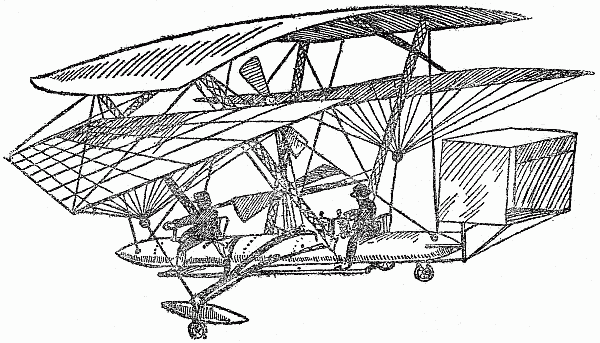 THE NEW BRITISH ARMY AEROPLANE: ROUGH SKETCH DRAWN BY LIEUT. KARL STRAUS,
OF THE GERMAN SECRET SERVICE.
THE NEW BRITISH ARMY AEROPLANE: ROUGH SKETCH DRAWN BY LIEUT. KARL STRAUS,
OF THE GERMAN SECRET SERVICE.
[120]
Ten minutes later he returned, saying:
"Just come with me for a moment, Jack."
I rose and followed.
We ascended the stairs, and passing along the corridor he
halted before the door of No. 11 and tapped at it quietly.
It opened, and Smith stood upon the threshold.
"I wish to speak with you a moment," Ray said,
facing him determinedly.
The man's face fell. We both entered, but so surprised
was he that he could utter no protest.
We saw that on the table beneath the lamp was
spread a number of photographs and papers.
He had been writing upon a sheet of foolscap and
the writing was in German.
"Yes," exclaimed Ray in a tone of satisfaction as
he bent over to glance at the first few lines. "I see.
You report: 'The upper plane is somewhat curved,
with an——'"
"What's my business to do with you, pray?" the
man asked defiantly in excellent English.
"Well, your business has interested me greatly,
Herr Straus," calmly replied my companion, "and
I congratulate you upon the ingenious method by
which you got a sight of the Kershaw aeroplane at
an early hour this morning. I was at Lochindorb
with you—and rather cold waiting, wasn't it?"
The man now recognised gave vent to a quick
imprecation.
"I see you've just developed that photograph you
took in secret as she sailed within twenty yards of
you! But I shall trouble you to give it over to me,
together with the rough sketch I see, and your written
description of our new military invention," he said,
with mock politeness.[121]
"I don't know you—and I shall do nothing of the
sort."
"I know you, Karl Straus, as a spy of Germany,"
exclaimed my friend, with a grin. "Your reputation
for ingenuity and cunning reached us from France";
and snatching up the sheet of foolscap he turned to
me, saying, "Listen to this, Jack," and while the German
agent stood biting his lips in chagrin at being discovered
at the eleventh hour, my friend read aloud the spy's
report, as follows:
"The upper plane of the Kershaw aeroplane
is somewhat curved, with an upward curve at
the front. The side planes are composed of a
light framework covered with a number of small
squares of some light material, each stretched on
a light frame hinged to the main frame at the
rear end of each. To the front end is fastened
a strong silken cord. These cords are all fastened
at their lower ends to a large ring. To this is
attached a wire rope, which passes over a pulley-wheel
at the end of a species of outrigger, and
thence into the cigar-like body of the car. From
what I have observed when the machine is in
flight, it is evident to me that the steersman
(who sits at the fore part of the car) is able to
manipulate these by means of levers, so that
the numerous flaps forming the surface of the
side planes can be opened and closed at will.
"Thus suppose the machine to be diving;
slackening these ropes, the pressure of the air
underneath causes the flaps to open. As soon
as this happens their inclination upwards tends
to make the machine rise so long as the propellers
are driving her forward, the angle of ascent being
controlled by the angle to which they are allowed[122]
to open. If the machine inclines to lean over to
right or left, the opening and closing of the flaps
on one side or the other can be used to counteract
it and restore the balance. With all kept tightly
closed she can go forward or dive. With them
open, and engines stopped, she dives quickly.
The rudder is of box-kite form, and fastened to
the after end of the cigar-like car, which apparently
contains the engines, petrol tanks, etc.,
and enough air space to render the machine
buoyant when water-borne. The propellers, which
are placed on hollow shafts, whose bearings
are supported on horizontal braces between the
two V-shaped aluminium lattice girders attaching
the planes to the car, are driven by separate
endless chains, which come up out of the centre
of the cylinder. They seem to be made either
of aluminium, or more probably magnalium.
"My drawing has rather exaggerated the diameter
of the cylindrical car. There is a light
wooden foot-board at either side, which also helps
to steady the machine when on the water and
two small floats at the end of the outriggers for
the same purpose. There are also three small
wheels fitted, I presume for facilitating ascent
from dry ground.
"Karl Straus."
The spy laughed a low, hollow laugh of defiance.
What could he say? He had been outwitted just at
the supreme moment of his success.
"I admit, my friend, that you were extremely
clever in putting forward Goldstein as the spy, and
thus misleading my friend Jacox," Ray said in triumph,
as he laid his hand upon the rough sketch of the Kershaw
invention. "But for a very timely discovery,[123]
too, my friend would have met with the terrible fate
which you and your accomplice planned with such
devilish ingenuity. So if you don't wish to be arrested
for conspiracy and murder you'd better make yourself
scarce out of England quickly."
"What do you mean, Ray?" I cried.
"I'll show you," he answered as he gathered up
the whole of the spy's papers while the German stood
helpless. "Come along to your room with me."
When inside he pointed to the old red-plush-covered
chairs, and said:
"Do you recollect my arrival after Straus's visit?
I examined those chairs, and saw upon one the traces
of chalk. The shoes of the occupant of room No. 11
had been chalked by the boots with his number, and
upon the chair I saw traces, and knew that he had
stood there to gain the top of your wardrobe."
"For what reason?" I asked.
For answer he turned up the gas and pointed to the
cornice of the ceiling behind the wardrobe, where I
saw that upon the leaden gas-pipe running along it
was a long, narrow strip of what looked like paper
which had been pasted.
"Those men meant to kill you, Jack," he said.
"On the morning I came here Straus had entered,
climbed up to the gas-pipe, and with his clasp-knife
cut a hole in it. Over that he, as you see, placed
several thicknesses of medical plaster, attaching to
it a piece of strong black cord, and carrying it outside
the door. After that they plugged up your window
and chimney, so that when you were asleep all they
had to do was to just pull the string, which would
strip off the plaster, allow the gas to escape into the
room, and thus asphyxiate you. The plaster could
be dragged beneath the door into the passage outside."
"Great heavens!" I gasped, staring astounded[124]
at the white medical plaster on the gas-pipe along
the cornice. "What a narrow escape I've had!"
"Yes. While I was in London, Vera went up with
her maid and stayed at the 'Star' at Kingussie, where
she overheard the two men in conversation, and learnt
the clever trick they were playing with Goldstein as
the spy. She suspected that they intended to rid
themselves of your unwelcome surveillance, and returned
at once to me in London. Fortunately I
discovered the dastardly plot, and that morning I
cut the cord."
"That fellow Straus is a much more desperate
character than he looks."
"Yes. But we'll just go back and you can tell
him your opinion of him," he laughed.
We went together along to No. 11. The spy had
already left, but ascending the stairs was Vera, in a
long travelling-coat, her maid following with the wraps.
She had just arrived from London, and after she
had greeted us in her usual merry manner, told us
that she was the bearer of very important news—news
of the activity of spies in another quarter.
We quickly told her how we had managed to outwit
Straus, while I, on my part, thanked her warmly for
having made that startling discovery which had, no
doubt, saved me from falling a victim to that dastardly
plot formed by one of the most ingenious of
the many unscrupulous spies of the Kaiser.
CHAPTER VI
THE SECRET OF THE NEW ARMOUR-PLATES
"I wonder if that fellow is aware of his danger?"
remarked Ray, speaking to himself behind the paper
he was reading before the fire in New Stone Buildings,[125]
one afternoon not long after we had returned from
Scotland.
"What fellow?" I inquired.
"Why Professor Emden," he replied. "It seems
that in a lecture at the London Institution last night,
he announced that he had discovered a new process
for the hardening of steel, which gives it no less than
eight times the resisting power of the present English
steel!"
"Well!" I asked, looking across at my friend, and
then glancing at Vera, who had called and was seated
with us, her hat still on, and a charming figure to boot.
"My dear fellow, can't you see that such an invention
would be of the utmost value to our friends
the Germans? They'd use it for the armour-plates
of their new navy."
"H'm! And you suspect they'll try and obtain
Emden's secret—eh?"
"I don't suspect, I'm confident of it," he declared,
throwing aside the paper. "I suppose he's a bespectacled,
unsuspicious man, like all scientists. The
Times is enthusiastic over the discovery—declaring
that the Admiralty should secure it at once, if they
have not already done so. It's being made experimentally
at Sheffield, it seems, and has been tried in
secret somewhere out near the Orkneys. Admiralty
experts are astounded at the results."
"Who is Emden?" I asked. "Just look at 'Who's
Who?' It's by your elbow, old chap."
Ray proceeded to search the fat red book of reference,
and presently exclaimed:
"It seems he's a Fellow of the Royal Society, a very
distinguished chemist, and a leading authority on
electro-metallurgy and ferro-alloys. He has improved
upon the Kjellin furnace as installed at Krupp's at
Essen, and at Vickers, Sons, and Maxim's at Sheffield,[126]
and by this improvement, it seems, has been able to
invent the new steel-making process."
"If he has improved upon any of the machinery
or processes at the Krupp works," remarked Vera,
glancing across at me, "then, no doubt, our friends
across the North Sea will endeavour to filch the secret
from him."
"Yes," I agreed, "he certainly ought to be warned
of his danger. As soon as Hartmann sees the announcement
in the papers, there's certain to be a desperate
attempt to get hold of the secret."
"That mustn't be allowed, my dear fellow," Ray
exclaimed. "With such steel as this the British Navy
will have a splendid and distinct advantage over that
of our friend 'William the Sudden.' This is a great
and important secret which England must keep at all
hazards."
"Certainly," declared Vera. "Really, Ray, you ought
to see Professor Emden and have a chat with him."
"His address is given at Richmond," was my
friend's reply, "but I have to go up to Selkirk early
to-morrow, and shall be away nearly a week."
"Then shall I run down and see him this evening?"
I suggested. And agreeing with my idea, he wrote
the address for me. Then we made a cup of tea for
Vera, who always delighted in the rough-and-ready
bachelordom of a barrister's chambers. Afterwards
Ray took his fiancée home to her aunt's, while I went
back to my rather dismal lodgings in Guilford Street,
Russell Square.
At nine o'clock that evening I rang at a pleasant,
good-sized, modern house, which overlooked the
beautiful Terrace Gardens and the river lying deep
below at Richmond—a house which, perhaps, commanded
the finest view within twenty miles of London.
The door was upon that main road which leads[127]
from the town up to the "Star and Garter," but the
frontage faced the Gardens. The dark-eyed maid
who opened the door informed me that the Professor
was at home, and took my card upstairs. Then, a
few moments later, I was ushered up to a cosy den,
the study of a studious man, where I found the distinguished
scientist standing in expectation, with his
back to the fire.
He was a strange-looking man of sixty-five, his hair
unusually white and slightly bald on top. Tall beyond
the average, he wore a moustache and slight pointed
beard, while his countenance seemed very broad in
the forehead tapering to a point. His face was, indeed,
almost grotesque.
I commenced by apologising for my intrusion, but
explained that I had called on a purely confidential
matter. When the door was closed, and we were alone,
I said:
"My mission, Professor, is a somewhat curious
one"; and I went on to explain our fears that German
secret agents might obtain knowledge of the new process
to which he had referred at the London Institution
on the previous night.
For a moment he stroked his pointed white beard
thoughtfully. I detected that he was as eccentric
as he was curious-looking. Then, with a light laugh,
he replied:
"Really Mr.—Mr. Jacox, I can't see your motive,
or that of your friends, in thus interfering in my private
affairs!"
"But is not this splendid discovery of yours of
national importance?" I protested. "Will it not
give us an enormous advantage over our enemies?
Therefore, is it not more than probable that you have
already attracted the attention of these spies of
Germany?"[128]
"My dear sir," he laughed, "I tell you quite frankly
that I don't believe in all these stories about German
spies. What is there in England for Germany to discover?
Nothing; they know everything. No, Mr.
Jacox, I'm an Englishman, a patriot, and I still believe
in England's power. We have nothing whatever to
fear from Germany."
"Your theory is hardly borne out by facts, Professor,"
I said, proceeding to tell him of our discovery
at Rosyth, and how we had outwitted the spies regarding
the new submarine, and also the airship at
Lochindorb.
But the strange-looking old scientist, distinguished
as he was, only laughed my fears to scorn.
"I'd like to see any German trying to learn my
secret," he said defiantly.
"Then I would urge you to take every precaution.
These agents employed by the German Secret
Police on behalf of the General Staff are bold and
unscrupulous."
"And do you allege that there are actually German
spies in England?" asked the strange man.
"Most certainly. We have in England and Scotland
more than five thousand fixed agents, men of
almost every nationality except German, and in every
walk of life, from humble labourers to men and women
in good positions, all of whom are collecting information
at the order of the German travelling agents, who
visit them from time to time, collect their reports, and
pay them their salaries. French, Swiss, and Italians
are mostly employed," I said. "At the present time
my friend Raymond has under observation a German
band, seven young fellows all army officers, who are
playing in the streets of Leeds, and at the same time
making a secret map of the water-mains of that city,
in order that when 'the Day' of invasion comes, the[129]
enemy will be able to suddenly deprive a densely
populated area of water."
"But have you any actual proof of this?" he
inquired.
As he spoke the door opened, and there entered a
pretty dark-haired girl of twenty-two, wearing a light
skirt and a pale pink evening blouse.
"Oh, dad!" she exclaimed, halting suddenly, "I'm
sorry I didn't know you had a visitor."
"I shan't be a moment, Nella dear," the curious-looking
old man said, and after a quick, inquisitive
glance at me the girl withdrew.
"Well," exclaimed the Professor, with a smile,
"I'm really very obliged to you for troubling to come
here to warn me, but I think, my dear sir, that warnings
are quite unnecessary. I haven't the slightest
fear that any attempt will ever be made to secure my
secret"; and he rose impatiently.
"Very well," I replied, shrugging my shoulders. "I
have warned you, Professor Emden. The Government
will not admit the presence of spies amongst us, and for
that reason we are now collecting indisputable evidence."
"Ah!" he laughed, "and you want me to help
you, eh? Well, sir, I don't believe in a word of this
scare—so I must decline that honour."
"And you will take no unusual precaution to keep
the truth out of the hands of our enemies, eh?"
"I leave it to Joynson's of Sheffield," he said.
"They've paid me a large sum down and a royalty for
the secret of my process, and it is scarcely likely that
they'll allow it to fall into other hands, is it?"
"They will not, but you, a private individual,
may," I said.
"I think not," he laughed, and a moment later I
descended the stairs, passing his pretty daughter Nella
on the way out.[130]
That night I called on Ray at Bruton Street, but
he was out at the theatre with Vera. At half-past
eleven they called as they went back to the girl's aunt's,
and as they sat before the fire, Vera with her opera-cloak
thrown back revealing a pretty pale blue corsage
a trifle décolleté, I reported the non-success of my mission.
"He's a pig-headed old ass!" I declared. "One
of millions of others in England. They close their
eyes to the dangers of this horde of spies among us,
and will only open them when the Germans come
marching up the street and billet themselves in their
houses. But he's a strange man, Ray, a very strange
man," I added.
"You're right, Mr. Jacox," the girl declared.
"Instead of teaching boys how to scout and instructing
young men in the use of popguns, we should strike
first at the root of all things. Cut off the source of
this secret information which daily goes across the
North Sea. Such hidebound patriots as the Professor
are a peril to the nation!"
"If he refuses to help himself, Jacox, we must protect
him ourselves," Ray declared. "I leave it to
you and Vera to keep an open eye until I return from
Selkirk next Monday. I'm bound to go down and
see my sister. She seems very ill indeed."
And so a very important and delicate affair was thus
placed in my hands.
Vera Vallance announced herself ready and eager
to assist me, and that night I walked back to Bloomsbury
much puzzled how next to act.
That the Germans would attempt to secure the
secret of the new steel was absolutely certain. But
to us, success meant the keeping of it to Britain, and
the armouring of our new Dreadnoughts with a resisting
power eight times that of our enemies.
Next day I journeyed down to Sheffield and called[131]
upon the manager of Messrs. Joynson and Mackinder,
the great steel-makers, who, as you know, hold the
contracts for making the armour-plates of our improved
Dreadnoughts. He told me how the firm had
just constructed six of the new Emden electrical
furnaces, and had also taken over the wonderful new
process which the Professor had invented.
He then courteously took me across to that portion
of the great grimy works, with its wonderful steel
melting and refining furnaces, to where the Emden
process was about to be carried out.
"I suppose you have no fear of the new method
being learnt by any of your rivals—by any German
firm, for instance?" I asked.
"Not in the least," laughed the manager, a bluff,
grey-bearded man, speaking in his broad Hallamshire
dialect; "we take good care of that. Each workman
only does a part, the whole of the process being
only known to myself. It wouldn't do for us to give
Professor Emden forty thousand pounds for the secret
and then allow it to fall into foreign hands. The
Germans would, of course, give anything for it," he
added. "Emden is a patriotic Englishman even
though he is very eccentric, and if he liked he could
have got almost anything he cared to ask from
Krupp's."
"That's just the point," I said; and then, as we
walked back to the office, I explained my fears. But,
like the Professor himself, he only laughed them to
scorn. So that evening I again returned to London
filled with anxiety and disappointment.
Just before eleven that same night I strolled past
the house of Hermann Hartmann, in Pont Street,
vaguely wondering what I could do to prevent a theft
which must, I knew, shortly be committed. In all
probability the ingenious Hartmann already had a[132]
secret agent in Joynson's works, but even if he had,
he would certainly not be able to discover the secret.
I had quite satisfied myself upon that point.
No, the peril lay in the Professor himself—the
strange old pig-headed patriot.
Scarcely had I passed Hartmann's house, the exterior
of which I knew so well, when I heard the front door
close and saw a man coming down the steps. As he
walked in my direction I halted beneath a lamp to
light a cigarette, and by so doing I obtained a glimpse
of his face as he passed.
He was a young, good-looking, smartly dressed
man, with dark eyes and hair and a rather sallow complexion.
I put him down to be an Italian, but I had
never set eyes upon him before. No doubt he was
one of Hartmann's travelling agents—a man who
went up and down England visiting the fixed spies
of Germany, or "letter-boxes," as they are known
in the bureau of secret police in Berlin—collecting
their reports and making payments for information
or services rendered.
Knowing so much of the ways of the German secret
agent, curiosity prompted me to follow him. He
strolled as far as the corner of Sloane Street and
Knightsbridge, and then boarded a motor-bus as far
as Piccadilly Circus. Thence he walked to the German
beer-hall, the Gambrinus, just off Coventry
Street, where he joined a tall, thin, grey-moustached
man, an Italian like himself, who was seated awaiting
him. I idled across to a table close by, called for
beer, and sat smoking a cigarette and straining my
ears to catch their conversation, which was in Italian,
a language I know fairly well.
I discovered the following facts. The thin-faced
man was called Giovanni, while the elegant young
fellow was Uberto, and they were discussing the arrival[133]
of somebody. Giovanni seemed dubious about something,
while the man who had left Hartmann's seemed
enthusiastic.
After a quarter of an hour Uberto glanced at his
watch, made some remark to his companion, and
they rose and went out together, driving in a
taxicab westward, I following in another, which I fortunately
found just in time. Through Kensington we went,
over Hammersmith Bridge, through Barnes, and
across the Common.
Then I realised we were going to Richmond.
The chase grew exciting. Before me I could see
the red back-lamp of the taxi as it sped forward, and
half an hour later we were crossing Richmond Bridge,
where, a short distance along the road to Twickenham,
they suddenly swung round to the left into St. Margaret's
and pulled up before a good-sized detached
house which stood back in its own grounds, in which
were several big trees. The thoroughfare was, I noted,
called Brunswick road.
My taxi-driver proved himself no fool. I had told
him to follow; therefore, unable to pull up sharply,
he swept past, and did not stop until we were round
the bend in the quiet suburban road and thus out of sight.
I ordered him to remain, and, alighting, strolled
back past the house in question. About its dark
exterior was a distinct air of mystery. The pair had
entered, and the taxi was awaiting them. The house
was an old-fashioned one, solid and substantial in
character, and apparently the residence of some prosperous
City man; yet I wondered why its owner should
have visitors at that hour. Surely great urgency had
compelled the pair to come all the way from Piccadilly
Circus to consult him.
But a surprise was in store for me.
After lurking about in the shadows with that expert[134]
evasiveness which I had now acquired, I presently saw
the pair make their exit, but, to my surprise, they
were accompanied out to the kerb by a woman—apparently
a lady in black evening dress, the bodice
of which was cut low.
About her shoulders she had wrapped a pale blue
shawl, and as the young Uberto entered the taxi I
heard her exclaim in Italian:
"Addio! To-morrow at one then, at Prince's."
As she moved I saw her countenance by the light
of the cab lamp, a handsome, well-cut face, typical
of a woman of Piedmont, for she had spoken in a dialect
unmistakably that of Turin. The Turinese are more
French than Italian, and are as different in both temperament
and language from those of the south as
the people of the Ardennes differ from those of
Paris.
Both men shook hands with her warmly, bade her
"Addio," and entering the taxi, drove away back to
London, while I stood still watching.
And as I gazed I saw as she walked back to the
house, in the doorway, silhouetted against the light,
an old man coming forward towards her.
"Dio!" she cried, half in alarm at seeing him.
Then in Italian, she added, "Why do you risk being
seen, you imbecile? Why didn't you keep where
you were?"
Then the door closed, and seeking my taxi I also
returned to Bloomsbury.
But that incident had aroused a good deal of doubt
and suspicion within me. Who was that handsome
young Italian woman whom the spies had visited at
that late hour? And, above all, who was that man
with whom she had been annoyed for showing himself?
Next day proved conclusively that some crooked
business was in progress, for while I sat alone eating[135]
my lunch in a corner of the big room at Prince's
Restaurant in Piccadilly, I was amazed to see the
well-dressed young Italian—the man whom I had
seen emerge from Hartmann's in Pont Street, enter
with no other person than Nella Emden.
Surely the spies had already made considerable
progress! My indignation was such that I could
have walked over to the table where the pair had
seated themselves, and denounced that elegant Italian
as a spy of the Kaiser. But I foresaw that by patience
I might yet discover more that would be of interest.
From my corner I watched the pair unnoticed. The
girl was certainly extremely good-looking, young, and
by her manner I could see that she was shy at being
with a male companion alone in a public restaurant.
He, on his part, was exercising over her all the fascination
of his nation. Once or twice I saw him smile
covertly across behind me, and when I had an opportunity
to glance round I realised, to my surprise, that
the man whom he had called Giovanni was lunching
with the handsome Italian woman from St. Margaret's.
It seemed that they were watching the young pair.
For what reason, I wondered?
I remained on the alert, but that day discovered
nothing more, though I followed the young pair back
to Richmond and saw the Italian part affectionately
from Nella Emden near her father's house.
For some days I prosecuted an unceasing vigil,
for already I had recognised the seriousness of a secret
falling into the enemies' hands which would undoubtedly
give them the advantage in the coming
struggle.
One afternoon Vera Vallance met me at Waterloo
Station, and together we went down to Richmond,
where I showed her the Professor's house, and together
we waited for the coming of Nella. Vera,[136]
enthusiastic as ever, and ingenious at keeping observation,
followed the girl, while in fear of being recognised
I went back to London.
Next day she called at New Stone Buildings, smart,
neat, and altogether sweet and winning.
"Well, Mr. Jacox," she said, seating herself by my
fire, "I had a curious experience after I left you yesterday
afternoon. Nella went first by tram to Twickenham,
and near the Town Hall there met the young
Italian, who had a companion—Hartmann himself!"
"Hartmann!" I gasped. "Then our suspicions
are surely well grounded!"
"Of course they are," she said. "I at once drew
back, fearing that our clever friend of Pont Street
should notice me. Fortunately he did not, therefore
I was able to watch and ascertain where they went—to
the house in St. Margaret's where you saw that
Italian woman. They apparently stayed there to
tea, for about half-past five the young man came out
and walked in the direction of Richmond Bridge. I,
however, remained behind, and though I waited for
hours, until long after dark, neither Hartmann nor
the girl made their reappearance. But at nine a very
remarkable incident occurred."
"What?" I inquired eagerly.
"Three men came along the road in the darkness
carrying something. When they drew near me and
turned into the gate of the house, I stood aghast.
Upon their shoulders was a coffin!"
"A coffin!" I echoed, staring at her.
"Yes. And though I waited until midnight, Hartmann
did not come forth, neither did the Professor's
daughter. What do you make of it?" she asked,
looking into my eyes.
I admitted that the affair was a mystery, and suggested[137]
that we might ascertain whether Nella had
returned to her home.
"Yes," she said. "Go down to Richmond and see."
This I did without delay. I watched the house
during that afternoon, and just at dusk saw the dark-eyed
maid-servant emerge to post a letter. I followed
her up the hill to the pillar-box, and by the application
of a couple of half-crowns obtained some
information.
"No, sir," replied the girl, "Miss Nella's not come
home. The master's in a great state about her. She
went out for a walk yesterday afternoon, and though he's
been to the police, nobody seems to have seen her."
"She was her father's assistant in his experiments,
I've heard?"
"Yes, sir, she was. Ever since poor Mrs. Emden
died, two years ago, she's been her father's right hand."
"Had she a lover?"
"Well"—and the girl hesitated. "We in the
kitchen have our suspicions. Davis the cook saw
her last Sunday walking over in Teddington with a
dark young man, who looked like a foreigner. But,"
she added, "why do you want to know all this?"
"I'm trying to trace the young lady," I said, in
the hope that she would believe me to be a detective.
"Tell me," I urged; "does the Professor make any
experiments at home?"
"Oh yes, sir; his laboratory is up on the top floor—fitted
up with an electric furnace and lots of funny
appliances."
"Has he any friends who are foreigners?" I inquired.
"Not that I know of," was the girl's reply. And
I thought she regarded me rather strangely. Why,
I could not conceive. Her name was Annie Whybrow,
she told me, and then, unable to detain her longer
I allowed her to re-enter the house.[138]
Vera's story of the coffin being taken into that
mysterious house in Brunswick Road, combined with
the non-return of the pretty Nella, was certainly
mystifying.
I returned to London, saw Vera, and we resolved
to wire to Ray at Selkirk asking him to return to
London as soon as possible.
That night, and the next, I haunted the usual resorts
of foreigners in the West End, the underground Café
de l'Europe, the Spaten beer-hall in Leicester Square,
the Café Monico, the Gambrinus, and other places,
in order to discover the young Italian. On the second
evening I was successful, for I saw him in the Monico,
and on inquiring of a man I knew, I learnt that his
name was Uberto Mellini, that until recently he had
lived in Paris, and that at the present moment he
was staying in a house in Dean Street, Soho.
At midnight, when I returned to Bloomsbury, I
found Vera and Ray anxiously awaiting me. The
latter had only arrived in London from Scotland an
hour before, and his fiancée had evidently told him
of the curious events which had transpired and the
sinister mystery surrounding the young girl's
disappearance.
"I can see no reason for it at all," he declared, when
we commenced to discuss the situation. "It's quite
plain that our friends the enemy are actively at work,
but surely the fact that Nella is missing would put
the Professor upon his guard. This young Italian
Mellini is evidently a new importation, and has pretended
to form an attachment for Nella for some
ulterior object."
"Certainly," I said. "But what do you make of
the incident of the coffin?"
"There has been no funeral from that house in
Brunswick Road?"[139]
"Not as far as I can gather."
"The Registrar of Deaths would be able to inform
us," he said reflectively. "We must inquire."
Next day all three of us returned to Richmond, and
while Ray and Vera crossed the bridge to the opposite
side of the Thames to find the Registrar's office, I
lingered and watched in the vicinity of the Professor's
house.
I waited for many weary hours in the wet—for rain
fell the whole day—but Ray did not return, which
caused me considerable misgivings. I was compelled
to resort to all sorts of subterfuges in order not to
attract attention; but as my friend had directed me
to remain and watch, I waited patiently at my post.
Just after the street lamps were lit, a telegraph
messenger arrived, and ten minutes after he had gone
the girl Annie came out with hat and jacket on, and
turning to the left hurried in my direction.
As she passed I spoke to her, and, recognising me,
she explained that she was going for a cab to convey
the Professor to the station.
"Miss Nella is at Liverpool," she added excitedly.
"The master has had a wire from her, asking him to
go there at once. She's very ill, it seems. The poor
master is greatly excited. He's just telephoned to
the police saying that Miss Nella has been found."
And then the girl hurried away, down the hill to
the foot of the bridge, where there was a cab-stand.
Nella at Liverpool! What could possibly have
occurred?
Later on I watched the Professor, carrying only a handbag,
enter a cab and drive rapidly to the station, while
Annie returned to the house and closed the front door.
It was then about six o'clock, and I had been watching
there for nearly eight hours. Therefore I decided
to go in search of Ray, who was over at St. Margaret's,[140]
and who, I thought, would most probably be watching
the house to which the coffin had been taken.
In this I was not mistaken, for I found him idling
at the end of that quiet, dark suburban road. He
was on the alert the instant he recognised me, and
in a few rapid sentences I told him what had occurred.
It puzzled him greatly.
"I've ascertained that Hartmann is back at Pont
Street," he said. "But why the coffin should be in
yonder house is still a mystery. The Registrar has
had no intimation of any death in Brunswick Road
for the past eight months. I've, however, found the
local undertaker, who says that a plain coffin was
ordered for a gentleman and that they duly delivered
it. They did not see the body, being told that the
funeral was to be undertaken by a big West End
firm, and that the body was to be conveyed for burial
somewhere near Leicester."
"Have you found out anything further regarding
the occupants of the house?"
"No, only that it was taken furnished by a gentleman
a month ago—a foreigner whose description
exactly tallies with that of Hartmann—for an old
man and his daughter—both Italians. They've kept
themselves very much to themselves, therefore the
neighbours know practically nothing about their
business."
"Well, Nella Emden was enticed in there. I'm
certain of that," I said. "Yet the fact that she's
in Liverpool rather negatives my first theory of foul
play," I added.
"Yes. But we must still remain watchful. Vera
has gone to make some inquiries for me over at Mortlake.
I expect her back in half an hour. You return
and keep a watchful eye upon the Professor's place. One
never knows what crooked business may be on hand!"[141]
So back I went, and through the whole evening
waited there, chilled to the bone, in vain expectancy.
I had noticed from Ray's manner that he had become
very suspicious. He somehow scented the
presence of spies at times when, I confess, I felt calm
and reassured. And his natural intuition was seldom,
if ever, wrong.
The church bells across the river had chimed midnight,
the Professor's servants had put out the lights
and retired, and the thoroughfare was now deserted.
Hungry and tired out, I was contemplating relaxing
my vigil when Ray suddenly turned a corner and
joined me, saying breathlessly:
"Uberto and his friend are coming up the hill with
another man. Vera and I have seen them call at
Brunswick Road, and they are now on their way here.
We must keep a strict watch. Something is up!"
We separated, and concealing ourselves in the basements
of the houses opposite, we witnessed that which
caused our heart-beats to quicken.
The three men came along in silence in the night,
for they evidently wore rubber heels on their boots.
The constable was then some distance down the hill,
therefore they passed him.
As they approached the house, the man whom I
had heard addressed as Giovanni hurried forward,
and slipping suddenly into the narrow front garden,
approached the kitchen window. Inserting something
between the sashes, he pushed back the latch, carefully
drew back the blind, and was within the house
almost before the two others had entered the
garden.
Then, without a sound, the pair followed him.
Indeed, the three spies had entered the premises so
quickly that we could scarcely believe our own eyes.
"The police!" whispered Ray. "We must get[142]
the constable. Slip down the hill and tell him. We'll
make a fine capture this time!"
Down the hill I sped, and five minutes later was
back with the constable, having briefly explained to
him our suspicions.
"I don't know anything about German spies, sir,
but whoever's inside is liable for burglariously entering,
and we'll have 'em," whispered the officer.
Silently we entered just as the spies had done,
passing through the kitchen, and up the stairs. The
laboratory was at the top of the house I knew, and
was always kept locked. Therefore we crept forward,
without the slightest sound.
Once or twice, we listened. The spies were absolutely
silent—well trained to that sort of nocturnal investigation,
no doubt.
As Ray and I got to the door of the big room, which,
by the light of the flash-lamp used by the intruders,
we could see was fitted with all sorts of appliances,
we witnessed through the crack that they had secured
a number of specimens of metals and were all three
at that moment engaged in drilling a hole in the big
dark green safe standing in the corner.
"Now," whispered the constable, "let's rush them."
And with a loud shout we dashed in upon them, revolvers
in hand.
In an instant we were in total darkness. Deep
curses in Italian sounded, and I heard a desperate
struggle taking place. Somebody grabbed at me,
but it was our friend the constable. Then, by the
red flash of a revolver which somebody fired, I distinguished
the flying form of one of the intruders
through the doorway.
Next second, in the darkness, I felt a man brush
past me, and instantly I closed with him. We fell
together, and as I gripped the fellow's throat he[143]
ejaculated a loud imprecation in Italian. Then we
rolled over in desperate embrace, but as I forced him
beneath me, shouting to the constable, whose lantern
had been knocked from his hand and broken, I suddenly
felt a crushing blow upon the skull. I saw a
thousand stars, and then the blackness of unconsciousness
fell upon me.
When I again grew cognisant of what was going on
about me, I found myself lying in bed in the Richmond
Cottage Hospital with a pleasant-faced nurse bending
eagerly over me. It was still night, for the gas was
burning.
She asked how I felt, remarking that I had received
a nasty crack, and had lain there unconscious for
three whole days.
Presently I felt the presence of some one else near
me, and gradually made them out to be Ray and Vera.
At first they would tell me nothing, but after the
doctor had seen me, Ray in his cheery way said:
"Yours was a bit of hard luck, old fellow. The
blackguards all got away—all three of them. But
we were just in time, for in that safe were the memoranda
of the Professor's experiments which, together
with the specimens of the new metal that could have been
analysed, would have undoubtedly placed the secret of
the new steel in the hands of the German Admiralty!"
"Then we really prevented them?" I said eagerly,
feeling the bandages about my head.
"Just in the very nick of time, old man," he replied.
"And we did more. We managed to save Miss Nella."
"How?" I inquired eagerly.
"She's here. She'll tell you herself." And next moment
I saw her standing before me with the Professor.
"Yes, Mr. Jacox," the girl said. "I have come[144]
to thank you. I was first approached by the young
Italian while crossing Richmond Bridge one day, and
later on he introduced me to his sister, who lived in
St. Margaret's. On the afternoon when I was induced
to go there I was given something in my tea which
at once rendered me unconscious. When I recovered,
I found myself lying in a coffin secured to rings inside,
while a villainous old man, a bearded German, and
an Italian woman were about to screw down the lid.
I screamed, but they took no notice, until in fear I
fainted. Ah! shall I ever forget those horrible
moments? I was alone, helpless in the hands of those
fiends, all because I had allowed myself to become
attracted by a stranger! They held me there for
days, trying to learn from me the secret of my father's
discovery. But I would tell them nothing. Ah!
how I suffered, believing every hour that they would
close down that lid. Then the brutes, finding me
defiant, and believing that no one was aware of their
existence, hit upon another device—sending a false
telegram to my father from Liverpool, and thus taking
him away from the house in order to be afforded a
clear field for their investigations. Of this I, of course,
knew nothing until your friends entered the house
forcibly with the police and found me still imprisoned—ah!
yes! ready for death and burial."
And then the strange old Professor, stepping forward,
seized my hand warmly in his, saying:
"To you and your two good friends, Mr. Jacox, the
country owes a great and deep debt of gratitude. I
was foolish in disregarding your timely warning, for
my dear daughter very nearly lost her life, because
the blackguards knew she had assisted me in my experiments
and had made the notes at my dictation,
while Britain very nearly lost the secret upon which,
in the near future, will depend her supremacy at sea."[145]
CHAPTER VII
THE SECRET OF THE IMPROVED "DREADNOUGHT"
The road was crooked and narrow, and the car was a
nondescript "ninety," full of knocks and noise.
By appointment I had, for certain reasons that will
afterwards be apparent, met, in the American Bar
of the "Savoy," two hours before, the Honourable
Robert Brackenbury, the dark, clean-shaven young
man now driving, and he had engaged me, at a salary
of two pounds ten per week, to be his chauffeur. I
had driven him out through the London traffic, until,
satisfied with my skill, he had taken the wheel himself,
and we were now out upon the Great North Road,
where he had a pressing engagement to meet a friend.
Beyond Hatfield we passed through Ayot Green,
and were on our way to Welwyn, when suddenly he
swung the powerful car into a narrow stony by-road,
where, after several sharp turns, he pulled up before a
pleasant, old-fashioned, red-roofed cottage standing
back in a large garden and covered with ivy and
climbing roses.
A big, stout, clean-shaven, merry-faced man, with
slightly curly fair hair, standing in the rustic porch,
waved his hand in welcome as we both descended.
I was invited into the clean cottage parlour, and
there introduced to the stout man, who, I found, was
named Charles Shand, and by whose speech I instantly
recognised an American.
"Good!" he exclaimed. "So this is the new
chauffeur, eh?" he asked, looking me up and down
with his large blue eyes. "Say, young man," he
added, "you've got a good berth if you can drive well—and
what's more important, keep a still tongue."[146]
I glanced from one to the other in surprise. What
did he mean?
Both saw that I was puzzled, whereupon he hastened
to allay my surprise by explaining.
"My friend and I run a car each. He has a six-cylinder
'sixty' here, and we want you to look after
both. No cleaning. You are engineer, and will
drive occasionally. Come and see the other car."
And taking me to the rear of the premises, they showed
me, standing in a newly built shed, one of the latest
pattern six-cylinder "Napiers" fitted with every
modern improvement. It was painted cream, and
upon the panels an imposing crest. A big searchlight
was set over the splash-board. It was fitted
with the latest lubrication, and seemed almost new.
To me, motor enthusiast as I am, it was a delight to
have such a splendid car under my control, and my
heart leapt within me.
"My friend, Mr. Brackenbury, will be liberal in
the matter of wages," remarked Shand, "provided
that you simply do as you are bid and ask no questions.
Blind obedience is all that we require. Our private
business does not concern you in the least—you understand
that?"
"Perfectly," I said.
"Then if you make a promise of faithful and silent
service, we shall pay you three pounds ten a week
instead of the two ten which we arranged this morning,"
said Brackenbury.
I thanked them both, and returning to the house
Shand produced some whisky and a syphon, gave me
a drink and a cigar, and told me that if I wished to
stroll about for an hour I was at liberty to do so.
The afternoon was a warm one in July, therefore I
passed out into a field, and beneath the shade of a
tree threw myself down to smoke and reflect. For[147]
nearly four months, though Ray and I had been ever
watchful, we had discovered but little. We had had
our suspicions aroused, however, and I had resolved
to follow them up. Both men seemed good fellows
enough, yet the glances they had exchanged were
meaning, and thereby increased my suspicions.
When, an hour later, I re-entered the house and
knocked at the door of the room, I found the pair with
a map spread out on the table. They had evidently
been in earnest consultation.
"Fortunately for you you are not married, Nye,"
exclaimed the Honourable Robert, whom I strongly
suspected to be of German birth, though he spoke
English perfectly and had appeared to have many
friends among the habitués of the "Savoy." Nye
was the name I had given. "You'll have two places
of residence—here with Shand, and with me at my
little place over at Barnes. You know the main roads
pretty well, you told me?"
"I did a lot of touring when I was with Mr. Michelreid,
the novelist," I said. "He used to be always
in search of fresh places to write about. We always
went to the Continent a lot."
"Well," he laughed, "you'll soon have an opportunity
of putting your knowledge of the road to the
test. To be of any real service to us, you'll have to
be able to find your way, say, from here to Harwich
in the night without taking one wrong turning."
"I've been touring England for nearly five years,
off and on," I said, with confidence; "therefore few
people know the roads, perhaps, better than myself."
"Very well, we shall see," remarked Shand; "only
not a word—not even to your sweetheart. My friend
and I are engaged in some purely private affairs—in
fact, I think there is no harm in telling you—now
that you are to be our confidential servant—that we[148]
are secret agents of the Government, and as such
are compelled on occasions to act in a manner that
any one unacquainted with the truth might consider
somewhat peculiar. Do you understand?"
"Perfectly," I said.
"And not a word must pass your lips—not to a soul,"
he urged. "For each success we gain in the various
missions entrusted to us you will receive from the
Secret Service fund a handsome honorarium as acknowledgment
of your faithful services."
Then he walked away, gaily singing the gay chanson
of Magda at the Ambassadeurs:
"Sous le ciel pur ou le ciel gris
Dès que les joyeux gazouillis
Des oiselets se font entendre,
Une voix amoureuse et tendre
Par la fenêtre au blanc rideau
Lance les couplets d'un rondeau;
C'est la voix d'une midinette
Qui fait, en chantant, sa toilette.
Ah! le joli réveil-matin,
Quand il faut partir au turbin!
Bientôt, de la chambre voisine,
Répond une voix masculine.
Paris! Paris! Gai paradis!
Voilà les chansons de Paris!"
Much gratified at securing such a post, I drove the
Honourable Robert back to London and waited for
him in the courtyard of the Hotel Cecil while he was
inside for a quarter of an hour. Then, getting up
beside me he directed me to drive to Hammersmith
Bridge, where, at a big block of red-brick flats overlooking
the river, called Lonsdale Mansions, we pulled
up, and he took me up to his small cosily furnished
flat, where William, the clean-shaven and highly-respectable
valet, awaited him.
The "ninety" was garaged, I found, almost
opposite, and when I returned to the flat the Honourable[149]
Robert was at the telephone in the dining-room
talking to the man we had left near Welwyn.
The elderly woman who acted as cook showed me
my room, gave me my dinner, and I sat smoking with
William for an hour or so afterwards.
The valet was a very inquisitive person, and I could
not fail to notice how cleverly he tried to pump me
concerning my post. He, however, failed to obtain
much from me.
"The guv'nor is one of the best fellows alive—a
thorough sportsman," he informed me. "Respect
his confidence, and don't breathe a word to any one
as to his doings, and you'll find your place worth
hundreds a year."
"But why these strict injunctions regarding
silence?" I inquired, in the hope of learning something.
"Well—because he's compelled to mix himself up
with queer affairs and queer people sometimes, and
in his position as the younger son of a peer it wouldn't
do if it leaked out. I simply act as he bids, and seek
no explanation. You'll have to do the same."
Hardly had he ceased speaking when "the guv'nor,"
in dinner-jacket and black tie, entered, and said:
"William, I want you to take a letter for me to
Raven at Nottingham by the next train. It leaves
St. Pancras at 10.45. You'll be there at 2.30 in the
morning. He's at the 'Black Boy.' Get an answer
and take the 5.50 back. You'll be here again soon
after nine in the morning."
"Very well, sir," answered the valet, taking the
letter from his master's hand; and ten minutes later
he went downstairs to catch his train.
This incident showed that Robert Brackenbury
was essentially a man of action. His keen, dark
aquiline face, bright, sharp eyes, and quick, almost
electric movements combined to show him to be a[150]
man of nerve, resource, and rapid decision. The
square lower jaw betokened hard determination,
while at the same time his manner was easy, nonchalant,
and essentially that of a born gentleman.
William returned next morning, and a few days
passed uneventfully. Both morning and evening each
day, at hours prearranged, he "got on" to Shand,
but their conversations were very enigmatical. Several
times I happened to be in the room, but could learn
nothing from the talk, which seemed, in the main,
to refer to the rise and fall of certain mining shares.
Each day I drove him out in the "ninety." The
car, a four-cylinder, had no flexibility, and was a
perfect terror in traffic. The noise it caused was as
though it had no silencer, while the police everywhere
looked askance as we crept through the Strand, dodged
the motor-buses in Oxford Street, or put on a move
down Kensington Gore.
While Bob Brackenbury—as he was known to his
friends of the "Savoy"—was out one day, I was in
his bedroom with William, when the latter opened
one of the huge wardrobes there. Inside I saw hanging
a collection of at least fifty coats of all kinds, some
smart and of latest style, others old-fashioned and
dingy, while more than one was greasy, out-at-elbow,
and ragged. I made no remark. Never in my life
had I seen such an extensive collection of clothes
belonging to one man. Surely those ragged coats
were kept there for purposes of disguise! Yet would
it not be highly necessary for a member of the Secret
Service to possess certain disguises, I reflected!
William noticed my interest, and shut the doors
hurriedly.
I drove Brackenbury hither and thither to various
parts of London, for he seemed to possess many friends.
Once we took two pretty young ladies from Hampstead[151]
down to the "Mitre" at Hampton Court, and on
another afternoon we took a young French girl and
her mother from the "Carlton" down to the "Old
Bridge House" at Windsor.
To me it was apparent that Bob Brackenbury was
very popular with a certain set at the Motor Club,
at the Automobile Club, and at other resorts.
My duties were not at all arduous, and such a
thoroughgoing sportsman was my master that he treated
me almost as an equal. When out in the country
he compelled me to have lunch at his table "for
company," he said. My people, I told him, had been
wealthy before the South African War, but had been
ruined by it, and though I had been at Rugby and
had done one year at Balliol College, Oxford, I hid the
fact now that I was compelled to earn my living as
a mere chauffeur. He had no idea that I was a barrister,
with chambers in New Stone Buildings.
One morning after breakfast Mr. Brackenbury
called me into the little dining-room, wherein stood
his capacious roll-top desk against the wall, with the
telephone upon it, and inviting me to a seat opposite
the fireplace, said in a voice which betrayed just the
faintest accent:
"Nye, I want to speak confidentially to you for
a few minutes. You recollect that the day before
yesterday when down at Windsor I was speaking
with a police-inspector in uniform, who called at the
hotel to see me, eh?"
"Yes. He looked round the car and spoke to me.
I thought he'd come to take our name for exceeding
the limit on the Staines road."
"You'd remember him again if you saw him?"
"Certainly," was my prompt reply.
"Well, don't forget him," he urged, "because you
may, before long, be required to meet him. And if[152]
you should chance to mistake the man, a very serious
contretemps would ensue."
"I'd recognise him again among a thousand!" I
declared.
"Good. Now listen attentively to me for a few
minutes," he said, lighting a fresh cigarette and fixing
his dark, penetrating eyes upon mine. "I and my
friend Shand have a very difficult task. A certain
Colonel von Rausch, of the German Intelligence Department,
is, we have discovered, in England on a
secret mission. It is suspected that he is here controlling
a number of spies who had been engaged in
staff-rides in the eastern counties, and to receive their
reports. My object is to learn the truth, and it can
only be done by great tact and caution. I tell you
this so that any orders I give you may not surprise
you. Obey, and do not seek motive. Am I clear?"
"Certainly," I answered, interested in what he
told me. It was curious that he, undoubtedly a
German, was at the same time antagonistic to the
colonel of the Kaiser's army.
"Well, I'm leaving London in an hour. Await
orders from me, and obey them promptly," he said,
dismissing me.
Through that day and the next I waited. He had
taken William with him into the country, and left
me alone in the flat. Once or twice the telephone
rang, but to the various inquirers I replied that my
master was absent.
Inactivity there was tantalising. I was naturally
fond of adventure, and I had taken on the guise of
chauffeur surely for the unmasking of a foreign spy.
On the third day, about two in the afternoon, I
received a trunk call on the 'phone. The post office
at Market Harborough called me up, and the voice
which I heard was that of my master.[153]
"Oh! that's you, Nye!" he said. "Well, I want
you to start in the car in an hour, and run her up to
Peterborough. When in the Market Place, inquire
the road to Edgcott Hall. It's about six miles out
on the Leicester road. Inquire for me there as Captain
Kinghorne—remember the name now. Do you hear
distinctly?"
I replied in the affirmative.
"Recollect what I told you before I left. I shall
expect you about six. Good-bye," he said, and then
rang off.
Full of excitement, I got out the car from the garage,
filled the petrol tank, saw to the carbide, and then
set out across the suspension bridge at Hammersmith,
and went through Kensal Green and Hampstead over
to Highgate, where I got upon the North Road.
It had been raining, and there was plenty of mud
about, but the big, powerful car ran well notwithstanding
the terrific noise it created. Indeed, she
was such a terror and possessed so many defects that
little wonder its maker had not placed his name upon
her. As a hill-climber, however, she was excellent,
and though being compelled constantly to change my
"speeds," I did an average of thirty miles an hour
after getting into the open country beyond Codicote.
Through crooked old Hitchin I slowed up, then away
again through Henlow and Eton Socon up Alconbury
Hill and down the broad road with its many telegraph
lines, I went with my exhaust open, roaring and
throbbing, through Stilton village into the quiet old
cathedral town of Peterborough. Inquiry in the
Market Place led me across a level crossing near the
station and down a long hill, then out again into a
flat agricultural district until I came to the handsome
lodge-gates of Edgcott Hall.
Up a fine elm avenue I went for nearly a mile, until[154]
I saw before me in the crimson sunset a long, old
Elizabethan mansion with high twisted chimneys and
many latticed windows. The door was open, and as
I pulled up I saw within a great high wall with stained
windows like a church and stands of armour ranged
down either side.
A footman in yellow waistcoat answered my ring,
and my inquiry for Captain Kinghorne brought forth
my master, smartly dressed in a brown flannel suit
and smiling.
"Hulloa, Nye!" he exclaimed. "Got here all
right, then. Newton will show the way to the garage,"
and he indicated the footman. "When you've put
her up, I want to see you in my room."
The footman, mounted beside me, directed me across
the park to the kennels of the celebrated Edgcott
hounds, and behind these I found a well-appointed
garage, in which were two other cars, a "sixteen"
Fiat of a type three years ago, and a "forty" Charron
with a limousine body, a very heavy, ponderous affair.
A quarter of an hour later I found myself with the
Honourable Bob in a big, old-fashioned bedroom overlooking
the park.
"You understood me on the 'phone, Nye?" he
asked when I had closed the door and we were alone.
"Shand is guest here with me under the name of
Pawson, while, as you know, I'm Captain Kinghorne,
D.S.O. This is necessary," he laughed. "The name
of Bob Brackenbury would, in an instant, frighten
away our friend the German. The people here, the
Edgcotts, don't know our real names," he added. "All
you have to do is to remain here and act as I direct."
A moment later the stout American entered and
greeting me, turned to his friend, saying:
"I suppose Nye knows that Charles Shand is off
the map at present, eh?"[155]
"I've just been explaining," my master replied.
"And you'd better spread a picturesque story among
the servants, too, Nye," the American went on—"the
bravery of Captain Kinghorne at Ladysmith,
and the wide circle of financial friends possessed
by Archibald Pawson, of Goldfields, Nevada. The
Edgcotts must be filled up with us, and that infernal
Dutchman mustn't suspect that we have anything to
do with Whitehall."
At that moment William, the valet, came in.
"Von Rausch met a strange man this afternoon in
a little thatched inn called the 'Fitzwilliam Arms,'
over at Castor. They were nearly half an hour together.
One of the grooms pulled up there for a drink
and saw them."
"Suppose he met one of his secret agents," remarked
my master, with a glance at his friend.
"We've got to have our eyes open, and there mustn't
be any moss on us in this affair. To expose this man
and his spying crowd will be to teach Germany a
lesson which she's long wanted. We shall receive the
private thanks of the Cabinet for our services, which
would be to us, patriotic Englishmen as we all are,
something to be proud of."
"Guess two heads are better than one, as the hatter
said when twins entered his shop," laughed the broad-faced
American.
We both agreed, and a few moments later I left
the room.
The Edgcotts seemed to be entertaining quite a
large house-party, all of them smart people, for that
evening after dinner I caught sight of pretty women
in handsome dresses and flashing jewels. Being a
warm night, bridge was played in the fine old hall,
where the vaulted roof echoed back the well-bred
laughter and gay chatter of the party, which included[156]
Mr. Henry Seymour, Civil Lord of the Admiralty, and
several well-known politicians.
Essentially a sporting crowd, many of them were
men and women who hunted in winter with the Cottesmore,
the Woodland Pytchley and the Edgcott packs.
William and I peeped in through the crack of one of
the doors, and he pointed out to me a tall, fair-haired,
middle-aged man whose soft-pleated shirt-front and
the cut of whose dress-coat betrayed him to be a
foreigner. At that moment he was leaning over the
chair of a pretty little dark-haired woman in pale blue,
who struck me as a foreigner also, and who wore twisted
twice around her neck a magnificent rope of large pearls.
"That's von Rausch," William explained. "And
look at the guv'nor!" he added. "He seems to be
having a good time with the thin woman over there.
He's talking in French to her."
My eyes wandered in search of Pawson, and I saw
that he was seated at one of the bridge-tables silently
contemplating his hand.
The German spy was evidently a great favourite
with the ladies. Perhaps his popularity with the
fair sex had gained for him entry to that little circle
of the elegant world. Two young girls approached
him, laughing gaily and slowly fanning themselves.
He then chatted with all three in English which had
only a slight trace of Teutonic accent.
And that man was, I reflected, the head of a horde
of secret agents which the German War Office had flung
upon our eastern coast. To expose and crush them all
was surely the patriotic duty of any Englishman.
The magnificent old mansion with its splendid
paintings, its antique furniture, its armour, its bric-à-brac,
old silver, and splendid heirlooms of the
Edgcotts rang with the laughter of the assembly as
two young subalterns indulged in humorous horse-play.[157]
The appearance of the old sphinx-like family butler,
however, compelled us to leave our point of observation,
and for an hour I strolled with William out in
the park in the balmy moonlight of the summer night.
"There'll be a sensation before long," declared the
valet to me. "You watch."
"In what way?" I inquired, with curiosity.
"Wait and see," he laughed, as though he possessed
knowledge of what was intended.
Next day I drove my master and the German
Colonel over to Nottingham, where we put up for an
hour at the Black Boy Hotel. This struck me as
curious, for I recollected that William had been sent
down from London with a message to some person
named Raven staying at that hotel.
All the way from Edgcott, through Oakham, Melton
Mowbray, and Trent, I had endeavoured to catch some
of the conversation between the pair in the car behind
me. The noise and rattle, however, prevented me
from overhearing much, but the stray sentences which
did reach me when I slowed down to change my speeds
showed them to be on the most friendly terms.
Evidently the spy was entirely unsuspicious of
his friend.
At the hotel, after I had put up the car, I saw my
master and the German speaking with a tall, thin,
consumptive-looking man in black, whose white tie
showed him to be a dissenting minister. He was
clean-shaven, aged fifty, and had an unusually protruding
chin.
All three went out together and walked along the
street chatting. When they had gone I went back
into the yard, and on inquiry found that the minister
was the Reverend Richard Raven, of the Baptist
Missionary Society.
He had been a missionary in China, and had addressed[158]
several meetings in Nottingham and the neighbourhood
on behalf of the society.
Why, I wondered, had Bob Brackenbury, so essentially
a man about town, come there to consult a
Baptist missionary, and accompanied, too, by the
man he was scheming to unmask?
But the ways of the Secret Service were devious
and crooked, I argued. There was method in it all.
Had Ray and I been mistaken after all? So I, too, lit
a cigarette, and strolled out into the bustling provincial
street awaiting my master and his friend.
After an hour and a half the trio came back and
had a drink together in the smoking-room—the missionary
taking lemonade—and then I brought round
the car, and we began the return journey of about
sixty-five miles.
"What do you think of it now?" asked my master of
his companion as soon as we were away from the hotel.
"Excellent!" was the German's reply. "It only
now lies with her, eh?" And he laughed lightly.
Dinner was over when we returned, and Captain
Kinghorne was profuse in his apologies to his host.
I had previously been warned to say nothing of where
we had been, and I heard my master explain that we
had passed through Huntingdon, where a tyre-burst
had delayed us.
I became puzzled. Yes, it was certainly both
interesting and exciting. Little did the gallant
German Colonel dream of the sword of England's
wrath suspended above his head.
Nearly a week passed. Captain Kinghorne, D.S.O.,
and Mr. Pawson, of Goldfields, Nevada, shared, I saw,
with the Colonel the highest popularity among members
of the house-party. With Mr. Henry Seymour they
had become on particularly friendly terms. There
were picnics, tennis, and a couple of dances to which[159]
all the local notabilities were bidden. At them all
Kinghorne was the life and soul of the general merriment.
A good many quiet flirtations were in progress
too. Kinghorne seemed to be particularly attracted
by the pretty little widow whom I had first seen in
pale blue, and who I discovered was French, her name
being the Baronne de Bourbriac. She seemed to
divide her attentions between Mr. Seymour and the
German Colonel.
From mademoiselle, her maid, I learned that Madame
la Baronne had lost her husband after only four months
of matrimony, and now found herself in possession of
a great fortune, a house in the Avenue des Champs
Elysées, a villa at Roquebrune, and the great mediæval
château of Bourbriac, in the great wine-lands along
the Saône.
Was she, I wondered, contemplating matrimony
again? One evening before the dressing-bell sounded,
I met them quite accidentally strolling together across
the park, and the earnestness of their conversation
caused my wonder to increase.
Careful observation, however, showed me that
Colonel von Rausch was almost as much a favourite
with the little widow as was the Honourable Bob.
Indeed, in the three days which followed I recognised
plainly that the skittish little widow, so charming, so
chic, and dressed with that perfection only possible
with the true Parisienne, was playing a double game.
I felt inclined to tell my master, yet on due reflection
saw that his love affairs were no concern of mine,
while to speak would be only to betray myself as spying
upon him.
So I held silence, but nevertheless continued to watch.
Several times I took out Brackenbury, Shand, von
Rausch, and others in the car. Twice the widow went
for a run alone with my master and myself. Life[160]
was, to say the least, extremely pleasant in those
warm summer days at Edgcott.
Late one afternoon the Honourable Bob found me
in the garage, and in a low voice said:
"You must pretend to be unwell, Nye. I want to
take von Rausch out by myself, so go back to the
house and pretend you're queer."
This I did without question, and he and the Colonel
were out together in an unknown direction until nearly
midnight. Had they, I wondered, gone again to
meet the consumptive converter of the Chinese to
Christianity?
I took William into my confidence, but he was
silent. He would express no opinion.
"There's no moss on the guv'nor, you bet," was
all he would vouchsafe.
Thus for yet another four days things progressed
merrily at Edgcott Hall. William had been sent
away on a message up to Manchester, and I was
taking his place, when one evening, while I was getting
out "the guv'nor's" dress clothes, he entered the
room, and closing the door carefully, said:
"Be ready for something to happen to-night, Nye.
We're going to hold up the spy and make him disgorge
all the secret reports supplied by his agents. Listen
to my instructions, for all must be done without any
fuss. We don't want to upset the good people here.
You see that small dressing-case of mine over there?"—and
he indicated a square crocodile-skin case with
silver fittings. "Well, at ten o'clock go and get the
car out on the excuse that you have to go into Peterborough
for me. You will find Shand's bag already
in it, so put your own in also, but don't let anybody
see you. Run her down the road about a mile from
the lodge-gates and into that by-road just beyond the
finger-posts where I showed you the other day. Then[161]
pull up, put out the lights, and leave her as though
you've had a breakdown. Walk back here, get my
dressing-case, and carry it back to the car. Then
wait for us. Only recollect, don't return to get my
bag until half-past ten. You see those two candles
on the dressing-table? Now if any hitch occurs, I
shall light them. So if I do, leave my bag here and
bring my car back. You understand?"
"Quite," I said, full of excitement. And then I
helped him to dress hurriedly, and he went downstairs.
We were about to "hold up" the spy. But how?
Those hours dragged slowly by. I peeped into the
hall after dinner and saw the Honourable Bob seated
in a corner with the Baronne, away from the others,
chatting with her. The spy, all unsuspicious, was
talking to his hostess, while Shand was playing poker.
Just before ten I crept out with my small bag, unseen
by any one, and walked across the park to the garage.
The night was stormy, the moon was hidden behind
a cloud-bank. There was nobody about, so I got out
the "ninety," started her, and mounting at the wheel
was soon gliding down the avenue, out of the lodge-gates,
and into the by-road which the Honourable
Bob had indicated. Descending, I looked inside the
car and saw that Shand's bag had already been placed
there by an unknown hand.
In that short run I noticed I had lost the screw cap
of the radiator. This surprised me, for I recollected
how that evening when filling up with water I had
screwed it down tightly. Somebody must have
tampered with it—some stable lad, perhaps.
Having extinguished the head-lights, I walked back
to the Hall by the stile and footpath, avoiding the
lodge-gates, and managed to slip up to my master's
room, just as the stable-clock was chiming the half hour.
The candles were unlit. All was therefore in order.[162]
The dressing-bag was, however, not there. I searched
for it in vain. Then stealing out again I sped by the
footpath back to the car.
Somebody hailed me in the darkness as I approached
the spot where I had left her.
I recognized the spy's voice.
"Have you see Herr Brackenbury?" he asked in
his broken English.
I halted, amazed. The spy had, it seemed, outwitted
us and upset all our plans!
Scarcely could I reply, however, before I heard a
movement behind me, and two figures loomed up.
They were my master and Shand.
"All right?" inquired the American in a low voice,
to which the spy gave an affirmative answer.
"Light those lamps, Nye," ordered my master
quickly. "We must get away this instant."
"But——" I exclaimed.
"Quick, my dear fellow! There's not a moment to
lose. Jump in, boys," he urged.
And a couple of minutes later, with our lamps
glaring, we had turned out upon the broad highway
and were travelling at a full forty miles an hour upon
the high road to Leicester.
What could it all mean? My master and his companion
seemed on the most friendly terms with the spy.
Ten miles from the lodge-gates of Edgcott at a
cross-road we picked up an ill-dressed man whom I
recognised as the Baptist missionary, Richard Raven,
and with the Honourable Bob at my side directing me
we tore on through the night, traversing numberless
by-roads, until at dawn I suddenly recognised that
we were on the North Road, close to Codicote.
A quarter of an hour later we had run the car round
to the rear of Shand's pretty rose-embowered cottage,
and all descended.[163]
I made excuse to the Honourable Bob that the screw
top of the radiator was missing, whereupon von Rausch
laughed heartily, and picking up a piece of wire from
the bench he bent it so as to form a hook, and with it
fished down in the hot water inside.
His companions stood watching, but judge my
surprise when I saw him of a sudden draw forth a small
aluminium cylinder, the top of which he screwed off and
from it took out a piece of tracing-linen tightly folded.
This he spread out, and my quick eyes saw that it
was a carefully drawn tracing of a portion of the new
type of battleship of the Neptune class (the improved
Dreadnought type), with many marginal notes in
German in a feminine hand.
In an instant the astounding truth became plain to
me. The Baronne, who was in von Rausch's employ,
had no doubt surreptitiously obtained the original
from Mr. Henry Seymour's despatch-box, it having
been sent down to him to Edgcott for his approval.
A most important British naval secret was, I saw,
in the hands of the clever spies of the Kaiser!
I made no remark, for in presence of those men
was I not helpless?
They took the tracing in the house, and for half
an hour held carousal in celebration of their success.
Presently Brackenbury came forth to me and said:
"The Colonel is going to Harwich this evening, and
you must drive him. The boat for the 'Hook' leaves
at half-past ten, I think."
"Very well, sir," I replied, with apparent indifference.
"I shall be quite ready."
At seven we started, von Rausch and I, and until
darkness fell I drove eastward, when at last we found
ourselves in Ipswich.
Suddenly, close to the White Horse Hotel and within
hailing distance of a police-constable, I brought the[164]
car to a dead stop, and turning to the German, who
was seated beside me, said in as quiet a tone as I could:
"Colonel von Rausch, I'll just trouble you to hand
over to me the tracing you and your friends have stolen
from Mr. Henry Seymour—the details of the new battleship
about to be built at Chatham."
"What do you mean?" cried the spy. "Drive on,
you fool. I have no time to lose."
"I wish for that tracing," I said, whipping out the
revolver I always carried. "Give it to me."
"What next!" he laughed, in open defiance. "Who
are you, a mere servant, that you should dictate to me?"
"I'm an Englishman!" I replied. "And I'll not allow
you to take that secret to your employers in Berlin."
The Colonel glanced round in some confusion. He
was evidently averse to a scene in that open street.
"Come into the hotel yonder," he said. "We can
discuss the matter there."
"It admits of no discussion," I said firmly. "You
will hand me the tracing over which you have so
ingeniously deceived me, or I shall call the constable
yonder and have you detained while we communicate
with the Admiralty."
"Drive on, I tell you," he cried in anger. "Don't
be an ass!"
"I am not a fool," I answered. "Give me that
tracing."
"Never."
I turned and whistled to the constable, who had
already noticed us in heated discussion.
The officer approached, but von Rausch, finding
himself in a corner, quickly produced an envelope
containing the tracing and handed it to me, urging:
"Remain silent, Nye. Say nothing. You have
promised."
I broke open the envelope, and after satisfying[165]
myself he had not deceived me, I placed it safely in
my breast-pocket, as further evidence of the work
of the Kaiser's spies amongst us.
Then, with excuses to the constable, I swung the
car into the yard of the White Horse Hotel, where
the spy descended, and with a fierce imprecation in
German he hurried out, and I saw him no more.
At midnight I was in Ray's chambers, in Bruton
Street, and we rang up Mr. Henry Seymour, who had,
we found, returned to his house in Curzon Street from
Edgcott only a couple of hours before.
In ignorance that spies had obtained the secret of
the Neptune or improved Dreadnought, he would not
at first believe the story we told him.
But when in his own library half an hour later we
handed him back the tracing, he was compelled to
admit the existence of German espionage in England,
though in the House of Commons only a week before
he had scorned the very idea.
CHAPTER VIII
THE GERMAN PLOT AGAINST ENGLAND
"When last I had the pleasure of meeting mademoiselle,
both her nationality and her name were—well—slightly
different, eh?" I remarked, bending
forward with a smile.
From her pretty lips rang out a merry ripple of
laughter, and over her sweet face spread a mischievous
look.
"I admit the allegation, M'sieur Jacox," was her
rather saucy response in French. "But I had no
idea you would again recognise me."
"Ah, mademoiselle, beauty such as yours is not[166]
universal, and is always to be remembered," I said,
with an expression of mock reproval.
"Now, why do you flatter me—you?" she asked,
"especially after what passed at Caux."
"Surely I may be permitted to admire you, Suzette?
Especially as I am now aware of the truth."
She started, and stared at me for a moment, a neat
little figure in black. Then she gave her shoulders a
slight shrug, pouting like a spoiled child.
There were none to overhear us. It was out of
the season in Paris, and on that afternoon, the 15th of
August, 1908, to be exact, we had driven by "auto" into
the Bois, and were taking our "five o'clock" under the
trees at Pré Catalan, that well-known restaurant in the
centre of the beautiful pleasure wood of the Parisians.
I had serious business with Suzette Darbour.
After our success in preventing the plans of the
improved Dreadnoughts falling into German hands, I
had, at Ray's suggestion, left Charing Cross in search
of the dainty little divinity before me, the neat-waisted
girl with the big dark eyes, the tiny mouth, and the
cheeks that still bore the bloom of youth upon them—the
girl who, at the Hôtel d'Angleterre, in Copenhagen,
had been known as Vera Yermoloff, of Riga,
and who had afterwards lived in the gay little watering-place
of Caux under the same name, and had so entirely
deceived me—the girl whom I now knew to be the
catspaw of others—in a word, a decoy!
Yet how sweet, how modest her manner, how demure
she looked as she sat there before me at the little table
beneath the trees, sipping her tea and lifting her
smiling eyes to mine. Even though I had told her
plainly that I was aware of the truth, she remained
quite unconcerned. She had no fear of me apparently.
For her, exposure and the police had no terrors. She
seemed rather amused than otherwise.[167]
I lit a cigarette, and by so doing obtained time for
reflection.
My search had led me first to the Midi, thence into
Italy, across to Sebenico in Dalmatia, to Venice, and
back to Paris, where only that morning, with the
assistance of my old friend of my student days in the
French capital, Gaston Bernard, of the Prefecture of
Police, I had succeeded in running her to earth. I
had only that morning found her residing with a girl
friend—a seamstress at Duclerc's—in a tiny flat au
cinquième in a frowsy old house at the top of the Rue
Pigalle, and living in her own name, that of Suzette
Darbour.
And as I sat smoking I wondered if I dared request
her assistance.
In the course of my efforts to combat the work of
German spies in England I had been forced to make
many queer friendships, but none perhaps so strange
as the one I was now cultivating. Suzette Darbour
was, I had learned from Ray Raymond a few months
ago, a decoy in association with a very prince of
swindlers, an American who made his head-quarters
in Paris, and who had in the past year or two effected
amazing coups, financial and otherwise, in the various
capitals of Europe.
Her age was perhaps twenty-two, though certainly
she did not look more than eighteen. She spoke both
English and Russian quite well, for, as she had told
me long ago, she had spent her early days in Petersburg.
And probably in those twenty years of her
life she had learnt more than many women had learned
in forty.
Hers was an angelic face, with big, wide-open,
truthful eyes, but her heart was, I knew, cold and
callous.
Could I—dare I—take her into my service—to[168]
assist me in a matter of the most vital importance to
British interests? The mission upon which I was
engaged at that moment was both delicate and difficult.
A single false move would mean exposure.
I was playing a deep game, and it surely behoved
me to exercise every precaution. During the years
I had been endeavouring to prove the peril to which
England was exposed from foreign invasion, I had
never been nearer failure than now. Indeed, I held
my breath each time I recollected all that depended
upon my success.
Ray Raymond, Vera Vallance, and myself had
constituted ourselves into a little band with the object
of combating the activity of the ingenious spies of
the Kaiser. Little does the average Englishman
dream of the work of the secret agent, or how his
success or failure is reflected in our diplomatic negotiations
with the Powers. Ambassadors and ministers
may wear smart uniforms with glittering decorations,
and move in their splendid embassies surrounded by
their brilliant staffs; attachés may flirt, and first
secretaries may take tea with duchesses, yet to the
spy is left the real work of diplomacy, for, after all, it
is upon the knowledge he obtains that His Excellency
the Ambassador frames his despatch to his Government,
or the Minister for Foreign Affairs presents a
"Note" to the Powers.
We had for months been working on without publicity,
unheeded, unrecognised, unprotected, unknown.
A thankless though dangerous task, our only reward
had been a kind word from the silent, sad-faced Prime
Minister himself. For months our whereabouts had
been unknown, even to each other. Ray generally
scented the presence of spies, and it was for me to
carry through the inquiry in the manner which I
considered best and safest for myself.[169]
"Suzette," I said at length, looking at her across
the rising smoke from my cigarette, "when we last
met you had the advantage of me. To-day we stand
upon even ground."
"Pardon! I don't quite understand?" asked the
little lady in the sheath costume with just a slight
tremor of the eyelids.
"Well—I have discovered that you and Henry
Banfield are friends—that to you he owes much of
his success, and that to you is the credit of a little
affair in Marienbad, which ended rather unpleasantly
for a certain hosiery manufacturer from Chemnitz
named Müller."
Her faced blanched, her eyes grew terrified, and her
nails clenched themselves into her white palms.
"Ah! Then you—you have found me, m'sieur,
for purposes of revenge—you—you intend to give
me over to the police because of the fraud I practised
upon you! But I ask you to have pity for me," she
begged in French. "I am a woman—and—and I
swear to you that I was forced to act towards you
as I did."
"You forced open my despatch-box, believing that
I carried valuables there, and found, to your dismay,
only a few papers."
"I was compelled to do so by Banfield," she said
simply. "He mistook you for another man, a diplomat,
and believed that you had certain important
documents with you."
"Then he made a very great mistake," I laughed.
"And after your clever love-making with me you
only got some extracts from a Government report,
together with a few old letters."
"From those letters we discovered who you really
were," mademoiselle said. "And then we were afraid."
I smiled.[170]
"Afraid that I would pay Banfield back in his own
coin, eh?"
"I was afraid. He was not, for he told me that
if you attempted any reprisal, he would at once denounce
you to the Germans."
"Thanks. I'm glad you've told me that," I said,
with feigned unconcern. Truth to tell, however, I
was much upset by the knowledge that the cunning
American who so cleverly evaded the police had discovered
my present vocation.
Yet, after all, had not the explanation of the pretty
girl before me rather strengthened my hand?
"Well, Suzette," I said, with a moment's reflection,
"I have not sought you in order to threaten you.
On the contrary, I am extremely anxious that we
should be friends. Indeed, I want you, if you will,
to do me a service."
She looked me straight in the face, apparently much
puzzled.
"I thought you were my enemy," she remarked.
"That I am not. If you will only allow me, I will
be your friend."
Her fine eyes were downcast, and I fancied I detected
in them the light of unshed tears. How strange
it was that upon her attitude towards me should depend
a nation's welfare!
"First, you must forgive me for my action at Caux,"
she said in a low, earnest voice, scarce above a whisper.
"You know my position, alas! I dare not disobey
that man who holds my future so irrevocably in his
hands."
"He threatens you, then?"
"Yes. If I disobeyed any single one of his commands,
he would deliver me over at once to the police
for a serious affair—a crime, however, of which I swear
to you that I am innocent—the crime of murder!"[171]
"He holds threats over you," I said, tossing away
my cigarette. "Describe the affair to me."
"It is the crime of the Rue de Royat, two years
ago. You no doubt recollect it," she faltered, after
some hesitation. "A Russian lady, named Levitsky, was
found strangled in her flat and all her jewellery taken."
"And Banfield charges you with the crime?"
"I admit that I was in the apartment when the
crime was committed—decoyed there for that purpose—but
I am not the culprit."
"But surely you could prove the identity of the
assassin?"
"I saw him for an instant. But I had no knowledge
of who he was."
"Then why do you fear this American crook?
Why not dissociate yourself from him?"
"Because it would mean my betrayal and ruin.
I have no means of disproving this dastardly allegation.
I am in his power."
"You love him, perhaps?" I remarked, my gaze
full upon her.
"Love him!" she protested, with flashing eyes.
"I hate him!" And she went on to explain how
she was held powerless in the hands of the scoundrel.
"You have a lover, I understand, mademoiselle?"
I remarked presently.
She was silent, but about the corners of her pretty
mouth there played a slight smile which told the truth.
"Why not cut yourself adrift from this life of
yours?" I urged. "Let me be your friend and assist
you against this fellow Banfield."
"How could you assist me? He knows what you
are, and would denounce you instantly!"
What she said was certainly a very awkward truth.
Banfield was one of the cleverest scoundrels in Europe,
an unscrupulous man who, by reason of certain sharp[172]
deals, had become possessed of very considerable
wealth, his criminal methods being always most carefully
concealed. The police knew him to be a swindler,
but there was never sufficient evidence to convict.
To obtain Suzette's services I would, I saw, be compelled
to propitiate him.
Alone there, beneath the softly murmuring trees,
I stretched forth my hand across the table and took
her neatly gloved fingers in mine, saying:
"Suzette, what I am you already know. I am a
cosmopolitan, perhaps unscrupulous, as a man occupied
as I am must needs be. I am an Englishman and, I
hope, a patriot. Yet I trust I have always been
chivalrous towards a woman. You are, I see, oppressed—held
in a bondage that is hateful——"
At my words she burst into tears, holding my hand
convulsively in hers.
"No," I said in a voice of sympathy. "The professions
of neither of us are—well, exactly honourable,
are they? Nevertheless, let us be friends. I want
your assistance, and in return I will assist you. Let
us be frank and open with each other. I will explain
the truth and rely upon your secrecy. Listen. In
Berlin certain negotiations are at this moment in
active progress with St. Petersburg and New York,
with the object of forming an offensive alliance against
England. This would mean that in the coming war,
which is inevitable, my country must meet not only
her fiercest enemy, Germany, but also the United
States and Russia. I have reason to believe that
matters have secretly progressed until they are very
near a settlement. What I desire to know is the
actual inducement held out by the Kaiser's Foreign
Office. Do you follow?"
"Perfectly," she said, at once attentive. "I quite
recognise the danger to your country."[173]
"The danger is to France also," I pointed out.
"For the past six months an active exchange of despatches
has been in progress, but so carefully has the
truth been concealed that only by sheer accident—a
word let drop in a drawing-room in London—I scented
what was in the wind. Then I at once saw that you,
Suzette, was the only person who could assist us."
"How?"
"You are an expert in the art of prying into despatch-boxes,"
I laughed.
"Well?"
"In Berlin, at the Kaiserhof Hotel, there is staying
a certain Charles Pierron. If any one is aware of the
truth that man is. I want you to go to Berlin, make
his acquaintance, and learn what he knows. If what
I suspect be true, he possesses copies of the despatches
emanating from the German Foreign Office. And of
these I must obtain a glimpse at all hazards."
"Who is this Pierron?"
"He was at the 'Angleterre,' in Copenhagen, when
you were there, but I do not think you saw him.
The reason of my presence there was because I chanced
to be interested in his movements."
"What is he—an undesirable?"
"As undesirable as I am myself, mademoiselle,"
I laughed. "He is a French secret agent—an Anglophobe
to his finger-tips."
She laughed.
"I see, m'sieur," she exclaimed; "you desire me to
adopt the profession of the spy with the kid glove, eh?"
I nodded in the affirmative.
"Pierron knows me. Indeed, he already has good
cause to remember me in England, where he acted
as a spy of Germany," I remarked. "He is always
impressionable where the fair sex is concerned, and
you will, I feel confident, quickly be successful if you[174]
lived for a few days at the 'Kaiserhof' as Vera
Yermoloff."
She was silent, apparently reflecting deeply.
"I am prepared, of course, to offer you a monetary
consideration," I added in a low voice.
"No monetary consideration is needed, m'sieur,"
was her quick response. "In return for the fraud I
practised upon you, it is only just that I should render
you this service. Yet without Banfield's knowledge
it would be utterly impossible."
"Why?"
"Because I dare not leave Paris without his permission."
"Then you must go with his knowledge—make
up some story—a relative ill or something—to account
for your journey to Berlin."
She seemed undecided. Therefore I repeated my
suggestion, well knowing that the sweet-faced girl
could, if she wished, obtain for us the knowledge which
would place power in the hands of Great Britain—power
to upset the machinations of our enemies.
Mine was becoming a profession full of subterfuge.
Her breast heaved and fell in a long-drawn sigh.
I saw that she was wavering.
She sipped her tea in silence, her eyes fixed upon
the shady trees opposite.
"Suzette," I exclaimed at last, "your lover's name
is Armand Thomas, clerk at the head office of the
Compte d'Escompte. He believes you to be the niece
of the rich American, Henry Banfield, little dreaming
of your real position."
"How do you know that?"
I smiled, telling her that I had made it my business
to discover the facts.
"You love him?" I asked, looking her straight
in the face.[175]
"Yes," was her serious response.
"And you have kept this love affair secret from
Banfield?"
"Of course. If he knew the truth he would be
enraged. He has always forbidden me to fall in
love."
"Because he fears that your lover may act as your
protector and shield you from his evil influence," I
remarked. "Well, Suzette," I added, "you are a
very clever girl. If you are successful on this mission
I will, I promise, find a means of uniting you with
your lover."
She shook her head sadly, replying:
"Remember Banfield's threat. Disobedience of any
of his commands will mean my ruin. Besides, he
knows who and what you are. Therefore how can
you assist me?"
"Mademoiselle," I said, again extending my hand
to my dainty little friend, "I make you this promise
not only on my own behalf—but also on behalf of my
country, England. Is it a compact?"
"Do you really believe you can help me to free
myself of my hateful bond?" she cried, bending
towards me with eager anticipation.
"I tell you, Suzette, that in return for this service
you shall be free."
Tears again stood in those fine dark eyes. I knew
of her secret affection for young Thomas, the hard-working
bank clerk, who dared not aspire to the hand
of the niece of the great American financier.
What a narrative of subterfuge and adventure the
delightful little girl seated there before me could write!
The small amount I knew was amazingly romantic.
Some of Banfield's smartest financial coups had been
accomplished owing to her clever manœuvring and to
the information she had gained by her almost childish[176]
artlessness. Surely the British Government could
have no more ingenious seeker after political secrets
than she. Women are always more successful as spies
than men. That is why so many are employed by both
Germany and France.
In all the varied adventures in my search after spies
I had never met a girl with a stranger history than
Suzette Darbour. That she had actually imposed upon
me was in itself, I think, sufficient evidence of her wit,
cunning, and innate ability.
When I rose from the table and strolled back to
where we had left the "auto," it was with the knowledge
that my long search had not been in vain. She
had taken my hand in promise to go to the "Kaiserhof"
in Berlin and pry into the papers of that foremost
of secret agents, Charles Pierron.
At five o'clock next morning I was back again in
London, and at ten I was seated in conference with
Ray Raymond in his cosy flat in Bruton Street.
"We must get at the terms offered by the Germans,
Jacox," he declared, snapping his fingers impatiently.
"It is imperative that the Foreign Office should know
them. At present our hands are utterly tied. We
are unable to act, and our diplomacy is at a complete
standstill. The situation is dangerous—distinctly
dangerous. The guv'nor was only saying so last
night. Once the agreement is signed, then good-bye
for ever to Britain's power and prestige."
I explained that so carefully was the secret preserved
that I had been unable to discover anything.
Yet I had hopes.
"My dear Jack, England relies entirely upon you,"
he exclaimed. "We must know the plans of our
enemies if we are successfully to combat them. In
the past you've often done marvels. I can only hope that
you will be equally successful in this critical moment."[177]
Then after a long and confidential chat we parted
and a couple of hours later I was again in the boat
train, bound for the Continent. I recognised how
urgent was the matter, and how each hour's delay
increased our peril.
The public, or rather the omnivorous readers of the
halfpenny press, little dream how near we were at that
moment to disaster. The completion of the cleverly
laid plans of Germany would mean a sudden blow
aimed at us, not only at our own shores, but also at
our colonies at the same moment—and such a blow,
with our weakened army and neglected navy, we
could not possibly ward off.
Well I remember how that night I sat in the corner
of the wagon-lit of the Simplon Express and reflected
deeply. I was on my way to Milan to join a friend.
At Boulogne I had received a wire from Suzette, who
had already departed on her mission to Berlin.
My chief difficulty lay in the unfortunate fact that
I was well known to Pierron, who had now forsaken
his original employers the Germans, hence I dare not
go to the German capital, lest he should recognise
me. I knew that in the pay of the French Secret
Service was a clerk in the Treaty department of the
German Foreign Office, and without doubt he was
furnishing Pierron with copies of all the correspondence
in progress. Both the French and German Governments
spend six times the amount annually upon secret
service that we do, hence they are always well and
accurately informed.
At Milan next day the porter at the "Métropole,"
the small hotel in the Piazza del Duomo where I always
stay, handed me a telegram, a cipher message from
Ray, which announced that his father had discovered
that, according to a despatch just received from His
Majesty's Ambassador at St. Petersburg, there was now[178]
no doubt whatever that the terms offered by Germany
were extremely advantageous to both Russia and
the United States, and that it was believed that the
agreement was on the actual point of being concluded.
That decided me. I felt that at all hazards, even
though Pierron might detect my presence, I must
be in Berlin.
I was, however, unable to leave Milan at once, for
Ford, whom I was awaiting, was on his way from Corfu
and had telegraphed saying that he had missed the mail
train at Brindisi, and would not arrive before the
morrow.
So all that day I was compelled to hang about Milan,
drinking vermouth and bitter at Biffi's café in the
Galleria, and dining alone at Salvini's. I always hate
Milan, for it is the noisiest and most uninteresting city
in all Italy.
Next afternoon I met Ford at the station and compelled
him to scramble into the Bâle express with me,
directly after he had alighted.
"I go to Berlin. You come with me, and go on to
St. Petersburg," I said in reply to his questions.
He was a middle-aged man, a retired army officer
and a perfect linguist, who was a secret agent of the
British Government and a great friend of Ray's.
All the way on that long, tedious run to Berlin we
discussed the situation. I was the first to explain
to him our imminent peril, and with what craft and
cunning the German Chancellor had formed his plans
for the defeat and downfall of our Empire.
As soon as he knew, all trace of fatigue vanished
from him. He went along the corridor, washed, put on
a fresh collar, brushed his well-worn suit of navy serge,
and returned spruce and smart, ready for any adventure.
I told him nothing of Suzette. Her existence I had
resolved to keep to myself. In going to Berlin I knew[179]
well that I was playing both a dangerous and desperate
game. Pierron hated me, and if he detected me, he
might very easily denounce me to the police as a spy.
Such a contretemps would, I reflected, mean for me
ten years' confinement in a fortress. The German
authorities would certainly not forget how for the
past two years I had hunted their agents up and down
Great Britain, and been the means of deporting several
as undesirable aliens.
Nevertheless, I felt, somehow, that my place was
near Suzette, so that I could prompt her, and if she
were successful I could read with my own eyes the
copies of the diplomatic correspondence from the
German Foreign Office.
On arrival at Berlin I bade Ford farewell, having
given him certain instructions how to act on arrival
in Petersburg. During our journey we had made up
a special telegraph code, and when I grasped his hand
he said:
"Well, good luck, Jacox. Be careful. Au revoir!"
And he hurried along the platform to catch the
Nord Express to bear him to the Russian capital.
At the "Kaiserhof" I took a sitting room and
bed-room adjoining. It was then about ten o'clock at
night; therefore I sat down and wrote a note to "Mdlle.
Vera Yermoloff," which I gave a waiter to deliver.
Ten minutes later I received a scribbled reply, requesting
me to meet her at half-past ten at a certain
café near the Lehrte Station.
I was awaiting her when she arrived. After she
had greeted me and expressed surprise at my sudden
appearance, she informed me she had not yet met
Pierron, for he was absent—in Hamburg it was said.
"I hear he returns to-night," she added. "Therefore,
I hope to meet him to-morrow."
I explained the extreme urgency of the matter, and[180]
then drove her back to the hotel, alighting from the
cab a few hundred yards away. To another café I
strolled to rest and have a smoke, and it was near
midnight when I re-entered the "Kaiserhof."
As I crossed the great hall a contretemps occurred.
I came face to face with Pierron, a tall, sallow-faced,
red-bearded man with eyes set close together, elegantly
dressed, and wearing a big diamond in his cravat.
In an instant he recognised me, whereupon I bowed,
saying:
"Ah, m'sieur! It is really quite a long time since
we met—in Denmark last, was it not?"
He raised his eyebrows slightly, and replied in a
withering tone:
"I do not know by what right m'sieur presumes
to address me!"
That moment required all my courage and self-possession.
I had not expected to meet him so suddenly.
He had evidently just come from his journey, for he
wore a light travelling-coat and soft felt hat.
"Well," I said, "I have something to say to you—something
to tell you in private, if you could grant
me a few minutes." I merely said this in order to
gain time.
"Bien! to-morrow, then—at whatever hour m'sieur
may name."
To-morrow. It would then be too late. In an
hour he might inform the police, and I would find
myself under arrest. The German police would be
only too pleased to have an opportunity of retaliating.
"No," I exclaimed. "To-night. Now. Our business
will only take a few moments. Come to my sitting-room.
The matter I want to explain brooks no delay.
Every moment is of consequence."
"Very well," laughed the Frenchman, with a distinct
air of bravado. "You believe yourself extremely[181]
clever, no doubt, M'sieur Jacox. Let me hear what
you have to say."
Together we ascended the broad marble steps to the
first floor, and I held open the door of my sitting-room.
When he had entered, I closed it, and offering
him a chair, commenced in a resolute tone:
"Now, M'sieur Pierron, I am here to offer terms to
you."
"Terms!" he laughed. "Diable! What do you
mean?"
"I mean that I foresee your evil intention against
myself, because of my success in the Brest affair,"
was my quick reply. "You will denounce me here
in Germany as a British agent, eh?"
"You are perfectly correct in your surmise, m'sieur.
Here they have an unpleasant habit in their treatment
of foreign spies."
"And does it not usually take two persons to play
a game?" I asked, perfectly cool. "Are you not
a spy also?"
"Go to the police, mon cher ami, and tell them what
you will," he laughed defiantly. "Straus, the chief of
police here, is my friend. You would not be the first
person who has tried to secure my arrest and failed."
His words confounded me. I saw that I alone was in
peril, and that he, by reason of his personal friendship
with the chief of police, was immune from arrest.
I had walked deliberately, and with eyes wide open,
into the trap!
"You see," he laughed, pointing to the telephone
instrument on the little writing-table, "I have only
to take that and call up the police office, and your
British Government will lose the services of one of
its shrewdest agents."
"So that is your revenge, eh?" I asked, realising
how utterly helpless I now was in the hands of my[182]
bitterest enemy—the man who had turned a traitor.
I could see no way out.
"Bah!" he laughed in my face. "The power of
your wonderful old country—so old that it has become
worm-eaten—is already at an end. In a month you
will have German soldiers swarming upon your shores,
while America will seize Canada and Australia, and
Russia will advance into India. You will be crushed,
beaten, humiliated—and the German eagle will fly
over your proud London. The John Bull bladder
is to be pricked!" he laughed.
"That is not exactly news to me, M'sieur Pierron,"
I answered quite coolly. "The danger of my country
is equally a danger to yours. With England crushed,
France, too, must fall."
"We have an army—a brave army—while you
have only the skeleton that your great Haldane has
left to you," he sneered. "But enough! I have long
desired this interview, and am pleased that it has
taken place here in Berlin," and he deliberately walked
across to the telephone.
I tried to snatch the transmitter from his hand, but
though we struggled, he succeeded in inquiring for
a number—the number of the police head-quarters.
I was caught like a rat in a trap, fool that I was
to have come there at risk of my liberty—I who was
always so wary and so circumspect!
I sprang at his throat, to prevent him speaking
further.
"You shall not do this!" I cried.
But his reply was only a hoarse laugh of triumph.
He was asking for somebody—his friend, the chief
of police! Then turning to me with a laugh, he said:
"Straus will undoubtedly be pleased to arrest such
big game as yourself."
As he uttered the words there sounded a low tap[183]
upon the door, and next second it opened, revealing
the neat figure in pale blue.
Pierron turned quickly, but in an instant his face
was blanched.
"Dieu! Suzette!" he gasped, staring at her,
while she stood upon the threshold, a strange look
overspreading her countenance as she recognised him.
"Ah! Look, M'sieur Jacox!" she shrieked a
second later. "Yes—yes, it is that man!" she went
on, pointing her finger at him. "At last! Thank
God! I have found him!"
"What do you mean?" I demanded. "This is
M'sieur Pierron."
"I tell you," she cried, "that is the man whom I
saw at the Rue de Royat—the man who strangled
poor Madame Levitsky!"
"You lie!" he cried, stepping towards her. "I—I've
never seen you before!"
"And yet you have just uttered mademoiselle's
name, m'sieur," I remarked quietly.
"He knows that I was present at the time of the
tragedy," exclaimed Suzette quickly, "and that he
was the paid assassin of Henry Banfield. He killed
the unfortunate woman for two reasons: first, in
order to obtain her husband's papers, which had both
political and financial importance; and secondly,
to obtain her jewellery, which was of very considerable
value. And upon me, because I was defenceless, the
guilt was placed. They said I was jealous of her."
"Suzette," I said slowly, "leave this man to me."
Then, glancing towards him, I saw what a terrible
effect her denunciation had had upon him. Pale to
the lips, he stood cowed, even trembling, for before
him was the living witness of his crime.
I stood with my back to the door, barring his escape.
"Now," I said, "what is your defence?"[184]
He was silent.
I repeated my question in a hard, distinct voice.
"Let's cry quits," he said in a low, hoarse tone.
"I will preserve your secret—if you will keep mine.
Will you not accept terms?"
"Not those," I replied promptly. "Suzette has
been accused by Banfield, and by you, of the crime
which you committed. She shall therefore name her
own terms."
Realising that, by the fortunate discovery of the
assassin of Madame Levitsky, she had at once freed
herself from the trammels cast about her by Banfield,
it was not surprising that the girl should stipulate as
a condition of allowing the spy his freedom that he
should hand over to me all the copies of the secret
diplomatic correspondence which he possessed.
At first he loudly protested that he had none, but
I compelled him to hand me the key of his despatch-box,
and accompanying him to his room at the further
end of the corridor, we searched and there found within
the steel box a file of papers which he held ready to
hand over to the Quai d'Orsay—the actual information
of which I had been in such active search.
The German inducements were all set out clearly
and concisely, the copies being in the neat hand of
the traitorous clerk in the Treaty Department.
Pierron, the tables thus turned upon him, begged
me to allow him at least to have copies. This I refused,
triumphantly taking possession of the whole
file and bidding him good-night.
In an hour we had both left the German capital,
and next day I had the satisfaction of handing the
copy of the German proposals and the whole correspondence
to the Minister for Foreign Affairs at
Downing Street.
An extraordinary meeting of the Cabinet was held,[185]
and cipher instructions at once sent to each of His
Majesty's Ambassadors abroad—instructions which had
the result of successfully combating the intrigue at
Berlin, and for the time being breaking up the proposed
powerful combination against us.
The bitter chagrin of the German Chancellor is
well known in diplomatic circles, yet to Suzette Darbour
our kid-gloved coup meant her freedom.
In my presence she openly defied Henry Banfield
and cut herself adrift from him, while Charles Pierron,
after his ignominious failure in Berlin, and possibly
on account of certain allegations made by the rich
American, who wished to get rid of him, was dismissed
from the French Secret Service and disappeared, while
the pretty Suzette, three months afterwards, married
Armand Thomas.
I was present at the quiet wedding out at Melun
in the first days of 1909, being the bearer of a costly
present in the form of a pretty diamond pendant, as
well as a dozen pairs of sixteen-button-length kid
gloves from an anonymous donor.
She alone knew that the pendant had been sent to
her as a mark of gratitude by the grave-faced old peer,
the confirmed woman-hater, who was Minister for Foreign
Affairs of His Majesty King Edward the Seventh.
More than once lately I have been a welcome visitor
at the bright little apartment within a stone's-throw
of the Étoile.
CHAPTER IX
THE SECRET OF OUR NEW GUN
Ray and I were in Newcastle-on-Tyne a few weeks
after our success in frustrating the German plot against
England.[186]
Certain observations we had kept had led us to
believe that a frantic endeavour was being made to
obtain certain details of a new type of gun, of enormous
power and range, which at that moment was under
construction at the Armstrong Works at Elswick.
The Tyne and Tees have long ago been surveyed by
Germany, and no doubt the accurate and detailed
information pigeon-holed in the Intelligence Bureau
at Berlin would, if seen by the good people of Newcastle,
cause them a mauvais quart d'heure, as well
as considerable alarm.
Yet there are one or two secrets of the Tyne and its
defences which are fortunately not yet the property
of our friends the enemy.
Vera was in Switzerland with her father.
But from our quarters at the Station Hotel in Newcastle
we made many careful and confidential inquiries.
We discovered, among other things, the existence of
a secret German club in a back street off Grainger
Street, and the members of this institution we watched
narrowly.
Now no British workman will willingly give away
any secret to a foreign Power, and we did not suspect
that any one employed at the great Elswick Works
would be guilty of treachery. In these days of socialistic,
fire-brand oratory there is always, however,
the danger of a discharged workman making revelations
with objects of private vengeance, never realising that
it is a nation's secrets that he may be betraying. Yet
in the course of a fortnight's inquiry we learned nothing
to lead us to suspect that our enemies would obtain
the information they sought.
Among the members of the secret German club—which,
by the way, included in its membership several
Swiss and Belgians—was a middle-aged man who
went by the name of John Barker, but who was either[187]
a German or a Swede, and whose real name most
probably ended in "burger."
He was, we found, employed as foreign-correspondence
clerk in the offices of a well-known shipping
firm, and amateur photography seemed his chief
hobby. He had a number of friends, one of whom
was a man named Charles Rosser, a highly respectable,
hardworking man, who was a foreman fitter at
Elswick.
We watched the pair closely, for our suspicions
were at last aroused.
Rosser often spent the evening with his friend Barker
at theatres and music-halls, and it was evident that
the shipping clerk paid for everything. Once or twice
Barker went out to Rosser's house in Dilston Road,
close to the Nun's Moor Recreation Ground, and there
spent the evening with his wife and family.
We took turns at keeping observation, but one
night Ray, who had been out following the pair, entered
my room at the hotel, saying:
"Barker is persuading his friend to buy a new house
in the Bentinck Road. It's a small, neat little red-brick
villa, just completed, and the price is three
hundred and fifty pounds."
"Well?" I asked.
"Well, to-night I overheard part of their conversation.
Barker actually offers to lend his friend half
the money."
"Ah!" I cried. "On certain conditions, I
suppose?"
"No conditions were mentioned, but, no doubt,
he intends to get poor Rosser into his toils, that he'll
be compelled to supply some information in order to
save himself and his family from ruin. The spies of
Germany are quite unscrupulous, remember!"
"Yes," I remarked. "The truth is quite clear.[188]
We must protect Rosser from this. He's no doubt
tempting the unsuspecting fellow, and posing as a
man of means. Rosser doesn't know that his generous
friend is a spy."
For the next few days it fell to my lot to watch
Barker. I followed him on Saturday afternoon to
Tynemouth, where it seemed his hobby was to snap-shot
incoming and outgoing ships at the estuary, at
the same time asking of seafaring men in the vicinity
how far the boat would be from the shore where he
was standing.
Both part of that afternoon and part of Sunday he
was engaged in taking some measurements near the
Ridges Reservoir, North Shields, afterwards going on
to Tynemouth again, and snap-shotting the castle
from various positions, the railway and its tunnels,
the various slips, the jetty, the fish quay, the harbour,
and the Narrows. Indeed, he seemed to be making
a most careful photographic survey of the whole
town.
He carried with him a memorandum book, in which
he made many notes. All this he did openly, in full
presence of passers-by, and even of the police, for who
suspects German spies in Tynemouth?
About six o'clock on Sunday afternoon he entered
the Royal Station Hotel, took off his light overcoat,
and, hanging it in the hall, went into the coffee-room
to order tea.
I had followed him in order to have tea myself, and
I took off my own overcoat and hung it up next to his.
But I did not enter the coffee-room; instead, I went
into the smoking-room. There I called for a drink,
and, having swallowed it, returned to the pegs where
our coats were hanging.
Swiftly I placed my hand in the breast pocket of
his coat, and there felt some papers which, in a second,[189]
I had seized and transferred to my own pocket. Then
I put on my coat leisurely, and strolled across to the
station.
 MAP OF THE NORTH SHIELDS RESERVOIRS, AND HOW TO CUT OFF THE
WATER SUPPLY, PREPARED BY THE SPY JOHN BARKER.
MAP OF THE NORTH SHIELDS RESERVOIRS, AND HOW TO CUT OFF THE
WATER SUPPLY, PREPARED BY THE SPY JOHN BARKER.
[190]
A train was fortunately just about to leave for
Newcastle, and I jumped in. Then when we had
moved away from the platform I eagerly examined
what I had secured.
It consisted of a tipster's circular, some newspaper
cuttings concerning football, a rough sketch of how
the water supply of North Shields could be cut off, and
a private letter from a business man which may be of
interest if I reproduce it. It read as follows:
"Berkeley Chambers,
"Cannon Street,
"London, E.C.,
"May 3rd, 1908.
"My dear John,
"I herewith enclose the interest in advance—four
five-pound notes.
"Continue to act as you have done, and obtain
orders wherever possible.
"Business just now, I am glad to say, leaves but
little to be desired, and we hope that next year your
share of profits may be increased.
"We have every confidence in this, you understand.
"Write to us oftener and give us news of your doings,
as we are always interested in your welfare.
"It is unwise of you, I think, to doubt Uncle Charles,
for I have always found him to be a man in whom one
can repose the utmost confidence. He is, I believe,
taking a house near Tynemouth.
"Every one is at present well, but the spring in
London is always trying. However, we are hoping
for warmer weather.
"My wife and the children, especially little Charlie,
[191]
Frederick, and Charlotte—who is growing quite a big
girl—send their love to you.
"Your affectionate cousin,
"Henry Lewis."
That letter, innocent enough upon the face of it,
contained certain instructions to the spy, besides enclosing
his monthly payment of £20.
Read by the alphabetical instructions with which
every German secret agent is supplied and which vary
in various districts, the message it contained was
as follows:
(Phrase I) I send you your monthly payment.
(Phrase 2) Your informations during the past month
are satisfactory.
(Phrase 3) Your service in general is giving satisfaction,
and if it continues so, we shall at the next inspection
augment your monthly payment.
(Phrase 4) We wish you, however, to send us more
detailed notes, and report oftener.
(Phrase 5) Cease your observations upon Charles.
We have what we require. Turn your attention to
defences at Tynemouth.
(Phrase 6) As you know, the chief (spring) is very
difficult to please, for at the last inspection we were
given increased work.
(Phrase 7) Remain in negotiation with your three
correspondents—Charles (meaning the foreman,
Rosser), Charlotte, and Frederick—until you hear
further. You may make them offers for the information.
Thus it will be seen that any one into whose hands
this letter from "Henry Lewis" fell would be unable
to ascertain its real meaning.
The fictitious Lewis, we afterwards discovered,
occupied a small office in Berkeley Chambers in the[192]
guise of a commission agent, but was no doubt the
travelling agent whose actions were controllable by
Hermann Hartmann, but who in turn controlled the
fixed agents of that district lying between the Humber
and the Tweed.
Most of these travelling agents visit their fixed
agents—the men who do the real work of espionage—in
the guise of a commercial traveller if the agent
is a shopkeeper, or if he is not, he will represent himself
as a client or an insurance agent, an auctioneer or a
house agent. This last métier is greatly recommended
by the German Secret Police as the best mode of concealing
espionage, and is adopted by the most dangerous
and ingenious of the spies.
When I returned I showed my treasures to Ray,
who at once became excited.
"The fellow is a fixed agent here in Newcastle, no
doubt," he declared. "We must watch him well."
We continued our observations. The spy and
Rosser were inseparable. They met each evening,
and more than once the whole Rosser family went out
to entertainments at Mr. Barker's expense. He would
allow the foreman fitter to pay for nothing.
Judicious inquiries at Elswick revealed the fact that
Charles Rosser was one of the most skilful fitters in
the employ of the firm, and that such was the confidence
placed in him, that he was at present engaged in the
finishing of the new gun which was to be a triumph
of the British Navy—a weapon which was far and away
in advance of any possessed by any other nation, or
anything ever turned out from Krupp's.
It was ticklish and exciting work, watching the
two men and observing the subtle craftiness of the
German, who was trying to get the honest Englishman
into his power. But in our self-imposed campaign
of contra-espionage we had had many stirring adventures,[193]
and after all, our life in Newcastle was not
unpleasant. Barker was engaged at his office all day,
and we were then free. It was only at evening when
we were compelled to adopt those hundred and one
subterfuges, and whenever the watching was wearisome
and chill we always recollected that we were
performing a patriotic duty, even though it be silent,
unknown, and unrecognised.
One night the pair were together in a bar in Westgate
Road, when, from their conversation, it was made
very clear to me that Barker had advanced his friend
one hundred and seventy-five pounds, and that the deeds
of the new house were to be signed next day. Rosser
was extremely grateful to his friend. Half the purchase-money
was to remain on mortgage—a mortgage made
over to Barker himself—just as we had expected.
The men clinked glasses, and it was plain that Rosser
had not the least suspicion of the abyss opened before
him. There are some men who are entirely unsuspecting,
and perhaps the British workman is most of all.
When I reported this to Ray and we had consulted
together, we decided that the time was ripe to approach
Rosser and expose his generous friend.
It was now quite plain to us that Barker would
quickly bring pressure to bear upon the foreman fitter
to either supply a drawing and rough specifications
of the new gun, or else come face to face with ruin.
We had ascertained that, though an honest workman,
Rosser only lived upon his weekly wages, and had
nothing put by for the support of his wife and four
children. The patriotic scruples of a man are not
difficult to overcome when he sees his wife and family
in danger of starvation.
On the next evening we followed Rosser from his
work up to Dilston Road and called at his clean and
humble home.[194]
At first he greatly resented our intrusion, and was
most indignant at our suggestion that he was about
to be made a cat's-paw by the Kaiser's spies.
But on production of the letter, which we deciphered,
the plan of the Ridges Waterworks, and our allegations
concerning his generous friend, he began to reflect.
"Has he ever asked you about the new gun now
being made at Elswick?" I asked.
"Well"—he hesitated—"now I recall the fact, he
has on several occasions."
"Ah!" I said. "He intended to either ruin you,
Rosser, or compel you to become a traitor."
"He'd never do that!" declared the stout-hearted
Briton. "By God! If what you tell me is true," he
cried fiercely, "I'll wring the blackguard's neck."
"No," I said, "don't do that. He's paid the purchase
money for a new house for you, hasn't he?"
"Yes."
"Then leave him to us. We'll compel him to hand
back the mortgage, and your revenge shall be a new
house at the expense of the German Government,"
whereat both Ray and he laughed heartily.
Next night we faced the spy at his own rooms, and
on pain of exposure and the police compelled him to
hand over the new little villa to his intended victim
unconditionally, a fact which caused him the most
intense chagrin, and induced him to utter the most
fearful threats of vengeance against us.
But we had already had many such threats. So we
only laughed at them.
We had, however, the satisfaction of exposing the
spy to the firm which employed him, and we were
present on the platform of the Central Station when,
two days later, having given up his rooms and packed
his belongings, he left the Tyne-side for London, evidently
to consult his travelling-inspector, "Henry Lewis."[195]
Several months passed. The attempt to obtain
details of our new gun had passed completely from
my mind.
An inquiry which Ray and I had been actively
prosecuting into an attempt to learn the secrets of
the "transmitting-room" of our new Dreadnoughts
had led me to the south of Germany. I had had a
rather exciting experience in Dresden and was now on
my way back to London.
"Ah! Your London is such a strange place. So
dull, so triste—so very damp and foggy," remarked
the girl seated in the train before me.
"Not always, mademoiselle," I replied. "You have
been there in winter. You should go in June. In the
season it is as pleasant as anywhere else in the world."
"I have no desire to return. And yet——"
"Well?"
"And yet I have decided to go straight on from
the Gare du Nord."
"The midday service! I shall cross by that also.
We shall be fellow-travellers," I said.
We were together in the night rapide from Berlin
to Paris, and had just left the great echoing station
of Cologne, with few stops between there and Paris.
Day was breaking.
I had met Julie Granier under curious circumstances
only a few hours before.
At Berlin, being known to the controller of the
Wagon-lit Company, I was at once given a two-berth
compartment in the long, dusty sleeping-car, those
big carriages in which I so often spent days, and nights
too, for the matter of that.
"M'sieur is for Paris?" asked the brown-uniformed
conductor as I entered, and after flinging in my traps,
I descended, went to the buffet and had a mazagran
and cigarette until our departure.[196]
I had not sat there more than five minutes when
the conductor, a man with whom I had travelled a
dozen times, put his head in at the door, and, seeing
me, withdrew. Then, a few moments later, he entered
with a tall, dark-haired, good-looking girl, who stood
aside as he approached me, cap in hand.
"Excuse me, m'sieur, but a lady wishes to ask a
great favour of you."
"Of me? What is it?" I inquired, rising.
Glancing at the tall figure in black, I saw that she
was not more than twenty-two at the outside, and
that she had the bearing and manner of a lady.
"Well, m'sieur, she will explain herself," the man
said, whereupon the fair stranger approached bowing,
and exclaimed:
"I trust m'sieur will pardon me for what I am
about to ask," she said in French. "I know it is great
presumption on my part, a total stranger, but the
fact is that I am bound to get to Paris to-morrow.
It is imperative—most imperative—that I should
be there and keep an appointment. I find, however,
that all the berths are taken, and that the only vacant
one is in your compartment. I thought——" and
she hesitated, with downcast eyes.
"You mean that you want me to allow you to travel
here, mademoiselle?" I said, with a smile.
"Ah, m'sieur! If you would; if you only would! It
would be an act of friendship that I would never forget."
She saw my hesitation, and I detected how anxious
she became. Her gloved hands were trembling, and
she seemed agitated and pale to the lips.
Again I scrutinised her. There was nothing of the
spy or adventuress about her. On the contrary, she
seemed a very charmingly modest young woman, for
in continuation of her request she suggested that
she could sit in the conductor's seat in the corridor.[197]
"But surely that would be rather wearisome, mademoiselle?"
I said.
"No, no, not at all. I must get to Paris at all
costs. Ah, m'sieur! You will allow me to do as I
ask, will you not? Do. I implore you."
I made no reply, for truth to tell, although I was
not suspicious, I hesitated to allow the fair stranger
to be my travelling companion. It was against my
principle. Yet reading disinclination in my silence,
she continued:
"Ah, m'sieur! If you only knew in what deadly
peril I am! By granting this favour to me you can"—and
she broke off short. "Well," she went on, "I
may as well tell you the truth, m'sieur," and in her
eyes there was a strange look that I had never seen
in those of any woman before, "you can save my life."
"Your life!" I echoed, but at that moment the
sleeping-car conductor, standing at the buffet-door,
called:
"En voiture, m'sieur. The train is just starting."
"Do take me," implored the girl. "Do, m'sieur.
Do."
There was no time for further discussion, therefore
I did as she requested, and a few moments later, with
a dressing-case, which was all the baggage she had,
she mounted into the wagon-lit, and we moved off to
the French capital.
I offered her the sleeping-compartment to herself,
but she steadily refused to accept it.
"No, m'sieur, certainly not," was her reply. "I
shall sit in the corridor all night, as I have already
said."
And so, hour after hour, while all the passengers
had retired to rest, we sat at the end of the car and
chatted. I asked her if she liked a cigarette, and she
gladly accepted. So we smoked together, while she[198]
told me something of herself. She was a native of
Orleans, where her people had been wealthy landowners,
she said, but some unfortunate speculation
on her father's part brought ruin to them, and she
was now governess in the family of a certain Baron
de Moret, of the Château de Moret, near Paris.
A governess! I had believed from her dress and
manner that she was at least the daughter of some
French aristocrat, and I confess I was disappointed
to find that she was only a superior servant.
"I have just come from Breslau," she explained.
"On very urgent business—business that concerns
my own self. If I am not in Paris this morning I
shall, in all probability, pay the penalty with my life."
"How? What do you mean?"
In the grey dawn as the express roared on towards
Paris I saw that her countenance was that of a woman
who held a secret. At first I had been conscious that
there was something unusual about her, and suspected
her to be an adventuress, but now, on further acquaintance,
I became convinced that she held possession
of some knowledge that she was yearning to betray,
yet feared to do so.
One fact that struck me as curious was that, in
the course of our conversation, she showed that she
knew my destination was London. At first this
puzzled me, but on reflection I saw that the conductor,
knowing me, had told her.
At Erquelinnes we had descended and had our early
café complet, and now as we rushed onward to the
capital she had suddenly made up her mind to go
through to London.
"When we arrive in Paris I must leave you to keep
my appointments," she said. "We will meet again
at the Gare du Nord—at the Calais train, eh?"
"Most certainly," was the reply.[199]
"Ah!" she sighed, looking straight into my face
with those dark eyes that were so luminous. "You
do not know—you can never guess what a great service
you have rendered me by allowing me to travel here
with you. My peril is the gravest that—well, that
ever threatened a woman—yet now, by your aid,
I shall be able to save myself. Otherwise, to-morrow
my body would have been exposed in the Morgue—the
corpse of a woman unknown."
"These words of yours interest me."
"Ah, m'sieur! You do not know. And I cannot
tell you. It is a secret—ah! if I only dare speak
you would help me, I know," and I saw in her face
a look full of apprehension and distress.
As she raised her hand to push the dark hair from
her brow, as though it oppressed her, my eyes caught
sight of something glistening upon her wrist, half
concealed by the lace on her sleeve. It was a magnificent
diamond bangle.
Surely such an ornament would not be worn by a
mere governess! I looked again into her handsome
face, and wondered if she were deceiving me.
"If it be in my power to assist you, mademoiselle,
I will do so with the greatest pleasure. But, of course,
I cannot without knowing the circumstances."
"And I regret that my lips are closed concerning
them," she sighed, looking straight before her
despairingly.
"Do you fear to go alone?"
"I fear my enemies no longer," was her reply as
she glanced at the little gold watch in her belt. "I
shall be in Paris before noon—thanks to you, m'sieur."
"Well, when you first made the request I had no
idea of the urgency of your journey," I remarked.
"But I'm glad, very glad, that I've had an opportunity
of rendering you some slight service."[200]
"Slight, m'sieur? Why, you have saved me! I
owe you a debt which I can never repay—never."
And the laces at her throat rose and fell as she sighed,
her wonderful eyes still fixed upon me.
Gradually the wintry sun rose over the bare, frozen
wine-lands over which we were speeding, when with
a sudden application of the brakes we pulled up at a
little station for a change of engine.
Then, after three minutes, we were off again, until
at nine o'clock we ran slowly into the huge terminus
in Paris.
She had tidied her hair, washed, brushed her dress,
and, as I assisted her to alight, she bore no trace of
her long journey across Germany and France. Strange
how well French women travel! English women are
always tousled and tumbled after a night journey,
but a French or Italian woman never.
"Au revoir, m'sieur, till twelve at the Gare du
Nord," she exclaimed, with a merry smile and a bow
as she drove away in a cab, leaving me upon the kerb
gazing after her and wondering.
Was she really a governess, as she pretended?
Her clothes, her manner, her smart chatter, her
exquisite chic, all revealed good breeding and a high
station in life. There was no touch of cheap shabbiness—or
at least I could not detect it.
A few moments before twelve she alighted at the
Gare du Nord and greeted me merrily. Her face
was slightly flushed, and I thought her hand trembled
as I took it. But together we walked to the train,
wherein I had already secured seats and places in the
wagon-restaurant.
The railway officials, the controller of the train,
the chief of the restaurant, and other officials, recognising
me, saluted, whereupon she said:
"You seem very well known in Paris, m'sieur."[201]
"I'm a constant traveller," I replied, with a laugh.
"A little too constant, perhaps. One gets wearied
with such continual travel as I am forced to undertake.
I never know to-morrow where I may be, and I move
swiftly from one capital to another, never spending
more than a day or two in the same place."
"But it must be very pleasant to travel so much,"
she declared. "I would love to be able to do so.
I'm passionately fond of constant change."
Together we travelled to Calais, crossed to Dover,
and that same evening alighted at Victoria.
On our journey to London she gave me an address
in the Vauxhall Bridge Road, where, she said, a letter
would find her. She refused to tell me her destination,
or to allow me to see her into a hansom. This latter
fact caused me considerable reflection. Why had
she so suddenly made up her mind to come to London,
and why should I not know whither she went when
she had told me so many details concerning herself?
Of one fact I felt quite convinced, namely, that
she had lied to me. She was not a governess, as she
pretended. Besides, I had been seized by suspicion
that a tall, thin-faced, elderly man, rather shabbily
dressed, whom I had noticed on the platform in Paris,
had followed us. He had travelled second-class, and,
on alighting at Victoria, had quickly made his way
through the crowd until he lingered quite close to us
as I wished her farewell.
His reappearance there recalled to me that he had
watched us as we had walked up and down the platform
of the Gare du Nord, and had appeared intensely
interested in all our movements. Whether my pretty
travelling companion noticed him I do not know.
I, however, followed her as she walked out of the
station carrying her dressing-bag, and saw the tall
man striding after her. Adventurer was written[202]
upon the fellow's face. His grey moustache was
upturned, and his keen grey eyes looked out from
beneath shaggy brows, while his dark, thread-bare
overcoat was tightly buttoned across his chest for
greater warmth.
Without approaching her he stood back in the
shadow and saw her enter a hansom in the station-yard
and drive out into Buckingham Palace Road. It
was clear that she was not going to the address she had
given me, for she was driving in the opposite direction.
My duty was to drive direct to Bruton Street to
see Ray and report what I had discovered, but so
interested was I in the thin-faced watcher that I gave
over my wraps to a porter who knew me, exchanged
my heavy travelling-coat for a lighter one I happened
to have, and walked out to keep further observation
upon the stranger.
Had not mademoiselle declared herself to be in
danger of her life? If so, was it not possible that
this fellow, whoever he was, was a secret assassin?
I did not like the aspect of the affair at all. I ought
to have warned her against him, and I now became
filled with regret. She was a complete mystery, and
as I dogged the footsteps of the unknown foreigner—for
that he undoubtedly was—I became more deeply
interested in what was in progress.
He walked to Trafalgar Square, where he hesitated
in such a manner as to show that he was not well
acquainted with London. He did not know which
of the converging thoroughfares to take. At last
he inquired of the constable on point-duty, and then
went up St. Martin's Lane.
As soon as he had turned I approached the policeman,
and asked what the stranger wanted, explaining
that he was a suspicious character whom I was following.
"'E's a Frenchman, sir. 'E wants Burton Crescent."[203]
"Where's that?"
"Why, just off the Euston Road—close to Judd
Street. I've told 'im the way."
I entered a hansom and drove to the place in
question, a semicircle of dark-looking, old-fashioned
houses of the Bloomsbury type—most of them let
out in apartments. Then alighting, I loitered for
half an hour up and down to await the arrival of the
stranger.
He came at last, his tall, meagre figure looming
dark in the lamp-light. Very eagerly he walked round
the Crescent, examining the numbers of the houses,
until he came to one rather cleaner than the others,
of which he took careful observation.
I, too, took note of the number.
Afterwards the stranger turned into the Euston
Road, crossed to King's Cross Station, where he sent
a telegram, and then went to one of the small uninviting
private hotels in the neighbourhood. Having
seen him there, I returned to Burton Crescent, and
for an hour watched the house, wondering whether
Julie Granier had taken up her abode there. To me
it seemed as though the stranger had overheard the
directions she had given the cabman.
The windows of the house were closed by green
Venetian blinds. I could see that there were lights
in most of the rooms, while over the fanlight of the
front door was a small transparent square of glass.
The front steps were well kept, and in the deep basement
was a well-lighted kitchen.
I had been there about half an hour when the door
opened, and a middle-aged man in evening dress, and
wearing a black overcoat and crush hat, emerged.
His dark face was an aristocratic one, and as he descended
the steps he drew on his white gloves, for he
was evidently on his way to the theatre. I took good[204]
notice of his face, for it was a striking countenance,
one which once seen could never be forgotten.
A man-servant behind him blew a cab-whistle, a
hansom drew up, and he drove away. Then I walked
up and down in the vicinity, keeping a weary vigil,
for my curiosity was now much excited. The stranger
meant mischief. Of that I was certain.
The one point I wished to clear up was whether
Julie Granier was actually within that house. But
though I watched until I became half frozen in the
drizzling rain, all was in vain. So I took a cab and
drove to Bruton Street.
That same night, when I got to my rooms, I wrote
a line to the address that Julie had given me, asking
whether she would make an appointment to meet
me, as I wished to give her some very important
information concerning herself, and to this, on the
following day, I received a reply asking me to call
at the house in Burton Crescent that evening at nine
o'clock.
Naturally I went. My surmise was correct that
the house watched by the stranger was her abode.
The fellow was keeping observation upon it with some
evil intent.
The man-servant, on admitting me, showed me
into a well-furnished drawing-room on the first floor,
where sat my pretty travelling companion ready to
receive me.
In French she greeted me very warmly, bade me be
seated, and after some preliminaries inquired the nature
of the information which I wished to impart to her.
Very briefly I told her of the shabby watcher, whereupon
she sprang to her feet with a cry of mingled
terror and surprise.
"Describe him—quickly!" she urged in breathless
agitation.[205]
I did so, and she sat back again in her chair, staring
straight before her.
"Ah!" she gasped, her countenance pale as death.
"Then they mean revenge, after all. Very well!
Now that I am forewarned I shall know how to act."
She rose, and pacing the room in agitation pushed
back the dark hair from her brow. Then her hands
clenched themselves, and her teeth were set, for she
was desperate.
The shabby man was an emissary of her enemies.
She told me as much. Yet in all she said was mystery.
At one moment I was convinced that she had told
the truth when she said she was a governess, and at
the next I suspected her of trying to deceive.
Presently, after she had handed me a cigarette, the
servant tapped the door, and a well-dressed man
entered—the same man I had seen leave the house
two nights previously.
"May I introduce you?" mademoiselle asked.
"M'sieur Jacox—M'sieur le Baron de Moret."
"Charmed to make your acquaintance, sir," the
Baron said, grasping my hand. "Mademoiselle here
has already spoken of you."
"The satisfaction is mutual, I assure you, Baron,"
was my reply, and then we reseated ourselves and
began to chat.
Suddenly mademoiselle made some remark in a
language—some Slav language—which I did not
understand. The effect it had upon the newcomer
was almost electrical. He started from his seat,
glaring at her. Then he began to question her rapidly
in the unknown tongue.
He was a flashily dressed man of overbearing manner,
with a thick neck and square, determined chin. It
was quite evident that the warning I had given them
aroused their apprehension, for they held a rapid[206]
consultation, and then Julie went out, returning with
another man, a dark-haired, low-bred looking foreigner,
who spoke the same tongue as his companions.
They disregarded my presence altogether in their
eager consultation; therefore I rose to go, for I saw
that I was not wanted.
Julie held my hand and looked into my eyes in
mute appeal. She appeared anxious to say something
to me in private. At least that was my impression.
When I left the house I passed, at the end of the
Crescent, a shabby man idly smoking. Was he one
of the watchers?
Four days went by.
One evening I was passing through the red-carpeted
hall of the Savoy Hotel when a neatly dressed figure
in black rose and greeted me. It was Julie, who
seemed to have been awaiting me.
"May I speak to you?" she asked breathlessly,
when we had exchanged greetings. "I wish to apologise
for the manner in which I treated you the other
evening."
I assured her that no apologies were needed, and
together we seated ourselves in a corner.
"I really ought not to trouble you with my affairs,"
she said presently, in an apologetic tone. "But you
remember what I told you when you so kindly allowed
me to travel by the wagon-lit—I mean of my peril?"
"Certainly. But I thought it was all over."
"I foolishly believed that it was. But I am watched—I—I'm
a marked woman." Then, after some hesitation,
she added, "I wonder if you would do me
another favour. You could save my life, M'sieur
Jacox, if you only would."
"Well, if I can render you such a service, mademoiselle,
I shall be only too delighted."
"At present my plans are immature," she answered[207]
after a pause. "But why not dine with me to-morrow
night? We have some friends, but we shall be able to
escape them and discuss the matter alone. Do come!"
I accepted, and she, taking a taxi in the Strand,
drove off.
On the following night at eight I entered the comfortable
drawing-room in Burton Crescent, where
three well-dressed men and three rather smart ladies
were assembled, including my hostess. They were
all foreigners, and among them was the Baron, who
appeared to be the most honoured guest. It was
now quite plain that, instead of being a governess
as she had asserted, my friend was a lady of good
family, and the Baron's social equal.
The party was a very pleasant one, and there was
considerable merriment at table. My hostess's apprehension
of the previous day had all disappeared, while
the Baron's demeanour was one of calm security.
I sat at her left hand, and she was particularly
gracious to me, the whole conversation at table being
in French.
At last, after dessert, the Baron remarked that, as
it was his birthday, we should have snap-dragon, and,
with his hostess's permission, left the dining-room and
prepared it. Presently it appeared in a big antique
Worcester bowl, and was placed on the table close to me.
Then the electric light was switched off and the
spirit ignited.
Next moment with shouts of laughter, the blue
flames shedding a weird light upon our faces, we were
pulling the plums out of the fire—a childish amusement.
I had placed one in my mouth, and swallowed it,
but as I was taking a second from the blue flames,
I suddenly felt a faintness. At first I put it down to
the heat of the room, but a moment later I felt a sharp
spasm through my heart, and my brain swelled too[208]
large for my skull. My jaws were set. I tried to
speak, but was unable to articulate a word!
I saw the fun had stopped, and the faces of all were
turned upon me anxiously. The Baron had risen,
and his dark countenance peered into mine with a
fiendish murderous expression.
"I'm ill!" I gasped. "I—I'm sure I'm poisoned!"
The faces of all smiled again, while the Baron uttered
some words which I could not understand, and then
there was a dead silence, all still watching me intently.
"You fiends!" I cried, with a great effort, as I
struggled to rise. "What have I done to you that
you should—poison—me?"
I know that the Baron grinned in my face, and that
I fell forward heavily upon the table, my heart gripped
in the spasm of death.
Of what occurred afterwards I have no recollection,
for, when I slowly regained knowledge of things around
me, I found myself, cramped and cold, lying beneath
a bare, leafless hedge in a grass field. I managed to
struggle to my feet and discovered myself in a bare,
flat, open country. As far as I could judge it was
midday.
I got to a gate, skirted a hedge, and gained the
main road. With difficulty I walked to the nearest
town, a distance of about four miles, without meeting
a soul, and to my surprise found myself in Hitchin.
The spectacle of a man entering the town in evening
dress and hatless in broad daylight was, no doubt,
curious, but I was anxious to return to London and
give information against those who had, without
any apparent motive, laid an ingenious plot to poison
me.
At the old Sun Inn, which motorists from London
know so well, I learned that the time was eleven in
the morning. The only manner in which I could[209]
account for my presence in Hitchin was that, believed
to be dead by the Baron and his accomplices, I had
been conveyed in a motor-car to the spot where I was
found.
A few shillings remained in my pocket, and, strangely
enough, beside me when I recovered consciousness I
had found a small fluted phial marked "Prussic acid—poison."
The assassins had attempted to make it
apparent that I had committed suicide!
Two hours later, after a rest and a wash, I borrowed
an overcoat and golf-cap and took the train to King's
Cross.
At Judd Street Police Station I made a statement,
and with two plain-clothes officers returned to the
house in Burton Crescent, only to find that the fair
Julie and her friends had flown.
On forcing the door, we found the dining-table just
as it had been left after the poisoned snap-dragon of
the previous night. Nothing had been touched.
Only Julie, the Baron, the man-servant, and the guests
had all gone, and the place was deserted.
The police were utterly puzzled at the entire absence
of motive.
On my return to Guilford Street I at once telephoned
to Ray, and he was quickly with me, Vera accompanying
him.
I related the whole of the circumstances, while
my friends sat listening very attentively.
"Well," Ray said at last, "it's a great pity, old
chap, you didn't mention this before. The Baron
de Moret is no other person than Lucien Carron, one
of Hartmann's most trusted agents, while Julie's real
name is Erna Hertfeldt, a very clever female spy,
who has, of late, been engaged in endeavouring to
obtain certain facts regarding the defences of the
Humber estuary. She was recalled to Berlin recently[210]
to consult Hirsch, chief of the German Intelligence
Department. You evidently came across her on her
way back, while the old man whom she met at the
Gare du Nord was Josef Gleichen, the spy whom I
told you was in association with Barker up at
Newcastle."
"Ah! I remember," I cried. "I never saw him."
"But he had evidently seen you, and again recognised
you," Ray replied. "It seems that he must
have followed you to London, where, having told
Lucien Carron, or 'the Baron,' of your return, they
formed a plot to avenge your action up at Elswick."
"Then I was entrapped by that woman Julie, eh?"
I exclaimed, my head still feeling sore and dizzy.
"Without a doubt. The spies have made yet
another attempt upon your life, Mr. Jacox," Vera
remarked.
"But why did they take me out in a motor-car
to Hitchin?"
"To make it appear like a case of suicide," Ray
said. "Remember that both of us, old chap, are
marked men by Hartmann and his unscrupulous
friends. But what does it matter if we have managed
to preserve the secret of our new gun? We'll be
even with our enemies for this one day ere long, mark
me," he laughed, as he lit a fresh cigarette.
CHAPTER X
THE SECRET OF THE CLYDE DEFENCES
A curious episode was that of the plans of the Clyde
Defences. It was a February evening. Wet, tired,
and hungry, I turned the long grey touring car into
the yard of the old "White Hart," at Salisbury, and[211]
descended with eager anticipation of a big fire and
comfortable dinner.
My mechanic Bennett and I had been on the road
since soon after dawn, and we yet had many miles to
cover. Two months ago I had mounted the car at
the garage in Wardour Street and set out upon a long
and weary ten-thousand-mile journey in England,
not for pleasure, as you may well imagine—but purely
upon business. My business, to be exact, was reconnoitring,
from a military stand-point, all the roads
and by-roads lying between the Tyne and the Thames
as well as certain districts south-west of London, in
order to write the book upon similar lines to The
Invasion of 1910.
For two months we had lived upon the road. Sometimes
Ray and Vera had travelled with me. When
Bennett and I had started it was late and pleasant
autumn. Now it was bleak, black winter, and hardly
the kind of weather to travel twelve or fourteen hours
daily in an open car. Day after day, week after week,
the big "sixty" had roared along, ploughing the mud
of those ever-winding roads of England until we had
lost all count of the days of the week; my voluminous
note-books were gradually being filled with valuable
data, and the nerves of both of us were becoming so
strained that we were victims of insomnia. Hence
at night, when we could not sleep, we travelled.
In a great portfolio in the back of the car I carried
the six-inch ordnance map of the whole of the east
of England divided into many sections, and upon these
I was carefully marking out, as result of my survey,
the weak points of our land in case an enemy invaded
our shores from the North Sea. All telegraphs, telephones,
and cables from London to Germany and
Holland I was especially noting, for would not the
enemy's emissaries, before they attempted to land,[212]
seize all means of communication with the metropolis?
Besides this I took note of places where food could
be obtained, lists of shops, and collected a quantity
of other valuable information.
In this work I had been assisted by half a dozen
of the highest officers of the Intelligence Department
of the War Office, as well as other well-known experts—careful,
methodical work prior to writing my forecast
of what must happen to our beloved country
in case of invasion. The newspapers had referred to
my long journey of inquiry, and often when I arrived
in a town, our car, smothered in mud, yet its powerful
engines running like a clock, was the object of public
curiosity, while Bennett, with true chauffeur-like imperturbability,
sat immovable, utterly regardless of
the interest we created. He was a gentleman-driver,
and the best man at the wheel I ever had.
When we were in a hurry he would travel nearly a
mile a minute over an open road, sounding his siren
driven off the fly-wheel, and scenting police-traps,
with the happy result that we were never held up for
exceeding the limit. We used to take it in turns to
drive—three hours at a time.
On that particular night, when we entered Salisbury
from Wincanton Road, having come up from Exeter,
it had been raining unceasingly all day, and we presented
a pretty plight in our yellow fishermen's oilskins—which
we had bought weeks before in King's
Lynn as the only means of keeping dry—dripping wet
and smothered to our very eyes in mud.
After a hasty wash I entered the coffee-room, and
found that I was the sole diner save a short, funny,
little old lady in black bonnet and cape, and a young,
rather pretty, well-dressed girl, whom I took to be her
daughter, seated at a table a little distance away.
Both glanced at me as they entered, and I saw that[213]
ere I was half through my meal their interest in me
had suddenly increased. Without doubt, the news
of my arrival had gone round the hotel, and the waiter
had informed the pair of my identity.
It was then eight o'clock, and I had arranged with
Bennett that after a rest, we would push forward at
half-past ten by Marlborough, as far as Swindon, on
our way to Birmingham.
The waiter had brought me a couple of telegrams
from Ray telling me good news of another inquiry he
was instituting, and having finished my meal I was
seated alone by the smoking-room fire enjoying a
cigarette and liqueur. Indeed, I had almost fallen
asleep when the waiter returned, saying:
"Excuse me, sir, but there's a lady outside in great
distress. She wants to speak to you for a moment,
and asks if she may come in." He presented a card,
and the name upon it was "Mrs. Henry Bingham."
Rather surprised, I nevertheless consented to see
her, and in a few moments the door reopened and the
younger of the two ladies I had seen at dinner entered.
She bowed to me as I rose, and then, evidently in a
state of great agitation, she said:
"I must apologise for disturbing you, only—only I
thought perhaps you would be generous enough, when
you have heard of our difficulty, to grant my mother
and I a favour."
"If I can be of any assistance to you, I shall be
most delighted, I'm sure," I answered, as her big grey
eyes met mine.
"Well," she said, looking me straight in the face,
"the fact is that our car has broken down—something
wrong with the clutch, our man says—and we can't
get any further to-night. We are on our way to
Swindon—to my husband, who has met with an accident
and is in the hospital, but—but, unfortunately,[214]
there is no train to-night. Your chauffeur has told
our man that you are just leaving for Swindon, and
my mother and I have been wondering—well—whether
we might encroach upon your good nature and beg
seats in your car?"
"You are quite welcome to travel with me, of course,"
I replied without hesitation. "But I fear that on such a
night it will hardly be pleasant to travel in an open car."
"Oh, we don't mind that a bit," she assured me.
"We have lots of waterproofs and things. It is really
most kind of you. I had a telegram at four o'clock
this afternoon that my husband had been taken to the
hospital for operation, and naturally I am most anxious
to be at his side."
"Naturally," I said. "I regret very much that
you should have such cause for distress. Let us start
at once. I shall be ready in ten minutes."
While she went back to her mother, I went out into
the yard where the head-lights of my big "sixty"
were gleaming.
"We shall have two lady passengers to Swindon,
Bennett," I said, as my chauffeur threw away his
cigarette and approached me. "What kind of car
have the ladies?"
"A twenty-four. It's in the garage up yonder.
The clutch won't hold, it seems. But their man's a
foreigner, and doesn't speak much English. I suppose
I'd better pack our luggage tighter, so as to give the
ladies room."
"Yes. Do so. And let's get on the road as soon
as possible."
"Very well, sir," responded the man as he entered
the car and began packing our suit-cases together
while almost immediately the two ladies emerged, the
elder one, whose voice was harsh and squeaky, and who
was, I noticed, very deformed, thanking me profusely.[215]
We stowed them away as comfortably as possible,
and just as the cathedral chimes rang out half-past
ten, the ladies gave parting injunctions to their
chauffeur, and we drew out of the yard.
I apologised for the dampness and discomfort of an
open car, and briefly explained my long journey and
its object. But both ladies—the name of the queer
little old widow I understood to be Sandford—only
laughed, and reassured me that they were all right.
That night I drove myself. With the exhaust
opened and roaring, and the siren shrieking, we sped
along through the dark, rainy night up by old Sarum,
through Netheravon, and across Overton Heath into
Marlborough without once changing speed or speaking
with my passengers. As we came down the hill from
Ogbourne, I had to pull up suddenly for a farmer's
cart, and turned, asking the pair behind how they
were faring.
As I did so I noticed that both of them seemed
considerably flurried, but attributed it to the high
pace we had been travelling when I had so suddenly
pulled up on rounding the bend.
Three-quarters of an hour later I deposited them
at their destination, the "Goddard Arms," in Old
Swindon, and, descending, received their profuse
thanks, the elder lady giving me her card with an
address in Earl's Court Road, Kensington, and asking
me to call upon her when in London.
It was then half an hour past midnight, but Bennett
and I resolved to push forward as far as Oxford, which
we did, arriving at the "Mitre" about half-past one,
utterly fagged and worn out.
Next day was brighter, and we proceeded north to
Birmingham and across once again to the east coast,
where the bulk of my work lay.
About a fortnight went by. With the assistance[216]
of two well-known staff-officers I had been reconnoitring
the country around Beccles, in Suffolk, which
we had decided upon as a most important strategical
point, and one morning I found myself at that old-fashioned
hotel "The Cups," at Colchester, taking a
day's rest. The two officers had returned to London,
and I was again alone.
Out in the garage I found a rather smart, good-looking
man in navy serge chatting with Bennett and
admiring my car. My chauffeur, with pardonable
pride, had been telling him of our long journey, and
as I approached, the stranger informed me of his own
enthusiasm as a motorist.
"Curiously enough," he added, "I have been wishing
to meet you, in order to thank you for your kindness
to my mother and sister the other night at Salisbury.
My name is Sandford—Charles Sandford—and if I'm not
mistaken we are members of the same club—White's."
"Are we?" I exclaimed. "Then I'm delighted to
make your acquaintance."
We lounged together for half an hour, smoking and
chatting, until presently he said:
"I live out at Edwardstone, about ten miles from
here. Why not come out and dine with me to-night?
My place isn't very extensive, but it's cosy enough for
a bachelor. I'd feel extremely honoured if you would.
I'm all alone. Do come."
Cosmopolitan that I am, yet I am not prone to accept
the invitations of strangers. Nevertheless this man
was not altogether a stranger, for was he not a member
of my own club? Truth to tell, I had become bored
by the deadly dullness of country hotels, therefore I
was glad enough to accept his proffered hospitality
and spend a pleasant evening.
"Very well," he said. "I'll send a wire to my
housekeeper, and I'll pilot you in your car to my place[217]
this evening. We'll start at seven, and dine at eight—if
that will suit you?"
And so it was arranged.
Bennett had the whole of the day to go through the
car and do one or two necessary repairs, while Sandford
and myself idled about the town. My companion
struck me as an exceedingly pleasant fellow,
who, having travelled very extensively, now preferred
a quiet existence in the country, with a little hunting
and a little shooting in due season, to the dinners,
theatres, and fevered haste of London life.
The evening proved a very dark one with threatening
rain as we turned out of the yard of "The Cups,"
Sandford and I seated behind. My friend directed
Bennett from time to time, and soon we found ourselves
out on the Sudbury road. We passed through a little
place which I knew to be Heyland, and then turned off
to the right, across what seemed to be a wide stretch
of bleak, open country.
Over the heath we went, our head-lights glaring far
before us, for about two miles when my friend called
to Bennett:
"Turn to the left at the cross-roads."
And a few moments later we were travelling rather
cautiously up a rough by-road, at the end of which we
came to a long, old-fashioned house—a farm-house
evidently, transformed into a residence.
The door was opened by a middle-aged, red-faced
man-servant, and as I stepped within the small hall
hung with foxes' masks, brushes, and other trophies,
my friend wished me a hearty welcome to his home.
The dining-room proved to be an old-fashioned
apartment panelled from floor to ceiling. The table,
set for two, bore a fine old silver candelabra, a quantity
of antique plate, and, adorned with flowers, was evidently
the table of a man who was comfortably off.[218]
We threw off our heavy coats and made ourselves
cosy beside the fire when the servant, whom my host
addressed as Henry, brought in the soup. Therefore
we went to the table and commenced.
The meal proved a well-cooked and well-chosen
one, and I congratulated him upon his cook.
"I'm forty, and for twenty years I was constantly
on the move," he remarked, with a laugh. "Nowadays
I'm glad to be able to settle down in England."
A moment later I heard the sound of a car leaving
the house.
"Is that my car?" I asked, rather surprised.
"Probably your man is taking it round to the back in
order to put it under cover. Hark! it has started to rain."
To me, however, the sound, growing fainter, was
very much as though Bennett had driven the car away.
The wines which Henry served so quietly and sedately
were of the best. But both my host and myself drank
little.
Sandford was telling me of the strange romance
concerning his sister Ellen and young Bingham—a
man who had come into eight thousand a year from
his uncle, and only a few days later had met with an
accident in Swindon, having been knocked down by
a train at a level-crossing.
Presently, after dessert, our conversation ran upon
ports and their vintages, when suddenly my host
remarked:
"I don't know whether you are a connoisseur of
brandies, but I happen to have a couple of rather
rare vintages. Let's try them."
I confessed I knew but little about brandies.
"Then I'll teach you how to test them in future,"
he laughed, adding, "Henry, bring up those three
old cognacs, a bottle of ordinary brandy, and some
liqueur-glasses."[219]
In a few minutes a dozen little glasses made their
appearance on a tray, together with four bottles of
brandy, three unlabelled, while the fourth bore the
label of a well-known brand.
"It is not generally known, I think, that one cannot
test brandy with any degree of accuracy by the palate,"
he said, removing his cigar.
"I wasn't aware of that," I said.
"Well, I'll show you," he went on, and taking four
glasses in a row he poured a little spirit out of each
of the bottles into the bottoms of the glasses. This
done, he twisted each glass round in order to wet the
inside with the spirit, and the surplus he emptied into
his finger-bowl. Then, handing me two, he said:
"Just hold one in each hand till they're warm. So."
And taking the remaining two he held one in the
hollow of each hand.
For a couple or three minutes we held them thus
while he chatted about the various vintages. Then
we placed them in a row.
"Now," he said, "take up each one separately and
smell it."
I did so, and found a most pleasant perfume—each,
however, quite separate and distinct, as different as
eau-de-Cologne is from lavender water.
"This," he said, after sniffing at one glass, "is
1815—Waterloo year—a magnificent vintage. And
this," he went on, handing me the second glass, "is
1829—very excellent, but quite a distinct perfume,
you notice. The third is 1864—also good. Of the
1815 I very fortunately have two bottles. Bellamy, in
Pall Mall, has three bottles, and there are perhaps four
bottles in all Paris. That is all that's left of it. The
fourth—smell it—is the ordinary brandy of commerce."
I did so, but the odour was nauseating after the
sweet and distinct perfume of the other three.[220]
"Just try the 1815," he urged, carefully pouring
out about a third of a glass of the precious pale gold
liquid and handing it to me.
I sipped it, finding it exceedingly pleasant to the
palate. So old was it that it seemed to have lost all
its strength. It was a really delicious liqueur—the
liqueur of a gourmet, and assuredly a fitting conclusion
to that excellent repast.
"I think I'll have the '64," he said, pouring out
a glass and swallowing it with all the gusto of a
man whose chief delight was the satisfaction of his
stomach.
I took a cigarette from the big silver box he handed
me, and I stretched out my hand for the matches....
Beyond that, curiously enough, I recollect nothing else.
But stay! Yes, I do.
I remember seeing, as though rising from out a
hazy grey mist, a woman's face—the countenance of
a very pretty girl, about eighteen, with big blue wide-open
eyes and very fair silky hair—a girl, whose eyes
bore in them a hideous look of inexpressible horror.
Next instant the blackness of unconsciousness fell
upon me.
When I recovered I was amazed to find myself in
bed, with the yellow wintry sunlight streaming into
the low, old-fashioned room. For some time—how
long I know not—I lay there staring at the diamond-paned
window straight before me, vaguely wondering
what had occurred.
A sound at last struck the right chord of my memory—the
sound of my host's voice exclaiming cheerily:
"How do you feel, old chap? Better, I hope, after
your long sleep. Do you know it's nearly two o'clock
in the afternoon?"
Two o'clock!
After a struggle I succeeded in sitting up in bed.[221]
"What occurred?" I managed to gasp. "I—I
don't exactly remember."
"Why nothing, my dear fellow," declared my friend,
laughing. "You were a bit tired last night, that's
all. So I thought I wouldn't disturb you."
"Where's Bennett?"
"Downstairs with the car, waiting till you feel quite
right again."
I then realised for the first time that I was still dressed.
Only my boots and collar and tie had been removed.
Much puzzled, and wondering whether it were
actually possible that I had taken too much wine, I
rose to my feet and slowly assumed my boots.
Was the man standing before me a friend, or was
he an enemy?
I recollected most distinctly sampling the brandy,
but beyond that—absolutely nothing.
At my host's orders Henry brought me up a refreshing
cup of tea and after a quarter of an hour or
so, during which Sandford declared that "such little
annoying incidents occur in the life of every man,"
I descended and found Bennett waiting with the car
before the door.
As I grasped my host's hand in farewell he whispered
confidentially.
"Let's say nothing about it in future. I'll call
and see you in town in a week or two—if I may."
Mechanically I declared that I should be delighted,
and mounting into the car we glided down the drive
to the road.
My brain was awhirl, and I was in no mood to talk.
Therefore I sat with the frosty air blowing upon my
fevered brow as we travelled back to Colchester.
"I didn't know you intended staying the night,
sir," Bennett ventured to remark just before we entered
the town.[222]
"I didn't, Bennett."
"But you sent word to me soon after we arrived,
telling me to return at noon to-day. So I went back to
'The Cups,' and spent all this morning on the engines."
"Who gave you that message?" I asked quickly.
"Mr. Sandford's man, Henry."
I sat in silence. What could it mean? What
mystery was there?
As an abstemious man I felt quite convinced that
I had not taken too much wine. A single liqueur-glass
of brandy certainly could never have produced
such an effect upon me. And strangely enough that
girl's face, so shadowy, so sweet, and yet so distorted
by horror, was ever before me.
Three weeks after the curious incident, having concluded
my survey, I found myself back in Guilford
Street, my journey at last ended. Pleasant, indeed,
it was to sit again at one's own fireside after those
wet, never-ending muddy roads upon which I had
lived for so long, and very soon I settled down to arrange
the mass of material I had collected and write my
book.
A few days after my return, in order to redeem my
promise and to learn more of Charles Sandford, I
called at the address of the queer old hump-backed
widow in Earl's Court Road.
To my surprise, I found the house in question empty,
with every evidence of its having been to let for a year
or more. There was no mistake in the number; it
was printed upon her card. This discovery caused
me increasing wonder.
What did it all mean?
Through many weeks I sat in my rooms in Bloomsbury
constantly at work upon my book. The technicalities
were many and the difficulties not a few.
One of the latter—and perhaps the chief one—was[223]
to so disguise the real vulnerable points of our country
which I had discovered on my tour with military
experts as to mislead the Germans, who might seek
to make use of the information I conveyed. The
book, to be of value, had, I recognised, to be correct
in detail, yet at the same time it must suppress all
facts that might be of use to a foreign Power.
The incident near Colchester had nearly passed
from my mind, when one night in February, 1909, I
chanced to be having supper with Ray Raymond and
Vera at the "Carlton," when at the table on the
opposite side of the big room sat a smart, dark-haired
young man with a pretty girl in turquoise-blue.
As I looked across, our eyes met. In an instant I
recollected that I had seen that countenance somewhere
before. Yes. It was actually the face of that
nightmare of mine after sampling Sandford's old
cognac! I sat there staring at her, like a man in a
dream. The countenance was the sweetest and most
perfect I had ever gazed upon. Yet why had I seen
it in my unconsciousness?
I noticed that she started. Then, turning her head,
she leaned over and whispered something to her companion.
Next moment, pulling her cloak about her
shoulders, she rose, and they both left hurriedly.
What could her fear imply? Why was she in such
terror of me? That look of horror which I had seen
on that memorable night was again there—yet only
for one single second.
My impulse was to rise and dash after the pair. Yet,
not being acquainted with her, I should only, by so doing,
make a fool of myself and also annoy my lady friend.
And so for many days and many weeks the remembrance
of that sweet and dainty figure ever haunted
me. I took a holiday, spending greater part of the
time on a friend's yacht in the Norwegian fjords. Yet[224]
I could not get away from that face and the curious
mystery attaching to it.
On my return home, I was next day rung up on
the telephone by my friend Major Carmichael, of the
Intelligence Department of the War Office, who had
been one of my assistants in preparing the forthcoming
book. At his urgent request I went round to see him
in Whitehall, and on being ushered into his office, I
was introduced to a tall, dark-bearded man, whose
name I understood to be Shayler.
"My dear Jacox," exclaimed the Major, "forgive
me for getting you here in order to cross-examine you,
but both Shayler and myself are eagerly in search of
some information. You recollect those maps of yours,
marked with all sorts of confidential memoranda
relating to the East Coast—facts that would be of
the utmost value to the German War Office—what
did you do with them?"
"I deposited them here. I suppose they're still
here," was my reply.
"Yes. But you'll recollect my warning long ago,
when you were reconnoitring. Did you ever allow
them to pass out of your hands?"
"Never. I carried them in my portfolio, the key
of which was always on my chain."
"Then what do you think of these?" he asked,
walking to a side table where lay a pile of twenty or
thirty glass photographic negatives. And taking up
one of them, he handed it to me.
It was a photograph of one of my own maps! The
plan was the section of country in the vicinity of
Glasgow. Upon it I saw notes in my own handwriting,
the tracing of the telegraph wires with
the communications of each wire, and dozens
of other facts of supreme importance to the
invader.[225]
"Great heavens!" I gasped. "Where did you
get that?"
"Shayler will tell you, my dear fellow!" answered
the Major. "It seems that you've been guilty of
some sad indiscretion."
"I am attached to the Special Department at New
Scotland Yard," explained the dark-bearded man.
"Two months ago a member of the secret service in
the employ of our Foreign Office made a report from
Berlin that a young girl, named Gertie Drew, living
in a Bloomsbury boarding-house, had approached
the German military attaché offering, for three thousand
pounds, to supply him with photographs of a
number of confidential plans of our eastern counties
and of the Clyde defences. The attaché had reported
to the War Office in Berlin, hence the knowledge
obtained by the British secret agent. The matter
was at once placed in my hands, and since that time
I have kept careful observation upon the girl—who
has been a photographer's assistant—and those in
association with her. The result is that I have
fortunately managed to obtain possession of these
negatives of your annotated plans."
"But how?" I demanded.
"By making a bold move," was the detective's
reply. "The Germans were already bargaining for
these negatives when I became convinced that the
girl was only the tool of a man who had also been a
photographer, and who had led a very adventurous
life—an American living away in the country, near
Colchester, under the name of Charles Sandford."
"Sandford!" I gasped, staring at him. "What
is the girl like?"
"Here is her portrait," was the detective's reply.
Yes! It was the sweet face of my nightmare!
"What have you discovered regarding Sandford?"[226]
I asked presently, when I had related to the two men
the story of the meeting at Salisbury and also my
night's adventure.
"Though born in America and adopting an English
name, his father was German, and we strongly suspect
him of having, on several occasions, sold information
to Germany. Yesterday, feeling quite certain of
my ground, I went down into Essex with a search
warrant and made an examination of the house. Upstairs
I found a very complete photographic plant,
and concealed beneath the floor-boards in the dining-room
was a box containing these negatives, many of
them being of your maps of the Clyde defences, which
they were just about to dispose of. The man had
got wind that we were keeping observation upon him,
and had already fled. The gang consisted of an old
hump-backed woman, who posed as his mother, a
young woman, who he said was his married sister, but
who was really the wife of his man-servant, and the
girl Drew, who was his photographic assistant."
"Where's the girl? I suppose you don't intend
to arrest her?"
"I think not. If you saw her perhaps you might
induce her to tell you the truth. The plot to photograph
those plans while you were insensible was certainly
a cleverly contrived one, and it's equally certain
that the two women you met in Salisbury only travelled
with you in order to be convinced that you really
carried the precious maps with you."
"Yes," I admitted, utterly amazed. "I was most
cleverly trapped, but it is most fortunate that we
were forewarned, and that our zealous friends across
the water have been prevented from purchasing the
detailed exposure of our most vulnerable points."
That afternoon, Gertie Drew, the neat-waisted girl
with the fair face, walked timidly into my room, and[227]
together we sat for fully an hour, during which time
she explained how the man Sandford had abstracted
the portfolio from my car and substituted an almost
exact replica, prior to sending Bennett back to Colchester,
and how at the moment of my unconsciousness—as
he was searching me for my key—she had
entered the dining-room when I had opened my eyes,
and staring at her had accused her of poisoning me.
She knew she had been recognised, and that had caused
her alarm in the "Carlton."
That Sandford had managed to replace the portfolio
in the car and abstract the replica next day was
explained, and that he had held the girl completely in
his power was equally apparent. Therefore, I have
since obtained for her a situation with a well-known
firm of photographers in Regent Street, where she still
remains. The hump-backed woman and her pseudo-daughter
have never been seen since, but only a couple
of months ago there was recovered from the Rhine at
Coblenz the body of a man whose head was fearfully
battered, and whom the police, by his clothes and
papers upon him, identified as Charles Sandford, the
man with whom I shall ever remember partaking of
that peculiarly seductive glass of 1815 cognac.
CHAPTER XI
THE PERIL OF LONDON
Certain information obtained by Ray led us to adopt
a novel method of trapping one of the Kaiser's secret
agents.
About six months after my curious motoring adventure
in Essex I sent to the Berliner Tageblatt, in
Berlin, an advertisement, offering myself as English
valet to any German gentleman coming to England,[228]
declaring that I had excellent references, and that I,
Henry Dickson, had been in service with several English
noblemen.
The replies forwarded to me caused us considerable
excitement. Vera was with us at New Stone Buildings
when the postman brought the bulky packet, and we
at once proceeded to read them one by one.
"Holloa!" she cried, holding up one of the letters.
"Here you are, Mr. Jacox! The Baron Heinrich von
Ehrenburg has replied!"
Eagerly we read the formal letter from the German
aristocrat, dated from the Leipziger Strasse, Berlin,
stating that, being about to take up his residence in
London, he was in want of a good and reliable English
servant. He would be at the Ritz Hotel in four days'
time, and he made an appointment for me to call.
"Good!" cried Ray. "You must ask very little
wages. Germans are a stingy lot. The Baron has
been acting as a secret agent of the Kaiser in Paris,
but had to fly on account of the recent Ullmo affair at
Toulon. He's a very clever spy—about as clever,
indeed, as Hartmann himself. Why he is coming
to England is not quite clear. But we must find out."
For the next four days I waited in great anxiety,
and when, at the appointed hour, I presented myself
at the "Ritz" and was shown into the private salon,
the middle-aged, fair-haired, rather elegant man eyed
me up and down swiftly as I stood before him with
great deference.
I was about to play a dangerous game.
After a number of questions, and an examination
of my credentials, all of which, I may as well admit,
had been prepared by Ray and Vera, he engaged me,
and that same evening I entered upon my duties,
greatly to the satisfaction of Vera and her lover.
Fortunately I was not known at the "Ritz," and[229]
was therefore able for the first week or so to do my
valeting, brushing my master's clothes, polishing his
boots, getting out his dress-suit, and other such duties,
undisturbed, my eyes, however, always open to get a
glimpse of any papers that might be left in the pockets
or elsewhere.
Twice he drove to Pont Street and dined with Hartmann.
The pair were in frequent consultation, it
seemed, for one afternoon the chief of the German
spies in England called, and was closeted closely with
my master for fully two hours.
I stood outside the door, but unfortunately the
doors of the "Ritz" are so constructed that nothing
can be heard in the corridors. All I knew was that,
on being called in to give a message over the telephone,
I saw lying on the table between them several English
six-inch ordnance maps.
No master could have been more generous than the
Baron. He was tall, rather dandified, and seemed a
great favourite with the ladies. Hartmann had introduced
him to certain well-known members of the
German colony in London, and he passed as the possessor
of a big estate near Cochem, on the Moselle. He
told me one day while I was brushing his coat that he
preferred life in England to Germany. He, however,
made no mention of his residence in France and how
he had ingeniously induced a French naval officer to
become a traitor.
From the "Ritz" we, later on, removed into expensive
quarters at "Claridge's," and here my master
received frequent visits from a shabby, thin-faced,
shrivelled-up old foreigner, whom I took to be a Dutchman,
his name being Mr. Van Nierop.
Whenever he called the Baron and he held close
consultation, sometimes for hours. We travelled to
Eastbourne, Bournemouth, Birmingham, Edinburgh,[230]
Glasgow, and other cities, yet ever and anon the shabby
old Dutchman seemed to turn up at odd times and
places, as though springing from nowhere.
When absent from London, the Baron frequently
sent telegraphic messages in cipher to a registered
address in London. Were these, I wondered, intended
for Hartmann or for the mysterious Van Nierop?
The old fellow seemed to haunt us everywhere,
dogging our footsteps continually, and appearing in
all sorts of out-of-the-way places with his long, greasy
overcoat, shabby hat, and shuffling gait, by which
many mistook him for a Hebrew.
And the more closely I watched my aristocratic
master, the more convinced I became that Van Nierop
and he were acting in collusion. But of what was in
progress I could obtain no inkling.
Frequently we moved quickly from one place to
another, as though my master feared pursuit, then
we went suddenly to Aix, Vichy, and Carlsbad, and
remained away for some weeks. Early in the autumn
we were back again at a suite of well-furnished chambers
in Clarges Street, off Piccadilly.
"I expect, Dickson, that we shall be in London
some months," the Baron had said to me on the second
morning after we had installed ourselves with our
luggage. The place belonged to a wealthy young peer
of racing proclivities, and was replete with every
comfort. All had been left just as it was, even to an
open box of cigars. His lordship had gone on a trip
round the world.
On the third day—a very wet and dismal one, I
recollect—the old Dutchman arrived. The Baron was
out, therefore he waited—waited in patience for six
long hours for his return. When my master re-entered,
the pair sat together for half an hour. Then suddenly
the Baron shouted to me, "Dickson! Pack my suit-case[231]
and biggest kit-bag at once. Put in both dress-coat
and dinner-jacket. And I shan't want you.
You'll stay here and mind the place."
"Yes, sir," I replied, and began briskly to execute
his orders.
When the shabby old fellow had gone, the Baron
called me into the sitting-room and gave me two cipher
telegrams, one written on the yellow form used for
foreign messages. The first, which he had numbered
"1" in blue pencil, was addressed "Zaza, Berlin," and
the second was to "Tejada, Post Office, Manchester."
"These, Dickson, I shall leave with you, for I may
want them despatched. Send them the instant you
receive word from me. I will tell you which to send.
It's half-past eight. I leave Charing Cross at nine,
but cannot give you any fixed address. Here's money
to get along with. Wait here until my return."
I was sorely disappointed. I knew that he was a
spy and was in England for some fixed purpose. But
what it was I could not discover.
"And," he added, as though it were an afterthought,
"if any one should by chance inquire about
Mr. Van Nierop—whether you know him, or if he has
been here—remember that you know nothing—nothing.
You understand?"
"Very well, sir," was my response.
Five minutes later, refusing to allow me to accompany
him to the station, he drove away into Piccadilly
with his luggage upon a hansom, and thus was I left
alone for an indefinite period.
That evening I went round to Bruton Street, where
I saw Ray, and described what had occurred.
He sat staring into the fire in silence for some time.
"Well," he answered at last, "if what I surmise
be true, Jack, the Baron ought to be back here in about
a week. Continue to keep both eyes and ears open.[232]
There's a deep game being played, I am certain. He's
with Hartmann very often. Recollect what I told
you about the clever manner in which the Baron conducted
the affair at Toulon. He would have been
entirely successful hadn't a woman given Ullmo away.
See me as little as you can. You never know who may
be watching you during the Baron's absence."
On the next evening I went out for a stroll towards
Piccadilly Circus and accidentally met a man I knew,
a German named Karl Stieber, a man of about thirty,
who was valet to a young gentleman who lived in the
flat beneath us.
Together we descended to that noisy café beneath
the Hôtel de l'Europe in Leicester Square, where we
met four other friends of Karl's, servants like himself.
As we sat together, he told me that his brother was
head-waiter at a little French restaurant in Dean Street,
Soho, called "La Belle Niçoise," a place where one could
obtain real Provençal dishes. Then, I on my part, told
him of my own position and my travels with the Baron.
When we ascended into Leicester Square again we
found the pavements congested, for Daly's, the Empire,
and the Alhambra had just disgorged their throngs.
As he walked with me he turned, and suddenly asked:
"Since you've been in London has old Van Nierop
visited the Baron?"
I started in quick surprise, but in an instant recollected
my master's injunctions.
"Van Nierop!" I echoed. "Whom do you mean?"
But he only laughed knowingly, exclaiming:
"All right. You'll deny all knowledge of him, of
course. But, my dear Dickson, take the advice of
one who knows, and be ever watchful. Take care of
your own self. Good night!"
And my friend, who seemed to possess some secret
knowledge, vanished in the crowd.[233]
Once or twice he ascended and called upon me, and
we sometimes used to spend our evenings together in that
illicit little gaming-room behind a shop in Old Compton
Street, a place much frequented by foreign servants.
I noticed, however, though he was very inquisitive
regarding the Baron and his movements, he would
never give me any reason. He sometimes warned me
mysteriously that I was in danger. But to me his
words appeared absurd.
One evening, in the third week of December, he
and I were in the Baron's room chatting, when a ring
came at the door, and I found the Baron himself,
looking very tired and fagged. He almost staggered
into his sitting-room, brushing past Karl on his way.
He was dressed in different clothes, and I scarcely
recognised him at first.
"Who's that, Dickson?" he demanded sharply.
"I thought I told you I forbade visitors here! Send
him away. I want to talk to you."
I obeyed, and when he heard the door close the
Baron, who I noticed was travel-worn and dirty, with
a soiled collar and many days' growth of beard, said:
"Don't have anybody here—not even your best
friend, Dickson. You'd admit no stranger here if you
knew the truth," he added, with a meaning look.
"Fortunately, perhaps you don't."
Then, after he had gulped down the cognac I had
brought at his order, he went on:
"Now, listen. In a little more than a week it will
be New Year's day. On that day there will arrive
for me a card of greeting. You will open all my letters
on that morning, and find it. Either it will be perfectly
plain and bear the words 'A Happy New Year'
in frosted letters, or else it will be a water-colour snow
scene—a house, bare trees, moonlight, you know the
kind of thing—with the words 'The Compliments of[234]
the Season.' Upon either will be written in violet
ink, in a woman's hand, the words in English, 'To
dear Heinrich.' You understand, eh?"
"Perfectly, sir."
"Good," he said. "Now, I gave you two telegrams
before I left. If the card is a plain one, burn it and
despatch the first telegram; if coloured, then send
the second message. Do you follow?"
I replied in the affirmative, when, to my surprise
he rose, and instead of entering his bedroom to wash,
he simply swallowed a second glass of brandy, sighed,
and departed, saying:
"Remember, you know nothing—nothing whatever.
If there should be any inquiries about me, keep your
mouth closed."
Twice my friend Stieber called in the days that
followed, but I flattered myself that from me he learnt
nothing.
On the morning of New Year's day five letters were
pushed through the box. Eagerly I tore them open.
The last, bearing a Dutch stamp, with the postmark
of Utrecht, contained the expected card, with the
inscription "To dear Heinrich," a small hand-painted
scene upon celluloid, with forget-me-nots woven round
the words "With the Compliments of the Season."
Half an hour later, having burned the card according
to my instructions, I despatched the mysterious
message to Manchester.
That evening, about ten o'clock, Stieber called for
me to go for a stroll and drink a New Year health.
But as we turned from Clarges Street into Piccadilly
I could have sworn that a man we passed in the darkness
was old Van Nierop. I made no remark, however,
because I did not wish to draw my companion's
attention to the shuffling old fellow.
Had the telegram, I wondered, brought him to London?[235]
Ten minutes later, in the Café Monico, my friend
Karl lifted his glass to me, saying:
"Well, a Happy New Year, my dear friend. Take
my advice, and don't trust your Baron too
implicitly."
"What do you mean?" I asked. "You always
speak in enigmas!"
But he laughed, and would say no more.
Next day dawned. Grey and muddy, it was rendered
more dismal by my loneliness. I idled away the
morning, anxious to be travelling again, but at noon
there was a caller, a thin, pale-faced girl of fifteen or
so, poorly dressed and evidently of the working-class.
When, in response to her question, I had told her
my name, she said:
"I've been sent by the Baron to tell you he wishes
to see you very particularly to-night at nine o'clock,
at this address."
She handed me an envelope with an address upon
it, and then went down the stairs.
The address I read was: "4A Bishop's Lane,
Chiswick."
The mysterious appointment puzzled me, but after
spending a very cheerless day, I hailed a taxi-cab at
eight o'clock and set forth for Chiswick, a district to
which I had never before been.
At length we found ourselves outside an old-fashioned
church, and on inquiry I was told by a boy
that Bishop's Lane was at the end of a footpath which
led through the churchyard.
I therefore dismissed the taxi, and after some search,
at length found No. 4A, an old-fashioned house standing
alone in the darkness amid a large garden surrounded
by high, bare trees—a house built in the long ago
days before Chiswick became a London suburb.[236]
As I walked up the path the door was opened, and
I found the old man Van Nierop standing behind it.
Without a word he ushered me into a back room,
which, to my surprise, was carpetless and barely furnished.
Then he said, in that strange croaking voice
of his:
"Your master will be here in about a quarter of
an hour. He's delayed. Have a cigarette."
I took one from the packet he offered, and still
puzzled, lit it and sat down to await the Baron.
The old man had shuffled out, and I was left alone,
when of a sudden a curious drowsiness overcame me.
I fancy there must have been a narcotic in the tobacco,
for I undoubtedly slept.
When I awoke I found, to my amazement, that I
could not use my arms. I was still seated in the
wooden arm-chair, but my arms and legs were bound
with ropes, while the chair itself had been secured
to four iron rings screwed into the floor.
Over my mouth was bound a cloth so that I could
not speak.
Before me, his thin face distorted by a hideous,
almost demoniacal laugh of triumph, stood old Van
Nierop, watching me as I recovered consciousness. At
his side, grinning in triumph, was my master, the Baron.
I tried to ask the meaning of it all, but was unable.
"See, see!" cried the old Dutchman, pointing with
his bony finger to the dirty table near me, whereon a
candle-end was burning straight before my eyes beside
a good-sized book—a leather-bound ledger it appeared
to be. "Do you know what I intend doing? Well,
I'm going to treat you as all English spies should be
treated. That candle will burn low in five minutes
and sever the string you see which joins the wick.
Look what that innocent-looking book contains!"
and with a peal of discordant laughter he lifted the[237]
cover, showing, to my horror, that it was a box, wherein
reposed a small glass tube filled with some yellow
liquid, a trigger held back by the string, and some
square packets wrapped in oiled paper.
"You see what this is!" he said slowly and distinctly.
"The moment the string is burned through,
the hammer will fall, and this house will be blown to
atoms. That book contains the most powerful
explosive known to science."
I could not demand an explanation, for though I
struggled, I could not speak.
I watched the old man fingering with fiendish delight
the terrible machine he had devised for my destruction.
"You and your friend Raymond thought to trap
us!" said the Baron. "But, you see, he who laughs
last laughs best. Adieu, and I wish you a pleasant
trip, my young friend, into the next world," and both
went out, closing the door after them.
All was silence. I sat there helpless, pinioned,
staring at the burning candle and awaiting the most
awful death that can await a man.
Ah, those moments! How can I ever adequately
describe them? Suffice it to say that my hair was dark
on that morning, but in those terrible moments of mental
agony, of fear and horror, it became streaked with grey.
Lower and still lower burned the flame, steadily,
imperceptibly, yet, alas! too sure. Each second
brought me nearer the grave.
I was face to face with death.
Frantically and fiercely I fought to wrench myself
free—fought until a great exhaustion fell upon me.
Then, as the candle had burned until the flame
was actually touching that thin string which held
me between life and death, I fainted.
A blinding flash, a terrific explosion that deafened
me, and a feeling of sudden numbness.[238]
I found myself lying on the path outside with two
men at my side.
One was a dark-bearded, thick-set, but gentlemanly-looking
man—the other was Ray Raymond.
Of the house where I had been, scarcely anything
remained save its foundations. The big trees in the
garden had been shattered and torn down, and every
window in the neighbourhood had been blown in, to
the intense alarm of hundreds of people who were
now rushing along the dark, unfrequented thoroughfare.
"My God!" cried Ray. "What a narrow escape
you've had! Why didn't you take my advice? It
was fortunate that, suspecting something, we followed
you here. This gentleman," he said, introducing
his friend, "is Bellamy, of the Special Department
at Scotland Yard. We just discovered you in time.
Old Van Nierop ran inside again when he met us in
the path. He thought he had time to escape through
the back, but he hadn't. He's been blown to atoms
himself, as well as the Baron, and thus saved us the
trouble of extradition."
I was too exhausted and confused to reply. Besides,
a huge crowd was already gathering, the fire-brigade
had come up, and the police seemed to be examining
the débris strewn everywhere.
"You watched the Baron well, but not quite well
enough, my dear Jacox," Ray said. "They evidently
suspected you of prying into their business, and plotted
to put you quietly out of the way. You have evidently
somehow betrayed yourself."
"But what was their business?" I asked. "I
searched every scrap of paper in the Baron's rooms,
but was never able to discover anything."
"Well, the truth is that the reason the Baron came
to England was in order to take a house in this
secluded spot. Aided by Van Nierop they have established[239]
a depôt close by in readiness for the coming
of the Kaiser's army. Come with me and let us
investigate."
And leading me to a stable at the rear of another
house about fifty yards distant, he, aided by Bellamy,
broke open the padlocked door.
Within we found great piles of small, strongly bound
boxes containing rifle ammunition, together with
about sixty cases of old Martini-Henry rifles, weapons
still very serviceable at close quarters, a quantity of
revolvers, and ten cases of gun-cotton—quite a formidable
store of arms and ammunition, similar to
that we found in Essex, and intended, no doubt, for
the arming of the horde of Germans already in London
on the day when the Kaiser gives the signal for the
dash upon our shores.
"This is only one of the depôts established in the
neighbourhood of the metropolis," Raymond said.
"There are others, and we must set to work to discover
them. Germany leaves nothing to chance, and
there are already in London fifty thousand well-trained
men of the Fatherland, most of whom belong to secret
clubs, and who will on 'the Day' rise en masse at the
signal of invasion."
"But the Baron!" I exclaimed, half dazed.
"Where is he?"
"They've just recovered portions of him," replied
Ray, with a grin.
"But that New Year's card!" I exclaimed, and
then amid the excitement proceeded to tell Bellamy
and my companion what had happened.
"The message you sent to Manchester was to
acquaint Hartmann, who is staying at this moment
at the Midland Grand Hotel, with their intended vengeance
upon you, my dear old chap. Nierop was a Dutch
merchant in the City, and his habit was to import[240]
arms and ammunition in small quantities, and distribute
them to the different secret depôts, one of
which we know is somewhere near the 'Adelaide,'
in Chalk Farm Road, another is at a house in Malmesbury
Road, Canning Town, a third in Shepperton
Street, Hoxton, and a fourth is said to be close by
the chapel in Cowley Road, Leytonstone."
"And there are others besides," remarked Bellamy.
"Yes," remarked Raymond, "one is certainly
somewhere in Crowland Road, South Tottenham,
another near the Gas Works at Hornsey, and others
somewhere between Highgate Hill and the New River
reservoir. Besides, there are no doubt several in such
towns as Ipswich, Chelmsford, Yarmouth, and Norwich."
The police had by this time taken possession of the
stable, but no information was given to the public, fearing
that a panic might be caused if the truth leaked out.
So the newspapers and the public believed the death
of the German and the Dutchman to be due to a gas
explosion—at least that was what the police reported
at the inquest. Next day the arms and ammunition
were quietly removed in closed vans from the house
and stable which the spies had rented, and conveyed
to safe keeping at Woolwich—where, I believe, they
still remain as evidence of the German intentions.
Londoners, indeed, sadly disregard the peril in
which they are placed with a hostile force already in
their midst—an advance guard of the enemy already
on the alert, and but awaiting the landing of their
compatriots from the Fatherland.
No sane man can to-day declare that, with our
maladministered Navy, the invasion of England is
impossible. Invasion is not a "scare." It is a hard
fact which must be faced, if we are not to fall beneath
the "mailed fist."
The peril is great, and it is increasing daily. The[241]
Germans are strenuous in their endeavours to make
every preparation for the successful raid upon our
shores.
As an instance, in February, 1909, what may well
be described as a careful, complete, and systematic
photographic survey of the coast between the Tyne
and the Tees was conducted, it is stated, by a party
of foreigners, three of whom were Germans.
Every indentation of the coast, and especially those
in the neighbourhood of the dunes about Heselden
and Castle Eden, was faithfully recorded by means
of the camera, photographs being taken both at low
tide and at high tide at various points.
Considerable attention was given to the entrances
to the Tyne, Tees and Wear, and also to the Harbour
entrances at Seaham Harbour and Hartlepool; whilst
the positions of the various coast batteries and coast-guard
stations were also photographed.
Nor did the party, whose operations extended over
a period of several weeks, confine their attention solely
to the coast line. Railway junctions and bridges
near the coast, collieries, and even farm-houses were
photographed; in fact, the salient features of the
countryside bordering the sea were all included in
what was altogether a most exhaustive series of
pictures.
A certain number of films were developed from
day to day at West Hartlepool, something like two
hundred pictures in all being dealt with, but these
formed only a tithe of the photographs taken, and
the undeveloped films, together with the prints from
those that had been developed, were despatched direct
to Hamburg and Berlin, while some were sent to the
head-quarters of the German espionage in Pont Street,
London.[242]
CHAPTER XII
HOW GERMANY FOMENTS STRIFE
Ray Raymond had been engaged watching the house
of Hermann Hartmann in Pont Street ever since our
discovery of the secret store of arms and ammunition
down at Chiswick.
I had been absent at Devonport, keeping observation
upon the movements of two Germans who had
once or twice paid visits to Hartmann, and who had
evidently received his instructions personally. The
two men in question were known to us as spies, for
with two other compatriots we had found them, only
three months before, busily engaged in preparing a
plan of the water-mains of East London, in order that,
in case of invasion, some of the German colony could
destroy the principal mains and thus deprive half the
metropolis of drinking-water.
In Leeds they had, we know, mapped out the whole
water-supply, as Barker had done at North Shields;
and again in Sheffield, the plans of which were in
Berlin; but fortunately we had discovered them at
work in London, and had been able to prevent them
from accomplishing their object. Two of the men
had returned to Germany on being detected, and the
other two were now at Devonport, where I had been
living for a month in irritating inactivity.
One afternoon, on receipt of a telegram from Ray,
I immediately returned to London, and as I entered
the flat in Bruton Street, my friend said:
"The great agent provocateur of the German Government,
our friend Hermann Hartmann, has left for
Russia, Jack. His employers have sent him there[243]
for some special reason. Would it not be wise for
you to follow, and ascertain the latest move?"
"If you think so, I'll go," I said readily. "You
can take my place down at Devonport. I've been
there too long and may be spotted. Where has Hartmann
gone?"
"First back to Berlin. He has been ordered to go
to Poland on a special mission."
"Then I must pick him up in Berlin," I said.
And thus it was arranged. Next morning I obtained
a special visa to my passport from the Russian Ambassador,
whom I chanced to know personally, and at
2.20 left Charing Cross for Calais, bound for Berlin.
I was puzzled why Hartmann, the most trusted
agent of the Kaiser's secret police, should be so suddenly
transferred to Russian territory. It was only
temporarily, no doubt, but it behoved us to have knowledge
of what might be in the wind.
It was winter, and the journey to the German
capital was cold and cheerless. Yet I had not been
there six hours before I had discovered that Hartmann
had left for a place called Ostrog, in Eastern
Poland.
Therefore I lost no time in setting forth for that
rather obscure place.
Yes, nowadays my life was a strange one, full of
romance and constant change, of excitement—and
sometimes of insecurity.
For what reason had the great Hartmann been
sent so far afield?
On leaving the railway, I travelled for two days in
a sleigh over those endless snow-covered roads and
dark forests, until my horses, with their jingling bells,
pulled up before a small inn on the outskirts of the
dismal-looking town of Ostrog. The place, with its
roofs covered with freshly-fallen snow, lay upon the[244]
slight slope of a low hill, beneath which wound the
Wilija Goryn, now frozen so hard that the bridge was
hardly ever used. It was January, and that month
in Poland is always a cold one.
I had crossed the frontier at the little village of
Kolodno, and thence driven along the valleys into
Volynien, a long, weary, dispiriting drive, on and on
until those bells maddened me by their monotonous
rhythm. Cramped and cold I was, notwithstanding
the big fur coat I wore, the fur cap with flaps, fur
gloves, and fur rug. The country inns in which I
had spent the past two nights had been filthy places
where the stoves had been surrounded by evil-smelling
peasantry, where the food was uneatable and where a
wooden bench had served me as a bed.
At each stage where we changed horses the post-house
keeper had held up his hands when he knew my
destination was Ostrog. "The Red Rooster" was
crowing there, they said significantly.
It was true. Russia was under the Terror again,
and in no place in the whole empire were the revolutionists
so determined as in the town whither I was
bound. I saw at once the reason why Hartmann
was there—to secretly stir up strife, for it is to the
advantage of Germany that Russia should be in a state
of unrest. To observe the German methods was certainly
interesting.
Ostrog at last! As I stood up and descended unsteadily
from my sleigh my eyes fell upon something
upon the snow near the door of the inn. There was
blood. It told its own tale.
From the white town across the frozen river I heard
revolver shots, followed by a loud explosion that shook
the whole place and startled the three horses in my sleigh.
Inside the long, low, common room of the inn, with
its high brick stove, against which half a dozen[245]
frightened-looking men and women were huddled, I
asked for the proprietor, whereupon an elderly man, with
shaggy hair and beard, came forth, pulling his forelock.
"I want to stay here," I said.
"Yes, your excellency," was the old fellow's reply,
in Polish. "Whatever accommodation my poor inn
can afford is at your service"—and he at once shouted
orders to my driver to bring in my kit, while the women,
all of them flat-faced peasants, made room for me at
the stove.
From where I stood I could hear the sound of desultory
firing across the bridge, and inquired what was
in progress.
But there was an ominous silence. They did not
reply, for, as I afterwards discovered, they had taken
me for a high police official from Petersburg, thus
accounting for the innkeeper's courtesy.
"Tell me," I said, addressing the wrinkled-faced
old Pole, "what is happening over yonder?"
"The Cossacks," he stammered. "Krasiloff and
his Cossacks are upon us. They have just entered
the town and are shooting down people everywhere.
Hartmann, the great patriot from Germany, has
arrived, and the fight for freedom has commenced,
excellency. But it is horrible. A poor woman was
shot dead before my door half an hour ago, and her
body taken away by the soldiers."
Tired as I was, I lost no time. With a glance to
see that my own revolver was loaded, I threw aside
my overcoat, and, leaving the inn, walked across the
bridge into a poor narrow street of wretched-looking
houses, many of them built of wood. A man limped
slowly past me, wounded in the leg, and leaving blood-spots
behind him as he went. An old woman was seated
in a doorway, her face buried in her hands, wailing:
"My poor son!—dead!—dead!"[246]
Before me I saw a great barricade composed of
trees, household furniture, paving-stones, overturned
carts, pieces of barbed wire—in fact, everything and
anything the populace could seize upon for the construction
of hasty defence. Upon the top, silhouetted against
the clear frosty sky, was the scarlet flag of the revolution—the
Red Rooster was crowing!
Excited men were there, armed with rifles, shouting
and giving orders. Then I saw that a small space had
been left open against the wall of a house so that persons
might pass and repass.
As I approached a wild-haired man shouted to me
and beckoned frantically. I grasped his meaning.
He wished me to come within. I ran forward, entered
the town proper, and a few moments later the opening
was closed by a dozen slabs of stone being heaped up
into it by as many willing hands.
Thus I found myself in the very centre of the revolution,
behind the barricades, of which there were, it
seemed, six or seven. From the rear there was constant
firing, and the streets in the vicinity were, I saw
to my horror, already filled with dead and wounded.
Women were wailing over husbands, lovers, brothers;
men over their daughters and wives. Even children
of tender age were lying helpless and wounded, some
of them shattered and dead.
Ah! that sight was sickening. Never had I seen
wholesale butchery such as that in which I was now
in the midst. I was looking about to find the German
agent provocateur, but I failed to find him. Perhaps,
having bidden the people to rise, he had himself
escaped. Most probably.
Above us bullets whistled as the Cossacks came
suddenly round a side street and made a desperate
attack upon the barricade I had entered only a few
minutes before. A dozen of those fighting for their[247]
freedom fell back dead at my feet at the first volley.
They had been on top of the barricade, offering a mark
to the troops of the Czar. Before us and behind us
there was firing, for at the rear of us was another
barricade. We were, in fact, between two deadly fires.
Revolver in hand, I stood ready to defend my own life.
In those exciting moments I disregarded the danger I
ran from being struck in that veritable hail of lead.
Men fell wounded all around me, and there was blood
everywhere. A thin, dark-headed young fellow under
thirty—a Moscow student, I subsequently heard—seemed
to be the ringleader, for above the firing could
be heard his shouts of encouragement.
"Fight! my comrades!" he cried, standing close
to me and waving the red flag he carried—the emblem
of the Terror—"Down with the Czar! Kill the vermin
he sends to us! Long live Germany! Long live
freedom! Kill them!" he shrieked. "They have
killed your wives and daughters. Men of Ostrog—remember
your duty to-day! Set an example to Russia.
Do not let the Moscow fiasco be repeated here. Fight!
Fight on as long as you have a drop of life-blood in
you, and we shall win, we shall win! Down with the
Autocrat! Down with the——"
His sentence was never finished, for at that instant
he reeled backwards with half his face shot away by a
Cossack bullet.
The situation was, for me, one of greatest peril. I
had had no opportunity of finding the governor of the
town to present my credentials, and thus obtain protection.
The whole place was in open revolt, and
when the troops broke down the defences, as I saw they
must do sooner or later, then we should all be caught
in a trap, and no quarter would be given.
The massacre would be the same as at Moscow and
many other towns in Western Russia, wherein the[248]
populace had been shot down indiscriminately, and
official telegrams had been sent to Petersburg reporting
"order now reigns."
I sought shelter in a doorway, but scarcely had I
done so than a bullet embedded itself in the woodwork
a few inches from my head. At the barricade the
women were helping the men, loading their rifles for
them, shouting and encouraging them to fight gallantly
for freedom. And suddenly I caught sight of Hartmann's
evil face. He was calmly talking to a man
who was no doubt also in the German employ. The
rising was their work!
A yellow-haired young woman, not more than
twenty, emerged from a house close by where I stood
and ran past me to the barricade. As she passed I
saw that she carried something in her hand. It
looked like a small cylinder of metal.
Shouting to a man who was firing through a loophole
near the top of the barricade, she handed it up to
him. Taking it carefully, he scrambled up higher,
waited for a few moments, and then, raising himself,
he hurled it far into the air into the midst of an advancing
troop of Cossacks.
There was a red flash, a terrific explosion which shook
the whole town, wrecking the houses in the immediate vicinity,
and blowing to atoms dozens of the Czar's soldiers.
A wild shout of victory went up from the revolutionists
when they saw the havoc caused by the awful
bomb. The yellow-haired girl returned again and
brought another, which, after some ten minutes or so,
was similarly hurled against the troops, with equally
disastrous effect.
The roadway was strewn with the bodies of those
Cossacks which General Kinski, the governor of the
town, had telegraphed for, and whom Krasiloff had
ordered to give no quarter to the revolutionists. In[249]
Western Russia the name of Krasiloff was synonymous
with all that was cruel and brutal. It was he who
ordered the flogging of the five young women at Minsk,
those poor unfortunate creatures who were knouted
by Cossacks who laid their backs bare to the bone.
As every one in Russia knows, two of them, both
members of good families, died within a few hours,
and yet no reprimand did he receive from Petersburg.
By the Czar and at the Ministry of the Interior he
was known to be a hard man, and for that reason certain
towns where the revolutionary spirit was strongest
had been given into his hands.
At Kiev he had executed without trial dozens of
men and woman arrested for revolutionary acts. A
common grave was dug in the prison yard, and the
victims, four at a time, were led forward to the edge
of the pit and shot, each batch being compelled to
witness the execution of the four prisoners preceding
them. With a refinement of cruelty that was only
equalled by the Inquisition, he had wrung confessions
from women, and afterwards had them shot and buried.
At Petersburg they knew these things, but he had
actually been commended and decorated for his loyalty
to the Czar!
And now that he had been hurriedly moved to
Ostrog the people knew that his order to the Cossacks
was to massacre the people, and more especially the
Jewish portion of the population, without mercy.
"Krasiloff is here!" said the man whose face was
smeared with blood as he stood by me. "He intends
that we shall all die, but we will fight for it. The revolution
has only just commenced. Soon the peasants
will rise, and we will sweep the country clean of the
vermin the Czar has placed upon us. To-day Kinski,
the governor, has been fired at twice, but unsuccessfully.
He wants a bomb, and he shall have it," he[250]
added meaningly. "Olga—the girl yonder with the
yellow hair—has one for him!"—and he laughed grimly.
I recognised my own deadly peril. I stood revolver
in hand, though I had not fired a shot, for I was no
revolutionist. I was only awaiting the inevitable
breaking down of the barricade—and the awful catastrophe
that must befall the town when those Cossacks,
drunk with the lust for blood, swept into the streets.
Around me men and women were shouting themselves
hoarse, while the red emblem of Terror still
waved lazily from the top of the barricade. The
men manning the improvised defence kept up a withering
fire upon the troops, who in the open road were
afforded no cover. Time after time the place shook
as those terrible bombs exploded with awful result,
for the yellow-haired girl seemed to keep up a continuous
supply of them. They were only seven or eight
inches long, but hurled into a company of soldiers
their effect was deadly.
For half an hour longer it seemed as though the
defence of the town would be effectual, yet, of a sudden,
the redoubled shouts of those about me told me the truth.
The Cossacks had been reinforced, and were about
to rush the barricade.
I managed to peer forth, and there, surely enough,
the whole roadway was filled with soldiers.
Yells, curses, heavy firing, men falling back from
the barricade to die around me, and the disappearance
of the red flag showed that the Cossacks were at last
scaling the great pile of miscellaneous objects that
blocked the street. A dozen of the Czar's soldiers
appeared silhouetted against the sky as they scrambled
across the top of the barricade, but the next second
a dozen corpses fell to earth, riddled by the bullets
of the men standing below in readiness.
In a moment, however, others appeared in their[251]
places, and still more and more. Women threw up
their hands in despair and fled for their lives, while
men—calmly prepared to die in the cause—shouted
again and again, "Down with Krasiloff and the Czar!
Long live the revolution! Long live Germany!
Give us the Kaiser! Victory for the people's will!"
I stood undecided. I was facing death. Those
Cossacks with orders to massacre would give no quarter,
and would not discriminate. Krasiloff was waiting
for his dastardly order to be carried out. The Czar
had given him instructions to crush the revolution
by whatever means he thought proper.
Those moments of suspense seemed hours. Suddenly
there was another flash, a stunning report, the air was
filled with débris, and a great breach opened in the
barricade. The Cossacks had used explosives to clear
away the obstruction. Next instant they were upon us.
I flew—flew for my life. Whither my legs carried
me I know not. Women's despairing shrieks rent
the air on every hand. The massacre had commenced.
I remember I dashed into a long, narrow street that
seemed half deserted, then turned corner after corner,
but behind me, ever increasing, rose the cries of the
doomed populace. The Cossacks were following the
people into their houses and killing men, women, and
even children.
Suddenly, as I turned into a side street, I saw that
it led into a large open thoroughfare, the main road
through the town, I expect. And there, straight
before me, I saw that an awful scene was being enacted.
I turned to run back, but at that instant a woman's
long, despairing cry reached me, causing me to glance
within a doorway, where stood a big, brutal Cossack,
who had pursued and captured a pretty, dark-haired,
well-dressed girl.
"Save me!" she shrieked as I passed. "Oh, save[252]
me, sir!" she gasped, white, terrified, and breathless
with struggling. "He will kill me!"
The burly soldier had his bearded face close down
to hers, his arms clasped around her, and had evidently
forced her from the street into the entry.
For a second I hesitated.
"Oh, sir, save me! Save me, and God will reward
you!" she implored, her big, dark eyes turned to
mine in final appeal.
The fellow at that moment raised his fist and struck
her a brutal blow upon the mouth that caused the
blood to flow, saying with a savage growl:
"Be quiet, will you?"
"Let that woman go!" I commanded in the best
Russian I could.
In an instant, with a glare in his fiery eyes, for the
blood-lust was within him, he turned upon me and
sneeringly asked who I was to give him orders, while
the poor girl reeled, half stunned by his blow.
"Let her go I say!" I shouted, advancing quickly
towards him.
But in a moment he had drawn his big army revolver,
and, ere I became aware of his dastardly intention, he
raised it to a few inches from her face.
Quick as thought I raised my own weapon, which
I had held behind me, and, being accredited a fairly
good shot, I fired in an endeavour to save the poor girl.
Fortunately my bullet struck, for he stepped back,
his revolver dropped from his fingers upon the stones,
and, stumbling forward, he fell dead at her feet without
a word. My shot had, I saw, hit him in the temple,
and death had probably been instantaneous.
With a cry of joy at her sudden release, the girl
rushed across to me, and raising my left hand to her
lips, kissed it, at the same time thanking me.
Then, for the first time, I recognised how uncommonly[253]
pretty she was. Not more than eighteen, she was
slim and petite, with a narrow waist and graceful
figure—quite unlike in refinement and in dress the
other women I had seen in Ostrog. Her dark hair
had come unbound in her desperate struggle with the
Cossack and hung about her shoulders, her bodice
was torn and revealed a bare white neck, and her
chest heaved and fell as in breathless, disjointed
sentences she thanked me again and again.
There was not a second to lose, however. She was,
I recognised, a Jewess, and Krasiloff's orders were not
to spare them.
From the main street beyond rose the shouts and
screams, the firing and wild triumphant yells as the
terrible massacre progressed.
"Come with me!" she cried breathlessly. "Along
here. I know of a place of safety!"
And she led the way, running swiftly for about
two hundred yards, and then, turning into a narrow,
dirty courtyard, passed through an evil, forbidding-looking
house, where all was silent as the grave.
With a key she quickly opened the door of a poor,
ill-furnished room, which she closed behind her, but
did not lock. Then, opening a door on the opposite
side, which had been papered over so as to escape
observation, I saw there was a flight of damp stone
stairs leading down to a cellar or some subterranean
regions beneath the house.
"Down here!" she said, taking a candle, lighting
it, and handing it to me. "Go—I will follow."
I descended cautiously into the cold, dank place,
discovering it to be a kind of unlighted cellar hewn
out of the rock. A table, a chair, a lamp, and some
provisions showed that preparation had been made
for concealment there, but ere I had entirely explored
the place my pretty fellow-fugitive rejoined me.[254]
"This, I hope, is a place of safety," she said. "They
will not find us here. This is where Gustave lived
before his flight."
"Gustave?" I repeated, looking her straight in
the face.
She dropped her eyes and blushed. Her silence
told its own tale. The previous occupant of that
rock chamber was her lover.
Her name was Luba—Luba Lazareff, she told me.
But of herself she would tell me nothing further. Her
reticence was curious, yet before long I recognised
the reason of her refusal.
In reply to further questions she said: "The Germans
are our friends. Two men from Berlin have been
in Ostrog nearly a month holding secret meetings and
urging us to rise."
"Do you know Hermann Hartmann?" I inquired.
"Ah! yes. He is the great patriot. He arrived
here the day before yesterday to address us before
the struggle," she replied enthusiastically.
Candle in hand, I was examining the deepest recesses
of the dark, cavernous place, while she lit the lamp,
when, to my surprise, I discovered at the further end
a workman's bench, upon which were various pieces
of turned metal, pieces of tube of various sizes, and
little phials of glass like those used for the tiny tabloids
for subcutaneous injections.
I took one up to examine it, but at that instant
she noticed me and screamed in terror.
"Ah, sir! For heaven's sake, put that down—very
carefully. Touch nothing there, or we may both
be blown to pieces! See!" she added in a low, intense
voice of confession, as she, dashed forward, "there
are finished bombs there! Gustave could not carry
them all away, so he left those with me."
"Then Gustave made these, eh?"[255]
"Yes. And, see, he gave me this"—and she drew
from her breast a small, shining cylinder of brass, a
beautifully finished little object about four inches
long similar to those used at the barricade. "He
gave this to me to use—if necessary!" the girl added,
a meaning flash in her dark eyes.
For a moment I was silent.
"Then you would have used it upon that Cossack?"
I said slowly.
"That was my intention."
"And kill yourself, as well as your assailant?"
"I have promised him," was her simple answer.
"And this Gustave? You love him? Tell me
all about him. Remember I am your friend, and
will help you if I can."
She hesitated, and I was compelled to urge her
again and again ere she would speak.
"Well, he is German—from Berlin," she said at
last, as we still stood before the bomb-maker's bench.
"He is a chemist, and, being an anarchist, came to
us, and joined us in the Revolution. The petards
thrown over the barricades to-day were of his make,
but he had to fly. He left yesterday."
"For Berlin?"
"Ah! How can I tell? The Cossacks may have
caught and killed him. He may be dead," she added
hoarsely.
"What direction has he taken?"
"He was compelled to leave hurriedly at midnight.
He came, kissed me, and gave me this," she said,
still holding the shining little bomb in her small white
hand. "He said he intended, if possible, to get over
the hills to the frontier at Satanow."
I saw that she was deeply in love with the fugitive,
whoever he might be.
Outside the awful massacre was in progress, we[256]
knew; but no sound of it reached us down in that
rock-hewn tomb.
The yellow candle-light fell upon her sweet dimpled
face, but when she turned her splendid eyes to mine
I saw that in them was a look of anxiety and terror
inexpressible.
I inquired of her father and mother, for she was
of a superior class, as I had from the first moment
detected. She spoke French extremely well, and
we had dropped into that language as being easier
for me than Russian.
"What can it matter to you, sir, a stranger?" she
sighed.
"But I am interested in you, mademoiselle," I
answered. "Had I not been I should not have fired
that shot."
"Ah, yes!" she cried quickly. "I am an ingrate!
You saved my life,"—and again she seized both my
hands and kissed them.
"Hark!" I cried, startled. "What's that?" for
I distinctly heard a sound of crackling wood.
The next moment men's gruff voices reached us
from above.
"The Cossacks!" she screamed. "They have
found us—they have found us!" And the light died
out of her beautiful countenance.
In her trembling hand she held the terrible little
engine of destruction.
With a quick movement I gripped her wrist, urging
her to refrain until all hope was abandoned, and together
we stood facing the soldiers as they descended the
stairs to where we were. They were, it seems, searching
every house.
"Ah!" they cried, "a good hiding-place this!
But the wall was hollow, and revealed the door!"
and next moment we saw the figures of men.[257]
"Well, my pretty!" exclaimed a big, leering
Cossack, chucking the trembling girl beneath the chin.
"Hold!" I commanded the half-dozen men who
now stood before us, their swords red with the life-blood
of the Revolution. But before I could utter
further word the poor girl was wrenched from my
grasp, and the Cossack was smothering her face with
his hot nauseous kisses.
"Hold, I tell you!" I shouted. "Release her,
or it is at your own peril!"
"Hulloa!" they laughed. "Who are you?"—and
one of the men raised his sword to strike me, whilst
another held him back, exclaiming, "Let us hear
what he has to say!"
"Then listen!" I said, drawing from my pocket
book a folded paper. "Read this, and look well at
the signature. I am a British subject, and this girl
is under my protection!"—and I handed to the man
who held little Luba in his arms my permit to travel
hither and thither in Russia, which the Ambassador
in London had signed for me.
The men, astounded at my announcement, read
the document beneath the lamp-light and took counsel
among themselves.
"And who, pray, is this Jewess?" inquired one.
"My affianced wife," was my quick reply. "And
I command you at once to take us under safe conduct
to General Krasiloff—quickly, without delay. We
took refuge in this place from the Revolution, in which
we have taken no part."
I saw, however, with sinking heart, that one of the
men was examining the bomb-maker's bench, and had
recognised the character of what remained there.
He looked at us, smiled grimly, and whispered something
to one of his companions.
Again in an authoritative tone I demanded to be taken[258]
to Krasiloff, and presently, after being marched as
prisoners across the town, past scenes so horrible that
they are still vividly before my eyes, we were taken
into the chief police-office, where the hated official, a
fat red-faced man in a general's uniform—the man without
pity or remorse, the murderer of women and children—was
sitting at a table. He greeted me with a grunt.
"General," I said, addressing him, "I have to present
to you this order of your Ambassador, and to demand
safe conduct. Your soldiers found me and my——"
I hesitated.
"Your pretty Jewess—eh?"—and a smile of sarcasm
spread over his fat face. "Well, go on"—and
he took the paper I handed him, knitting his brows again
as his eyes fell upon the British royal arms and the visa.
"We were found in a cellar where we had hidden
from the revolt," I said.
"The place has been used for the manufacture of
bombs," declared one of the Cossacks.
The General looked my pretty companion straight
in the face.
"What is your name, girl?" he demanded roughly.
"Luba Lazareff."
"Native of where?"
"Of Petersburg."
"What are you doing in Ostrog?"
"She is with me," I interposed. "I demand protection
for her."
"I am addressing the prisoner, sir," was his cold remark.
"You refuse to obey the order of the Emperor's
representative in London! Good! Then I shall
report you to the Minister," I exclaimed, piqued at
his insolence.
"Speak, girl!" he roared, his black eyes fixed
fiercely upon her. "Why are you in Ostrog? You
are no provincial, you know."[259]
"She is my affianced wife," I said, "and in face of
my statement and my passport she need make no
reply to any of your questions."
A short, stout little man, shabbily dressed, pushed
his way forward to the table, saying:
"Luba Lazareff is a well-known revolutionist, your
Excellency. The German maker of bombs, Gustave
Englebach, is her lover—not this gentleman. Gustave
only left Ostrog yesterday."
The speaker was, I afterwards discovered, one of
Hartmann's agents.
"And where is Englebach now? I gave orders
for his arrest some days ago."
"He was found this morning by the patrol on the road
to Schumsk, recognised, and shot, your Excellency."
At this poor little Luba gave vent to a piercing scream
and burst into a torrent of bitter tears.
"You fiends!" she cried. "You have shot my
Gustave! He is dead—dead!"
"There was no doubt, I suppose, as to his identity?"
asked the General.
"None, your Excellency. Some papers found upon
the body have been forwarded to us with the report."
"Then let the girl be shot also. She aided him in
the manufacture of the bombs."
"Shot!" I gasped, utterly staggered. "What do
you mean, General? You will shoot a poor defenceless
girl, and in face of my demand for her protection. I
have promised her marriage," I cried in desperation,
"and you condemn her to execution!"
"My Emperor has given me orders to quell the
rebellion, and all who make bombs for use against the
Government must die. His Majesty gave me orders
to execute all such," said the official sternly. "You,
sir, will have safe conduct to whatever place you wish
to visit. Take the girl away."[260]
"But, General, reflect a moment whether this is
not——"
"I never reflect, sir," he cried angrily, and rising
from his chair with outstretched hand, he snapped:
"How much of my time are you going to lose over the
wench? Take her away, and let it be done at once."
The poor condemned girl, blanched to the lips and
trembling from head to foot, turned quickly to me,
and in a few words in French thanked me, and again
kissed my hand, with the brief words, "Farewell;
you have done your best. God will reward you!"
Then, with one accord, we all turned, and together
went mournfully forth into the street.
A lump arose in my throat, for I saw, as the General
pointed out, that my passport did not extend beyond
my own person. Luba was a Russian subject, and
therefore under the Russian martial law.
Of a sudden, however, just as we emerged into the roadway,
the unfortunate girl, at whose side I still remained,
turned and, raising her tearful face to mine, kissed me.
Then, before any of us were aware of her intention,
she again turned, wrenched herself free, and rushed
back into the room where the General was still sitting.
The Cossacks dashed after her, but ere they reached
the chamber there was a terrific explosion, the air
was filled with débris, the back of the building was
torn completely out, and when a few minutes later I
summoned courage to enter and peep within the
wrecked room, I saw a scene that I dare not describe
here in cold print.
Suffice it to say that the bodies of Luba and General
Stepan Krasiloff were unrecognisable, save for the
shreds of clothing that still remained.
Luba had used her bomb in revenge for Gustave's
death, and she had freed Russia of the heartless tyrant
who had condemned her to die.[261]
But the man Hartmann—the German "patriot,"
whose underlings had stirred up the revolt—was
already on his way back to Berlin.
As in France and Russia, so also in England, German
Secret agents are, we have discovered, at work stirring
strife in many directions.
One is a dastardly scheme, by which, immediately
before a dash is made upon our shores, a great railway
strike is to be organised, ostensibly by the socialists,
in order to further paralyse our trade and render us
in various ways unable to resist the triumphant entry
of the foe.
When "the Day" comes, this plot of our friends
across the North Sea will assuredly be revealed, just
as the truth was revealed to me at Ostrog.
CHAPTER XIII
OUR WIRELESS SECRETS
Something important was being attempted, but what
it was neither Ray Raymond nor myself could make out.
We had exerted a good deal of vigilance and kept
constant watch upon Hartmann's house in Pont Street
since my return from Poland, but all to no purpose.
Vera had been staying in London with her aunt and
had greatly assisted us in keeping observation upon
two strangers who had arrived in London about a
month ago, and who were staying in an obscure hotel
near Victoria Station.
Their names were Paul Dubois, a Belgian, and
Frederick Gessner, a German. The first-named was,
we judged, about forty, stout, flabby-faced, wearing
gold pince-nez, while the German was somewhat
younger, both quiet, studious-looking men who seemed,[262]
however, to be welcomed by many of the prominent
members of the German colony in London.
On five separate occasions we had followed the pair
to King's Cross Station and watched them take third
class tickets to Hull. They would remain there
perhaps two or three days, and then return to
London.
After a while they had grown tired of their hotel,
and had taken a small furnished house at the top of
Sydenham Hill, close to the Crystal Palace, a pleasant
little place with a small secluded garden in which were
several high old elms. They engaged a rather obese
old Frenchwoman as housekeeper, and there they led
a quiet life, engrossed apparently in literary studies.
I confess that when it came my turn to watch them
I became more than ever convinced that Raymond's
suspicions were ungrounded. They seldom went
out, and when they did, it was either to dine with
Hartmann, or to stroll about the suburban roads of
Norwood, Sydenham, and Penge.
Late one afternoon, however, while I was down at
Sydenham, I saw them emerge from the house, carrying
their small suit-cases, and followed them to King's
Cross Station, where they took tickets for Hull.
Instantly I rushed to the telephone and informed
Ray in Bruton Street of my intention to follow them.
That same night I found myself in the smoke-grimed
Station Hotel in Hull, where the two foreigners had
also put up.
Next day they called at a solicitor's office at the
end of Whitefriargate, and thence, accompanied by a
man who was apparently the lawyer's managing clerk,
they went in a cab along the Docks, where, at a spot
close to the Queen's Dock, they pulled up before an
empty factory, a place which was not very large, but
which possessed a very high chimney.[263]
The managing clerk entered the premises with a
key, and for about half an hour the pair were within,
apparently inspecting everything.
I was puzzled. Why they were in treaty to rent a
place of this description was an utter enigma.
They returned to the hotel to luncheon, and I watched
them engaged in animated discussion afterwards, and
I also noticed that they despatched a telegram.
Next day they called upon the solicitor, and by their
satisfied manner when they came forth from the office,
I guessed that they had become tenants of the place.
In this I was not mistaken, for that same afternoon
they went together to the factory and let themselves
in with the key, remaining within for over an hour,
evidently planning something.
That night I wrote a long report to Raymond, and
next morning spoke to him over the telephone.
"Vera wants to know if you want her in Hull. If
so, she'll come," my friend said. "I'm just as puzzled
as you are. Those two men mean mischief—but in
what manner is a mystery."
"If Miss Vallance can come, I'll be only too thankful,"
I replied. "I fear the men know you, but they
don't know her. And she can greatly assist me."
"Very well, Jacox," was his reply. "She'll leave
this evening. She'll wire to the hotel. She'd better
not be seen with you. So, to the hotel people, you'll
be strangers. Meet outside, and arrange matters.
'Phone me when you want me up there."
"Right, old chap," I replied. "I'll ring you up at
eleven to-morrow and report. So be in. Good-bye."
And I rang off.
Vera arrived just before eleven that evening. I
was in the hall of the hotel when the porter entered,
carrying her dressing-case. She passed me and went
to the office, but I did not acknowledge her. She[264]
wore a neat dark blue travelling gown, well cut by her
tailor, and a little toque which suited her face admirably.
She possessed perfect taste in dress.
Half an hour later I sent a note up to her room by a
waiter, asking her to meet me outside on the railway
platform at ten o'clock next morning.
She kept the appointment, and in order to escape
observation we entered the refreshment-room.
"The numbers of the rooms occupied by the two
men are sixty-eight and seventy-two," I explained.
"Perhaps it will be as well if you watch them the
whole of to-day. They are at present in the writing-room,
so you can at once pick them up."
"Certainly, Mr. Jacox," she said. "Jack is intensely
anxious. He's very puzzled as to what they intend
doing."
"Yes," I replied, "it's quite a mystery. But we
shall discover something ere long, never fear."
Vera laughed as she sipped the glass of milk I had
ordered.
Then I briefly explained all that I had discovered,
telling her how the two men had evidently taken the
factory on a lease, and how they were there every day,
apparently making plans for future business.
"But what business do they intend starting?"
she asked.
"Ah!" I said; "that's what we have to find out.
And we shall do so before very long, if we are careful
and vigilant."
"Trust me," she said; "I am entirely at your orders."
"Then I shall wait and hear your report," I said.
"When you return to the hotel send a line to my
room."
And with that arrangement we parted.
That day I spent idling in the vicinity of the hotel.
It was mid-August, and the atmosphere was stifling.[265]
That district of Hull is not a very pleasant one, for
it is one of mean provincial streets and of the noise
of railway lorries rumbling over the granite setts.
The afternoon I spent in playing billiards with the
marker, when about six o'clock a page-boy brought
me a note from my enthusiastic little friend.
"I shall be in the station refreshment-room at
half-past six. Meet me.—Vera."
Those were the words I found within the envelope.
Half an hour later, when I sat at the little marble-topped
table with her, she related how she had been
following the pair all day.
"They were in the factory from half-past one until
four," she said. "They've ordered a builder to put
up ladders to examine the chimney. They appear
to think it isn't quite safe."
She told me the name of the builder, adding that
the contract was to have the ladders in position during
the next three days.
"They are leaving for London to-night by the last
train," she added. "I heard the Belgian telling the
hall-porter as I came out."
"Then we'll wire to Ray to meet them, and keep
an eye upon them," I said. "I suppose you will go
up to town?"
"I think so. And when they return I will follow
them down if Ray deems it best," replied the pretty
girl, who was just as enthusiastic in her patriotism
as ourselves.
So still mystified I was compelled to remain inactive
in Hull, while Vera and the two foreigners whom we
suspected of espionage went up to London.
For the next four days I heard nothing until suddenly,
at eight o'clock one morning, Ray entered my
bedroom before I was up.
"I've found out one thing about those Johnnies!"[266]
he exclaimed. "They've been buying, in Clerkenwell,
a whole lot of electrical appliances—coils of
wire, insulators, and batteries. Some of it has been
sent direct to the place they've taken here, and the
rest has been sent to their house down in Sydenham."
"What can they want that for?" I queried.
"Don't know, my dear chap. Let's wait and see."
"Perhaps, after all, they are about to set up in
business," I said. "Neither of them has struck me
as being spies. Save that they've visited Hartmann
once or twice, their movements have not been very
suspicious. Many foreigners are setting up factories
in England, owing to the recent change in our patent
laws."
"I know," said my friend. "Yet their confidential
negotiations with Hartmann have aroused my suspicions,
and I feel confident we shall discover something
interesting before long. They came back by
the same train as I travelled."
After breakfast, we both strolled round to the
factory. The ground it covered was not much, and
it was surrounded by a wall about twelve feet high,
so that no one could see within the courtyard. It
had, at one time, been a lead-mill, but for the past
eight years had, we learned, been untenanted.
Even as we loitered near, we saw the builder's men
bringing long ladders for the inspection of the chimney.
We watched for a whole week, but as each day
passed, I became more confident that we were upon
a false scent.
The chimney had been inspected, the ladders taken
down again, and once more the German and the Belgian
had returned south to that pleasant London suburb.
In order to ascertain what was really in progress
I called one morning upon the solicitor in Whitefriargate,
on pretext of being a likely tenant of the factory.[267]
I was, however, informed by the managing clerk that
it was already let to a firm of electrical engineers.
Thus the purchase of electrical appliances was
entirely accounted for.
Once again I returned to London. They seemed,
by the electrical accessories that had been delivered,
to be fitting up a second factory in their house in
Sydenham.
That, being a private house, seemed somewhat
mysterious.
They had become friendly also with a tall, rather
well-dressed Englishman named Fowler, who had the
appearance of a superior clerk, and who resided in a
rather nice house in Hopton Road, Streatham Hill.
Fowler had become a frequent visitor at their house,
while, on several occasions, he dined with Dubois at
De Keyser's Hotel, facing Blackfriars Bridge.
In consequence of some conversation I one evening
overheard—a conversation in English, which the
Belgian spoke fluently—I judged Fowler to be an
electrician, and it seemed, later on, very much as
though he had been, or was about to be, taken into
partnership with them.
As far as we could discover, however, he had been
told nothing about the factory in Hull. More than
once I suspected that the two foreigners were swindlers,
who intended to "do" the Englishman out of his
money. This was impressed I upon me the more,
because one evening a German woman was introduced
to their newly-found friend as Frau Gessner, who had
just arrived from Wiesbaden.
Whether she was really Gessner's wife I doubted.
It was curious that, on keeping observation that evening,
I found that the lady did not reside at Sydenham,
but at a small hotel in Bloomsbury, not a stone's-throw
from my own rooms.[268]
There was certainly some deep game in progress.
What could it be?
Vera had watched Fowler on several occasions,
but beyond the fact that he was an electrical engineer,
occupying a responsible position with a well-known
telegraph construction company, we could discover
nothing.
After nearly three weeks in London, Dubois and
Gessner returned to Hull, where, while living at the
Station Hotel, they spent each day at their "works."
They engaged no assistant, and were bent apparently
upon doing everything by themselves. They were
joined one day by a shrivelled-up old man of rather
seedy appearance, and typically German. His name
was Busch, and he lived in lodgings out on the
Beverley Road. He was taken to the works, and
remained there all day.
A quantity of electrical appliances were delivered
from London, and Dubois and Gessner received them
and unpacked them themselves.
Ray Raymond was down at Sheerness upon another
matter—a serious attempt to obtain some confidential
naval information—therefore I remained in Hull
anxiously watching. Vera had again offered her
services, but at that moment she was down at Sheerness
with Ray.
Day by day old Busch went regularly to the factory,
and by the appearance of the trio when they came
forth, it was apparent that they worked very hard.
I was intensely inquisitive, and dearly wished to obtain
a glance within the place. But that was quite out of
the question.
Busch, it seemed, had lived in Hull for a considerable
period. Inquiries of his neighbours revealed
that he was a well-known figure. He did but little
work, preferring to take long walks into the country.[269]
One man told me that he had met him twice away
near Spurn Head, at the estuary of the Humber, and
on another occasion he had seen him wandering aimlessly
along the low-lying coast in the vicinity of
Hornsea. In explanation of this, it seemed that he
had once lived for a whole summer in Withernsea,
not far from Spurn Head, and had grown fond of the
neighbourhood. Everybody looked upon him as a
harmless old man, a trifle eccentric, and a great walker.
That constant rambling over that low-lying district
of Holderness had aroused my suspicions, and I determined
to turn my attention to him.
One day the old man did not go to the factory, but
instead went forth upon one of his rambles. He took
train from Hull to Hornsea, where the railway ends
at the sea, and walked along the shore for several miles;
indeed until he was three parts of the distance to
Bridlington, when he suddenly halted near the little
village of Barmston, and producing a neat pocket-camera
took a long series of snap-shots of the flat
coast, where I saw there were several places which
would afford an easy landing for the invader.
The truth was in an instant plain. Old Busch was
a "fixed-agent," who was carrying on the same work
along the Yorkshire coast as his ingenious compatriots
were doing in Norfolk, Suffolk, and Essex. The
remainder of that day I kept a sharp eye upon him,
and witnessed him making many notes and taking
many photographs of the various farms and houses
near the sea. He noted the number of haystacks
in the farmyards—for his report on fodder stores,
no doubt—and made certain notes regarding the houses,
of great use, no doubt, when the Germans came to
billet their troops.
It was not until nearly midnight that I was back
at the hotel in Hull. Then, by judicious inquiry of[270]
the hall porter—who had become my particular friend—I
ascertained that Gessner had left for London by
the last train.
Should I follow, or should I remain in Hull?
I decided upon the latter course, and retired to
bed, thoroughly fagged out.
Early next morning I went round to the telephone-exchange,
rather than use the instrument in the hotel,
and rang up Raymond.
To my delight he answered my call. He was at home.
I gave him a rapid digest of what I had discovered,
and told him that the German had returned to
Sydenham.
"All right, old chap," came his voice over the wire.
"Vera will watch at this end, while you watch yours.
If what I guess is right, they're doing something far
more serious than surveying that flat coast north of
the Humber. Be careful not to betray yourself."
"Trust me for that," I laughed. "Are you going
back to Sheerness?"
"Yes. I'll be there all day to-day—and to-morrow
I hope to get one of our friends the enemy arrested.
That's what I'm trying for. Good-bye—and good
luck," and he rang off.
Busch went to the factory where Dubois was already
awaiting him. As I stood outside that building of
mystery I wondered what devilment was being plotted
within. It had not been cleaned or painted, the
windows being still thick with soot, and several of
them, which had been broken, were boarded up. The
place had certainly not been cleaned down for years,
and no wonder they had been suspicious of the stability
of that chimney which towered so high towards the
murky sky.
There was no sign whatever of activity within, or
of any business about to be carried on. Thus, day[271]
followed day, Busch and Dubois spending most of their
time within those high walls which held their secret.
One curious thing was the number of telegrams
delivered there. Sometimes they sent and received
as many as fourteen or fifteen in a day. How I longed
to know with whom they were in such constant
communication.
Suddenly, after the third day, the shoal of wires
entirely ceased. Busch and Dubois, instead of going
to the factory, spent the day in the country, taking
train to Patrington and walking through Skeffling
went out to Kilnsea, opposite Great Grimsby at the
entrance to the Humber.
From the point where I watched I could see that
the old man with considerable gesticulation was
standing upon the shore facing seaward and
explaining something to his companion.
The Belgian apparently put many questions to
him, and had become intensely interested. Then
presently his companion produced a paper from his
pocket—evidently a plan, for he pointed out something
upon it.
They both lit their pipes, and sitting down upon
a rock discussed something quietly. Apparently
Busch was making an elaborate explanation, now and
then pointing with his finger seaward.
Where he pointed was the channel through which
passed all the shipping into the Humber.
Then, after a time, he rose from where he sat, and
seemed to be measuring a distance by taking paces,
his companion walking at his side over the level
expanse of sand.
Suddenly he halted, pointing to the ground.
Dubois examined the shore at that point with
apparent curiosity. With what object I could not
imagine.[272]
They remained there for fully an hour, and the sun
had already set when they returned to Patrington,
and took the train back to Hull.
That old Busch was a spy I had proved long ago,
but what part Dubois and Gessner were playing was
not yet at all clear.
On the following evening, about ten o'clock, I saw
Dubois near the Dock office, and on watching him,
followed him to the factory, which he entered with
his key. Beyond the gate was the small paved courtyard
in which rose the high chimney. Within the
factory he lit the gas, for I could see its reflection,
though from the street I could not get sight of the
lower windows.
The night was bright and moonlit, and as I waited
I heard within the grinding of a windlass, and saw
to my surprise, a thin light iron rod about six feet
long and placed vertically rising slowly up the side
of the chimney stack, evidently being drawn up to
a pulley at its summit.
Dubois was hoisting it to the top, where at last
it remained stationary, its ends just protruding beneath
the coping and hardly visible.
Scarcely had this been done when Busch came along,
and I had to exercise a quick movement to avoid
detection. He was admitted by Dubois, and the door
was closed and locked as usual.
I stood beneath the wall, trying to overhear their
words. But I could understand nothing.
Suddenly a dull, crackling noise broke the silence
of the night, as though the sound was dulled by a
padded room.
Again I listened. Then at last the truth dawned
upon me.
The spies had put in a secret installation of wireless
telegraphy![273]
Those intermittent sounds were that of the Morse
code. They were exchanging signals with some other
persons.
Gessner was absent. No doubt the corresponding
station was at that house high upon Sydenham Hill
to the south of London, two hundred miles distant!
I waited for a quarter of an hour, listening to those
secret signals. Then I hurried to the telephone, and
fortunately found Raymond at home. I told him
what I had discovered, and urged him to take a taxi
at once down to Sydenham and ascertain whether
they were receiving signals there.
This he promised to do, telling me he would 'phone
me the result to the hotel at eight o'clock next morning.
Therefore I returned to the factory, and through
the long night-hours listened to their secret experiments.
At eight next morning the telephone rang, and Ray
briefly explained that Gessner, who had placed his
apparatus upon the high flagstaff in his garden, had
been receiving messages all night!
"Have you seen anything of Fowler?"
"No. But Hartmann has spent the night with
Gessner, apparently watching his experiments.
Couldn't you manage to watch your opportunity
and get inside the factory somehow? I'll come north
at noon, and we'll see what we can do."
At five o'clock he stepped from the London express,
and together we walked down to the Imperial Hotel,
to which I had suddenly changed my quarters, feeling
that I had been too long in the close vicinity of the
spy Dubois.
"It seems that they carry out their experiments
at night," I explained. "For in the daytime the
wireless apparatus is no longer in position. I see now
why they engaged a builder to examine the chimney[274]—in
order to place a pulley with a wire rope in position
at the top!"
"But Gessner and Dubois are expert electricians,
no doubt. Members of the Telegraphen-Abtheilung
of the German army, most probably," remarked my
friend.
"And who is Fowler?"
"A victim, I should say. He appears to be a most
respectable man."
"In any financial difficulty?"
"Not that I can discover."
"But why have they established this secret communication
between Hull and London?"
"That's just what we have to discover, my dear
fellow," laughed Ray. "But if we are to get a peep
inside the place it's evident we can only do so in the
daytime. At night they are down there."
"At early morning," I suggested, "after they have
left."
"Very well," he said; "we'll watch them to-night,
and get in after they leave. I've brought a few
necessaries in my bag—the set of housebreaking implements,"
he added, with a grin.
"Well," I said, "neither of us know much about
wireless telegraphy. Couldn't we get hold of an
operator from one of the Wilson liners in dock, and
take him along with us? A sailor is always an
adventurer."
Ray was struck with the idea, and by eight o'clock
that evening we had enlisted the services of a smart
young fellow, one of the operators in the Wilson
American service, to whom, in strictest confidence, we
related our suspicions.
That night proved an exciting one. Fortunately
for us it was cloudy, with rain, at intervals. Murphy,
the wireless operator, listening under the wall declared[275]
that we were not mistaken. The men were sending
messages in code.
"Most probably," he said, "they have another station
across at Borkum, Wilhelmshaven, or somewhere. I
wonder what they're at?" he added, much puzzled.
Through those long hours we watched anxiously;
but just before the dawn Dubois and Busch lowered
their apparatus from the top of the chimney, and a
few minutes later emerged, walking together towards
the hotel.
As soon as they were out of sight we held a consultation,
and it was decided that, while Murphy and I kept
watch for the police, Ray should use his jemmy upon
the door and break it open. He would admit us and
remain himself outside to give us warning.
Those moments were breathless ones.
We parted, the wireless operator walking one way,
while I went in the opposite direction. Suddenly we
heard the cracking of wood, followed by a low cough.
By that, we knew all was well.
We hurried back, and a few seconds later were in
the courtyard of the disused factory. Ray had handed
me his jemmy, and with it I broke open the second
door of the empty place, flashing a light with the
electric torch I carried.
We passed into the small office, but no second glance
was needed to show that the place was completely fitted
with a wireless installation of the most approved pattern.
"We'll try it," suggested young Murphy, and taking
out the apparatus we hauled it up to the top of the
chimney. Then re-entering the office, he placed the
receiver over his ears, and listened intently, in his hand
a pencil he had found ready upon the paper pad.
I stood watching his face. Apparently he heard
nothing.
Then he touched the key of the instrument and[276]
instantly a great blue spark, causing a crackling noise,
flashed across the room.
He was calling.
Suddenly his face brightened, and he was listening.
Then he grew greatly puzzled.
Taking the receiver off his head he began to search
the table upon which were several books; but at that
instant I heard a light footstep behind me, and as I
turned I felt a heavy crushing blow upon the top of
my skull.
Then the blackness of unconsciousness fell upon me.
I knew no more till, on opening my eyes, I found
myself lying in bed with a nurse bending over me.
I gazed around in amazement. There were other
beds in the vicinity. I was in a hospital with my head
tightly bandaged.
For a whole day and night I lay there, the nurse
forbidding me to speak.
Then suddenly there entered Ray, whose arm was
in a sling, accompanied by young Murphy.
"The spies came back—unexpectedly, and went
for me before I could raise the alarm," Raymond explained.
"Dubois hit you over the head with a jemmy,
and by Jove! it's a mercy you weren't killed. He's
cleared out of the country, however, fearing a charge
of attempted murder. I've informed the police, and
they are looking for both him and Busch, as well as
Gessner, who is missing from Sydenham."
"Yes, but why had they established these two
wireless stations?" I asked.
"Yes," replied Murphy, "it's a most ingenious
piece of work. By some unknown means both the
station here, and at Sydenham, had been tuned with
the one which I daresay you've seen stretched across
the top of the new Admiralty, in Whitehall, hence
they could read all the orders given to the Home and[277]
Channel Fleets and the reports received from them,
while I have to-day discovered that there is a similar
secret station existing somewhere near Borkum also
in tune with these, and with our Admiralty. Therefore
the Germans are aware of every signal sent to our
Fleet! The station at Sydenham was only temporary,
but the one here was evidently devised in order that
the German admiral in the North Sea, on seizing Hull
and establishing a base here, might have constant
knowledge of our Admiralty orders and the whereabouts
of our ships. When I was listening I was
surprised at the code, but the truth was made plain
by the discovery of a complete copy of the British
naval code lying upon the table. By means of this,
the spies could decipher all messages to and from our
ships. The Civil Lord of the Admiralty and three
officials have arrived in Hull, and I have been with
them down at the factory this afternoon. The chief
wireless engineer declares that the secret of the exact
tuning must have been learnt from somebody in the
office of the constructors."
And both Ray and I then remembered the man
Fowler, who had, as we afterwards discovered, been on
the verge of bankruptcy, and had suddenly gone
abroad, a fact which was sufficiently instructive for
our purpose.
Next day I was well enough to leave the hospital,
and I guided the superintendent of the Hull police and
two detectives to Busch's house, where, on searching
his room, we discovered a volume of plans and reports
of defences of the Humber and its estuary, estimates
of food and fodder supplies in the country north of
Hull, together with a list of the foreign pilots and their
addresses, as well as an annotated chart of the river,
showing the position where mines would be sunk at
the river's mouth on the alarm of invasion.[278]
But what, perhaps, would have been even more
alarming to the general public, had they but known,
was the discovery of several great bundles of huge
posters ready prepared for posting up on the day of
invasion—the Proclamation threatening with death
all who dared to oppose the German landing and
advance—a copy of which I have given in these
pages.
It shows, indeed, what careful preparation our
enemies are now making, just as the installation of
the secret wireless showed the tactful cunning of the
invader.
For our exertions, Raymond, Murphy, and myself
received the best thanks of the Lords of the Admiralty,
at which, I confess, we were all three much gratified.
CHAPTER XIV
PLAYING A DESPERATE GAME
On the 20th of December, 1908, it rained incessantly
in London, and well I recollect it. After lunch I sat
in the club-window in St. James's Street, idly watching
the drenched passers-by, many of them people who were
up from the country to do their Christmas shopping.
The outlook was a gloomy one; particularly so for
myself, for I had arranged to spend Christmas with
an aunt who had a pretty villa among the olives outside
Nice, but that morning I had received a telegram
from her saying that she was very unwell and asking
me to postpone my visit.
The club was practically deserted save for one or
two old cronies. Every one had gone to country
houses, Ray was spending Christmas with Vera's
father at Portsmouth, and in view of the message I[279]
had received I felt dull and alone. It is astonishing
how very lonely a man may be at Christmas in our
great London, even though at other times he may
possess hosts of friends.
I had received fully a dozen invitations to country
houses, all of which I had declined, and was now, alas!
stranded, without hope of spending "A Merry Christmas,"
except in the lonely silence of my own bachelor
chambers. So I smoked on, looking forth into the
darkening gloom.
The waiter switched on the light in the great smoking-room
at last, and then drew the heavy curtains at all
the long windows, shutting out the dismal scene.
A man I knew, a hard-working member of Parliament,
entered, threw himself down wearily and lit a
cigar. Then, idler that I was, I began to gossip.
He was going up to Perthshire by the 11.45 from
Euston that night, he remarked.
"Where are you spending Christmas?" he asked.
"Don't know," I replied. "Probably at home."
"You seem to have the hump, my dear fellow," he
remarked, with a laugh, and then I confided to him the
reason.
At last, about six o'clock, I put on my overcoat and
left the club. The rain had now stopped, therefore I
decided to walk along to my rooms in Guilford
Street.
Hardly had I turned the corner into Piccadilly,
when I heard a voice at my elbow uttering my name
with a foreign accent.
Turning quickly, I saw, to my great surprise, a man
named Engler, whom I had known in Bremen. He was
a clerk in the Deutsche Bank, opposite the Liebfrauen-Kirche,
and popular in a certain circle in that Hanseatic
city.
"My dear Meester Jacox!" he exclaimed in broken[280]
English in his enthusiastic way. "My dear frendt.
Well, well! who would have thought of meeting you.
I am so ve-ry glad!" he cried. "I have only been in
London since three days."
I shook my friend's hand warmly, for a year ago,
when I had spent some time beside the Weser watching
two men I had followed from London, we had been
extremely friendly.
I told him that I was on my way to my rooms, and
invited him in to have a chat.
He gladly accompanied me, and when we were
comfortably seated in my cosy sitting-room he began
to relate to me all the latest news from Bremen and
of several of my friends.
Otto Engler was a well-dressed, rather elegant
man of forty, whose fair beard was well trimmed,
whose eyes were full of fire, and who rather prided
himself upon being something of a lady-killer. He
was in London in connection with an important financial
scheme in which his brother and a German merchant
in London, named Griesbach, were interested.
He and his brother Wilhelm were over on a visit to
the merchant, who, he told me, had offices in Coleman
Street, and who lived in Lonsdale Road, Barnes.
There was a fortune in the business, he declared,
which was the discovery of a new alloy, lighter than
aluminium, yet with twenty times the rigidity.
That evening we dined together at the "Trocadero,"
looked in at the Empire, and returned to the club for
a smoke.
Indeed, I was delighted to have found an old friend
just when I was in deepest despair of the dullness of
everything, and of Christmas in particular.
Otto Engler had one failing—his impudent inquisitiveness.
After he had left me it occurred to me
that all the time we had been together he had been[281]
constantly endeavouring to discover my recent movements,
where I had visited of late, where I intended
spending Christmas, and my subsequent movements.
Why did he desire to know all these particulars?
He was a busybody, I knew, and the worst gossip in
the whole of that gossip-loving city on the Weser.
Therefore I attributed his inquisitiveness to his natural
propensity for prying into other people's affairs.
"Ah! my dear friend," he had said as he gripped
my hand on leaving me, "they often speak of you
in Bremen. How we all wish you were back again
with us of an evening at the Wiener Café!"
"I fear I shall never go back," I said briefly.
"Business nowadays keeps me in London, as you
know."
"I know—I know," he replied. "Remember, you
have always had a true friend in Otto Engler—and
you always will, I trust."
Then he had entered the taxi which the hall-porter
had called for him.
Next afternoon he called upon me at New Stone
Buildings, as we had arranged. Ray Raymond was
seated with me. I introduced him, and we spent a
pleasant hour, chatting and smoking. Ray had also
been in Bremen, and the two men had, they found,
many mutual friends. Then, when he had left, Ray
declared himself charmed by him.
"So different to the usual German," he declared.
"There's nothing of the popinjay about him, nothing
of the modern military fop of Berlin or Dresden, men
who are, in my estimation, the very acme of bad
breeding and degenerate idiocy."
"No," I said. "Engler is quite a good fellow.
I'm glad he's found me. I expected to be deadly
dull this Christmas."
"So do I," replied my friend. "I've got a wire[282]
this morning from the Admiral saying he is down
with influenza, and the Christmas house-party is
postponed. So I shall stay in town."
"In that case we might spend Christmas day together,"
I suggested.
This was arranged.
My German friend Otto saw me daily. I was introduced
to his brother, Wilhelm, a tall, thin, rather
narrow-eyed man who, from his atrocious German,
I judged was from Dantzig. It was one evening in
the Café Royal that I first saw Wilhelm, who was
seated playing dominoes with a rather stout, middle-aged
man in gold-rimmed spectacles, Heinrich Griesbach.
Both men expressed delight at meeting me, and I
invited the trio to my rooms for a smoke and a gossip.
We sat until nearly two o'clock in the morning.
Griesbach had been many years in London, and was
apparently financing the scheme of the brothers
Engler, a scheme which, on the face of it, seemed a
very sound undertaking.
All three were thorough-going cosmopolitans, cheery,
easy-going men of the world, who told many quaint
stories which caused my room to ring with laughter.
Next day was Christmas Eve, and Griesbach suddenly
suggested that if I had nothing better to do
he would be delighted if I would join their party at
dinner on Christmas night at his house over at Barnes.
"I regret very much," I said, "but I've already
arranged to dine with my friend Raymond, who shares
chambers with me in Lincoln's Inn."
"Oh!" exclaimed Otto Engler, "I'm sure Herr
Griesbach would be very pleased if he came also."
"Of course!" cried the German merrily. "The
more the merrier. We shall dine at eight, and we'll
expect you both. I'll send a note to Mr. Raymond,
if you'll give me his address."[283]
I gave it to him, and nothing loath to spend the
festival in such jovial company, I accepted.
I entertained a shrewd suspicion that by their
hospitality they wished to enlist my aid, because
I had one or two friends in the City who might, perhaps,
assist them materially in their scheme. And yet, after
all, Otto Engler had often been my guest in Bremen.
Next day I heard on the telephone from Ray that
he would go down to Barnes with me, and would
call for me at six at Guilford Street. Curiously
enough, I had become so impressed by the possibilities
of the new alloy about to be exploited with British
capital, that I had really become anxious to "go in"
with them. Ray Raymond, too, was much interested
when I showed him the specimen of the new metal
which Engler had given me.
"Do you know," said he when he called for me at
six o'clock on Christmas evening, "I was about
town a lot yesterday and I'm quite certain that I was
followed by a foreigner—a rather big man wearing
gold spectacles."
"Nonsense!" I laughed. "Why should you be
followed by any foreigner?"
"It isn't nonsense, my dear Jacox," he declared.
"The fellow kept close observation on me all yesterday
afternoon. When I got back to Bruton Street,
I looked out half an hour afterwards and there he
was, still idling outside."
"Some chap who wants to serve you with a writ, perhaps!"
I laughed grimly. "A neglected tailor's bill!"
"No," he said. "He's watching with some evil
intent, I'm certain. I expect he's somewhere near,
even now," he added.
"Why!" I laughed. "You seem quite nervy
over it! Next time you see him, go up to the Johnnie
and ask him what the dickens he wants."[284]
Then, half an hour later, I put on my hat and coat,
and together we took a taxi past Kensington Church
and Olympia, to Hammersmith Bridge, over which
we turned off to the right in Castelnau, into a long
ill-lit thoroughfare, running parallel with the river.
Bare trees lined the road, and each house was a good-sized
one, standing in its own grounds.
Before one of these, hidden from the road by a high
wall, and standing back a good distance from the
road, the cab pulled up, and, alighting, we opened the
gate, and passing up a well-kept drive pulled the bell.
Our summons was answered by a thin, rather consumptive-looking
German man-servant, who took our
coats and ceremoniously ushered us into a big well-furnished
drawing-room, where Griesbach and his
two friends were already assembled awaiting us. All
were smoking cigarettes, which showed that no ladies
were to be present.
The instant Ray entered the room I saw that he
gave a start, and a few moments later he seized an
opportunity to whisper to me that the man who had
so persistently followed him on the previous day was
none other than our host Griesbach.
"Don't worry over it, my dear old fellow," I urged.
"What motive would he have? He didn't even know
you!"
And then the gossip became merry in that room so
seasonably decorated with holly, while Griesbach
assured us of his delight in having us as his guests.
Dinner was served in the adjoining room, and a
most excellent and thoroughly English repast it was.
Our host had been long enough in England, he told
us, to appreciate English fare, hence we had part of
a baron of beef with Christmas pudding afterwards,
and excellent old port and nuts to follow.
Two young Germans waited at table, and the party[285]
was as merry a one as any of us could wish. Only
Ray seemed serious and preoccupied. He was suspicious
I knew—but of what?
I now openly confess that I pretended a gaiety
which I certainly did not feel, for after Raymond
had told me that he had recognised Griesbach, a very
strange thought had occurred to me. It was this.
As we had entered the garden to approach the house,
I felt certain that I had caught sight of the figure of
a man crouching against one of the bushes in the
shadow. At the time I had thought nothing of it,
so eager was I to meet my friends. Yet now, in face
of Ray's whispered words, I grew very suspicious.
Why had that man been lurking there?
When the cloth had been cleared and dessert laid,
the elder of the two servants placed upon the table
before our host a big box of long crackers covered with
dark green gelatine and embellished with gold paper.
"These are German bon-bons," remarked Griesbach,
his grey eyes beaming through his spectacles. "I
get them each Christmas from my home in Stuttgart."
The conversation had again turned upon the splendid
investment about to be offered to the British public,
whereupon I half suggested that I was ready to go
into the affair myself. Griesbach jumped at the
idea, just as I expected, and handed round the box
of crackers. Each of us took one, in celebration of
Christmas, and on their being pulled we discovered
small but really acceptable articles of masculine
jewellery within. My "surprise" was a pair of plain
gold sleeve-links, worth fully three or four pounds,
while Ray, with whom I pulled, received a nice turquoise
scarf-pin, an incident which quite reassured him.
Our host refused to take one.
"No," he declared, "they are for you, my dear
fellows—all for you."[286]
So again the box was passed round, and four more
crackers were taken. That time Ray's bon-bon contained
a tiny gold match-box, while within mine I
found a small charm in the form of a gold enamelled
doll to hang upon one's watch-chain.
As Ray and I pulled my cracker, I had suddenly
raised my eyes and caught sight of the expression
upon the face of my friend Engler. It struck me as
very curious. His sallow cheeks were pale, and his dark
eyes seemed starting out of his head with excitement.
"Now, gentlemen," said our genial host, after he
had passed the box for the third time, first to his two
compatriots, who handed the remaining two bon-bons
across the table to us, "you have each a final bon-bon.
In one of them there will be found a twenty-mark
piece—our German custom. I suggest, in order to
mark this festive occasion, that whoever of you four
obtains the coin shall receive, free of any obligation,
five shares in our new syndicate."
"A most generous proposal!" declared my friend
Engler, a sentiment with which we all agreed.
The two Germans pulled their bon-bons, but were
unsuccessful. The prize—certainly a prize worth
winning—now lay between Ray and myself.
At that instant, however, Griesbach rose from the
table suddenly, saying:
"You two gentlemen must settle between yourselves.
It lies between you."
And before we were aware of his intention he had
passed into the adjoining room, followed by his two
friends.
"Well," I laughed to Ray when we were alone,
"here goes. Let's decide it!" And we both gripped
the long green-and-gold cracker. If the coin were
within, then I should receive a very handsome present,
worth a little later on, perhaps, several thousand pounds.[287]
At that instant, however, we were both startled
by a loud smashing of glass in the next room, curses
in German and loud shouts in English, followed by
the dull report of a revolver.
We both sprang into the room, and there, to our
surprise, found that six men had entered through
the broken French window and were struggling fiercely
with our host and his friends.
"What in the name of Fate does this mean?" I
cried, startled and amazed at that sudden termination
to our cosy Christmas dinner.
"All right, Mr. Raymond," answered a big brown-bearded
man. "You know me—Pelham of Scotland
Yard! Keep an eye on those bon-bons in the next
room. Don't touch them at peril of your life!"
"Why?" I asked.
Then, when our host and our two friends had been
secured—not, however, before the room had been
wrecked in a most desperate struggle—Inspector
Pelham came forward to where Ray was standing
with me, and said:
"My God, Mr. Raymond! You two have had
a very narrow escape, and no mistake! Where are
those bon-bons?"
We took him into the dining-room, showed him the
remaining two, and told him we had been about to
pull them.
"I know. We were watching you through the
window. Those men were flying from the house
when they ran into our arms!"
"Why?"
"Because they are a dangerous trio whom we want
on several charges. In addition, all three, and also
the two servants, are ingenious spies in the service
of the German General Staff. They've been busy
this last two years. They intended to wreak upon[288]
both of you a terrible revenge for your recent exposures
of the German system of espionage in England
and your constant prosecution of their spies."
"Revenge!" I gasped. "What revenge?"
"Well," replied the detective-inspector, "both
these bon-bons contain powerful bombs, and had you
pulled either of them you'd both have been blown to
atoms. That was their dastardly intention. But
fortunately we got wind of it, and were in time to
watch and prevent it."
"And only just in the nick of time, too!" gasped
Ray, pale-faced at thought of our narrow escape.
"I somehow felt all along some vague presage that
evil was intended."
The three spies were conveyed to Barnes police-station
in cabs, and that was the last we ever saw
of them. The Government again hushed up the matter
in order to avoid international complications, I suppose,
but a week later the interesting trio were deported by
the police to Hamburg as undesirable aliens.
And to-day, with Ray Raymond, I am wondering
what is to be the outcome of all this organised espionage
in England.
What will happen? When will Germany strike?
WHO KNOWS?
THE END


 PORTIONS OF MAP OF NEW NAVAL BASE AT ROSYTH DISCOVERED IN
POSSESSION OF A SPY.
PORTIONS OF MAP OF NEW NAVAL BASE AT ROSYTH DISCOVERED IN
POSSESSION OF A SPY. The letters refer to the notes which were also found, and which ran as follows: AA, Conning Tower; BB, Telephone Buoys;
CC, Hatchways; D, Lifeboat (detachable); E, Rudder; FF, Wells with Horizontal Propellers; GG, Planes; H, Hatch from
Diving Chamber; II, Wheels in Recesses; K, Detachable Safety Weight in Recess; L, Tiller; T T T T, Torpedo Tubes;
P P P P, Propellers.
I. Side View (in awash position). II. Horizontal position (from above). Scale, 1/2 inch to 12 feet." title="" />
LEON KARFF'S ROUGH DRAWING OF THE NEW BRITISH SUBMARINE.
The letters refer to the notes which were also found, and which ran as follows: AA, Conning Tower; BB, Telephone Buoys;
CC, Hatchways; D, Lifeboat (detachable); E, Rudder; FF, Wells with Horizontal Propellers; GG, Planes; H, Hatch from
Diving Chamber; II, Wheels in Recesses; K, Detachable Safety Weight in Recess; L, Tiller; T T T T, Torpedo Tubes;
P P P P, Propellers.
I. Side View (in awash position). II. Horizontal position (from above). Scale, 1/2 inch to 12 feet." title="" />
LEON KARFF'S ROUGH DRAWING OF THE NEW BRITISH SUBMARINE. THE NEW BRITISH ARMY AEROPLANE: ROUGH SKETCH DRAWN BY LIEUT. KARL STRAUS,
OF THE GERMAN SECRET SERVICE.
THE NEW BRITISH ARMY AEROPLANE: ROUGH SKETCH DRAWN BY LIEUT. KARL STRAUS,
OF THE GERMAN SECRET SERVICE.
